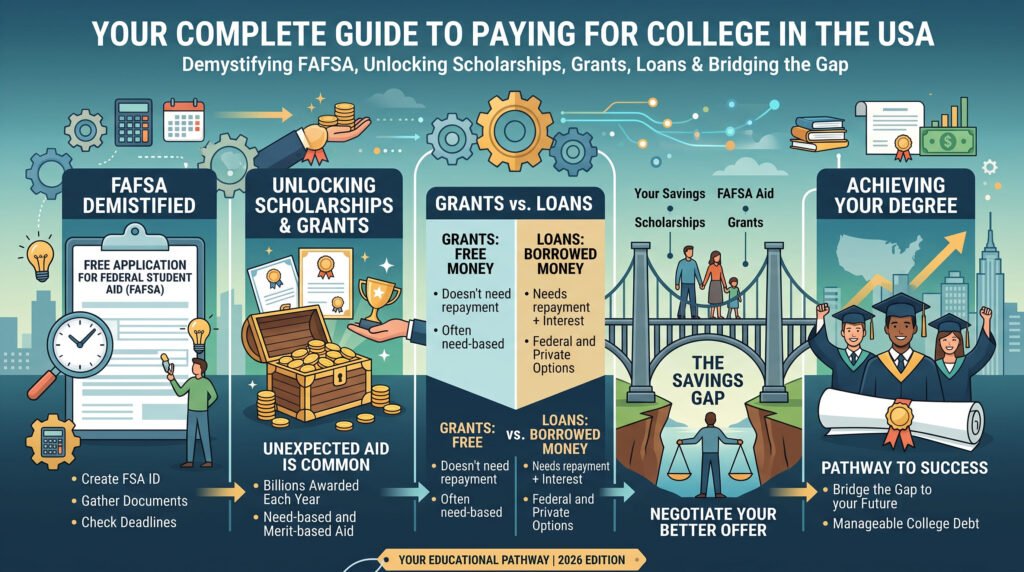
The sticker price of a college education in the United States can feel like a heart-stopping number. You see tuition, room and board, and fees listed, and you might wonder if you need a trust fund or a winning lottery ticket just to walk onto campus. The reality is far less intimidating once you understand the system.
The vast majority of students do not pay the full sticker price. In fact, billions of dollars in financial aid are awarded every single year. The challenge is not a lack of money; it is a lack of knowledge on how to access it.
This guide is your complete walkthrough of the American college payment system. We are going to demystify the FAFSA, break down the differences between grants and loans, and show you how to negotiate a better offer. By the time you finish reading, you will know exactly how to bridge the gap between your savings and the cost of your degree.
Understanding College Costs in America
Before you can figure out how to pay for college, you must understand what you are actually paying for. The “Cost of Attendance” (COA) is more than just tuition. It is a comprehensive budget that includes everything the university expects you to spend during an academic year.
Breaking Down the Cost of Attendance (COA)
The COA is the baseline number used by financial aid offices to determine your eligibility for aid. If you do not know your COA, you cannot accurately compare offers from different schools.
Here is what typically makes up the COA:
- Tuition and Fees: The core cost of your classes and university services.
- Room and Board: Housing and meal plans, whether you live on or off campus.
- Books and Supplies: Textbooks, lab equipment, and software.
- Transportation: Travel to and from campus, plus local commuting costs.
- Personal Expenses: Laundry, toiletries, clothing, and entertainment.
| Expense Category | Average Annual Cost (Public In-State) | Average Annual Cost (Private Nonprofit) |
|---|---|---|
| Tuition and Fees | $11,260 | $41,540 |
| Room and Board | $12,990 | $14,650 |
| Books and Supplies | $1,250 | $1,250 |
| Transportation | $1,250 | $1,100 |
| Other Expenses | $2,200 | $1,900 |
| Total Estimated COA | $28,950 | $60,440 |
Note: These figures are national averages and vary significantly by location and institution.
Public vs. Private vs. Community College
The type of institution you choose dramatically changes your bill. Many students overlook the long-term financial implications of this choice.
- Community Colleges: Offer the lowest tuition rates. They are excellent for completing general education requirements before transferring to a four-year university.
- Public Universities: Subsidized by state taxes, making them cheaper for residents of that state. Out-of-state students pay a premium.
- Private Universities: Have the highest sticker prices, but often have the largest endowments and can offer the most generous institutional grants.
Expert Tip: Do not dismiss a private university solely based on the sticker price. The “net price”—the amount you pay after grants and scholarships—is often lower at private schools than at public ones because they have more money to give away.
Why College is Expensive in the USA
You might be asking why the cost has risen so dramatically over the last three decades. Understanding this helps you navigate the system strategically.
The Baumol Effect and Administrative Growth
Colleges are labor-intensive. Unlike a factory, a university cannot easily automate a lecture hall without losing quality. As salaries rise in the broader economy, universities must pay professors and staff more to retain them.
Additionally, administrative bloat has added layers of non-teaching staff. Compliance officers, student life coordinators, and marketing departments all add to the overhead without directly contributing to classroom instruction.
State Funding Cuts
Historically, state governments heavily subsidized public universities. In the last few decades, many states have drastically reduced this funding. To make up for the shortfall, public universities have shifted the burden to students in the form of higher tuition.
The Amenities Arms Race
To attract students, universities have invested billions in luxury amenities. Climbing walls, lazy rivers, gourmet dining halls, and luxury dormitories are used as marketing tools. While nice, these amenities significantly increase the cost of room and board.
Availability of Federal Loans
There is an economic argument that the availability of federal student loans has allowed universities to raise prices without facing immediate student pushback. As the government lends more, institutions charge more, creating a cycle of debt.
Did You Know? The cost of college textbooks increased by over 160% between 2000 and 2020, outpacing almost every other consumer good.
The FAFSA Explained
The Free Application for Federal Student Aid (FAFSA) is the single most important document in the college payment process. It is your gateway to almost all financial aid in the United States.
What is the FAFSA?
The FAFSA is a form administered by the U.S. Department of Education. It collects financial information from students and their families to calculate how much the government believes your family can afford to pay for college.
This number is used to determine your eligibility for federal grants, loans, and work-study. Additionally, most states and universities use your FAFSA data to award their own institutional aid.
Why You Must Fill It Out
Many families skip the FAFSA because they believe they make too much money to qualify. This is a massive mistake.
- Loans: Even high-income families need access to federal loans, which have better terms than private loans.
- Scholarships: Many merit-based scholarships still require the FAFSA to be on file.
- State Aid: Many state grant programs use FAFSA data exclusively.
Common FAFSA Myths
Let’s clear up some confusion immediately. Believing these myths costs students millions of dollars in lost aid every year.
- Myth: “My parents make too much money.” There is no income cutoff for the FAFSA. Assets, family size, and number of students in college all play a role.
- Myth: “I am too old.” There is no age limit for federal financial aid.
- Myth: “I have to file taxes first.” You can file the FAFSA using estimated tax data and update it later.
Important Note: The FAFSA is FREE. If a website asks for your credit card information to submit the form, you are on the wrong website. The official domain is studentaid.gov.
Who Qualifies for Financial Aid?
Eligibility for federal student aid is broad. While “need-based” aid depends on your financial situation, “non-need-based” aid is available to almost everyone.
Basic Eligibility Requirements
To receive federal aid, you must meet these minimum standards:
- Citizenship: Be a U.S. citizen or an eligible noncitizen (such as a permanent resident).
- Education: Have a high school diploma or a recognized equivalent (like a GED).
- Enrollment: Be enrolled or accepted for enrollment in an eligible degree or certificate program.
- Selective Service: Males must be registered with Selective Service.
- Academic Progress: Maintain satisfactory academic progress (SAP) once in school.
Dependency Status
Your dependency status determines whether you report your parents’ financial information or just your own. This is often a point of confusion.
If you are under 24, unmarried, and do not have dependents of your own, you are usually considered a “dependent” student. This means your parents’ income is counted, even if they do not plan to help you pay.
Exceptions include being married, serving in the military, having children, or being an orphan or ward of the court.
Special Circumstances
The FAFSA uses tax data from two years prior (the “prior-prior” year). This means your current financial situation might not be accurately reflected. If your family has experienced a job loss, medical emergency, or divorce, you can appeal to the financial aid office.
Action Step: Always contact the financial aid office to explain “special circumstances.” They have the authority to adjust your aid eligibility based on current data, not just old tax returns.
How to Complete the FAFSA
Completing the FAFSA can feel like filing taxes, but it is manageable if you prepare. The new simplified FAFSA has reduced the number of questions significantly.
Step-by-Step Guide to the FAFSA
- Create Your FSA ID: Both the student and at least one parent (if dependent) need an FSA ID. This is your electronic signature. Do this days in advance; it takes time to verify.
- Gather Documents: Have your Social Security number, driver’s license, federal tax returns, records of untaxed income, and current bank statements ready.
- Start the Application: Go to studentaid.gov and select “Start New FAFSA.”
- Student Demographics: Fill out basic information about yourself.
- School Selection: List the schools you want to receive your FAFSA data. You can list up to 20 schools online.
- Dependency Questions: Answer the questions to determine if you are dependent or independent.
- Financial Information: Use the IRS Data Retrieval Tool (DRT). It transfers your tax data directly from the IRS, saving time and reducing errors.
- Sign and Submit: Both the student and parent must sign the form using their FSA IDs.
Common Errors to Avoid
- Leaving blank fields: Enter ‘0’ rather than leaving a field empty.
- Reporting retirement accounts: Do not include the value of 401(k)s or IRAs as assets.
- Using the wrong parent: If parents are divorced, use the information of the parent who provides the most financial support (the custodial parent).
- Forgetting to list the college: If the school code is not listed, that school will not receive your information.
| Step | Action Item | Time Required |
|---|---|---|
| 1 | Create FSA ID | 10 minutes (wait 1-3 days for activation) |
| 2 | Gather Tax Returns | 15 minutes |
| 3 | Complete Online Form | 30-60 minutes |
| 4 | IRS Data Retrieval | 5 minutes |
| 5 | Parent Signature | 5 minutes |
Critical FAFSA Deadlines
Missing a deadline is one of the most painful mistakes in the college process because it is easily avoidable. Different pots of money are exhausted at different times.
Federal Deadline
The federal FAFSA deadline is June 30 of the academic year. For example, for the 2025-2026 school year, the federal deadline is June 30, 2026. However, you should not wait for this.
State Deadlines
State aid is often first-come, first-served. Some states, like Illinois and Kentucky, have “priority deadlines” that fall as early as November or December of the year before you start school. Missing the priority deadline does not mean you get nothing, but it means you might miss out on free money.
Institutional Deadlines
Universities often have their own deadlines for institutional grants. These are often marked as “Priority Filing Dates.” Check the financial aid website of every school on your list.
Best Practice: Submit the FAFSA as close to the opening date (usually October 1) as possible. Do not wait until you file your taxes. Use the “Will Not File” option or estimated data if necessary, and update it later.
The Student Aid Index (SAI)
In the past, the FAFSA calculated an “Expected Family Contribution” (EFC). The system has been overhauled, and the new number is called the Student Aid Index (SAI).
What is the SAI?
The SAI is a number calculated from your FAFSA data. It is not the amount of money you will pay. Instead, it is an index number used by financial aid offices to determine your need.
- Low SAI: You have high financial need. You will qualify for maximum grants.
- High SAI: You have lower financial need. You may still qualify for loans and merit aid.
- Negative SAI: Unlike the EFC, the SAI can be as low as -1500. This allows for more granular targeting of aid to the poorest students.
How Need is Calculated
The formula is simple:
Cost of Attendance (COA) – Student Aid Index (SAI) = Financial Need
For example, if your university costs $40,000 and your SAI is $15,000, your financial need is $25,000. The university will try to fill that $25,000 gap with aid, though they are not always legally required to fill 100% of it.
Federal Grants: Free Money
Grants are the holy grail of financial aid. They are essentially free money that does not need to be repaid (unless you withdraw from school).
Types of Federal Grants
The federal government offers several grant programs. Each has specific eligibility rules.
- Pell Grant: The most common and well-known grant for low-to-moderate-income undergraduates.
- FSEOG (Federal Supplemental Educational Opportunity Grant): For students with exceptional financial need. Funds are limited and awarded on a first-come, first-served basis by the school.
- TEACH Grant: For students planning to become teachers in high-need fields in low-income areas. Warning: If you do not fulfill the teaching requirement, this grant converts to a loan.
- Iraq and Afghanistan Service Grant: For students whose parent or guardian died in military service after 9/11.
Eligibility Requirements
Eligibility is generally tied to your SAI, your enrollment status (full-time vs. part-time), and whether you have already earned a bachelor’s degree. You must maintain satisfactory academic progress to keep receiving grants.
The Pell Grant
The Pell Grant is the foundation of need-based aid in the United States. It is crucial to understand how it works.
How Much Money Can You Get?
The maximum Pell Grant award changes annually. For the 2024-2025 award year, the maximum award is $7,395. The actual amount you receive depends on:
- Your Student Aid Index (SAI).
- Your enrollment status (full-time students get more than part-time students).
- The cost of your school.
Pell Grant Lifetime Limit
You can only receive the Pell Grant for the equivalent of 12 full-time semesters (roughly six years). You can check your “Lifetime Eligibility Used” (LEU) percentage on your Federal Student Aid dashboard.
Quick Fact: Pell Grant recipients are often eligible for additional benefits, such as discounted internet service (Affordable Connectivity Program) and fee waivers for graduate school applications.
Federal Student Loans
After grants and scholarships, loans cover the remaining gap. While debt is scary, federal student loans are considered “good debt” if managed wisely because they offer protections no private lender can match.
Subsidized vs. Unsubsidized Loans
This is the most important distinction to understand before borrowing.
- Direct Subsidized Loans: For students with demonstrated financial need. The government pays the interest while you are in school at least half-time, during your grace period, and during deferment periods.
- Direct Unsubsidized Loans: Available to all students regardless of financial need. Interest accrues from the moment the loan is disbursed. You can pay the interest while in school to avoid it capitalizing.
| Feature | Subsidized Loan | Unsubsidized Loan |
|---|---|---|
| Need Required? | Yes | No |
| Interest During School? | Paid by Government | Accrues (added to balance) |
| Borrower | Undergraduate only | Undergrad/Graduate |
| Financial Benefit | High (saves thousands) | Moderate |
PLUS Loans
If federal student loans do not cover the cost, parents can take out Parent PLUS Loans. These require a credit check (though not a high score) and generally have higher interest rates than Direct Loans.
Grad students can take out Grad PLUS Loans for themselves.
Warning: Parent PLUS Loans are the parent’s legal responsibility, not the student’s. Do not take out more than you can realistically repay before retirement.
Income-Driven Repayment (IDR)
Federal loans offer repayment plans based on your income. If your income is low, your payment could be $0. After 20 or 25 years of payments, the remaining balance is forgiven. This safety net does not exist with private loans.
The Federal Work-Study Program
Work-study is a form of aid that requires you to work to earn the money. It is often misunderstood, so let’s clarify how it works.
How It Works
The federal government funds a portion of your wages, and the university funds the rest. This incentivizes universities to hire students for part-time jobs.
- You are paid an hourly wage (at least the federal minimum wage).
- You receive a paycheck, not a tuition credit.
- Jobs can be on-campus (library, cafeteria) or off-campus (non-profits, community service).
Does “Work-Study” Reduce Tuition?
No. Unlike a grant, work-study is money you earn by working. However, listing work-study on your resume looks good, and the income earned through work-study does not count against you on next year’s FAFSA as heavily as other income.
Pro Tip: If your financial aid package includes work-study, actually take the job. You earn money, build skills, and often have time to study while working at quiet campus desks.
State-Sponsored Financial Aid
In addition to the federal government, your state government is a major source of funding. State aid is often overlooked because students focus so heavily on the FAFSA.
Examples of State Grant Programs
Almost every state has a grant program for residents attending in-state schools.
- Cal Grant (California): Provides significant tuition assistance to California residents at UC, CSU, and community colleges.
- TAP (New York): The Tuition Assistance Program is separate from the federal FAFSA and provides grants to New York residents.
- Bright Futures (Florida): A merit-based scholarship funded by the Florida Lottery.
- HOPE Scholarship (Georgia): Provides tuition assistance to Georgia residents with a minimum GPA.
Residency Requirements
To qualify for state aid, you must be a legal resident of that state. This usually means living in the state for at least 12 consecutive months before starting school and having a valid state ID or voter registration.
Important Note: Some states have reciprocity agreements. For example, some counties in bordering states allow students to attend out-of-state schools while paying in-state tuition.
University Scholarships and Grants
Universities use their own money (endowments, donations) to attract students. This is called “institutional aid.” It is often the largest source of free money.
Where Does Institutional Aid Come From?
Alumni donations, endowment investment returns, and university revenue fund these programs. Elite private universities often have billions of dollars in endowment funds dedicated solely to financial aid.
How to Access It
In most cases, your FAFSA is enough to be considered for institutional need-based aid. However, some schools—particularly private colleges—require the CSS Profile.
The CSS Profile is more detailed than the FAFSA. It considers home equity, retirement accounts, and non-custodial parent income. It costs money to submit, though fee waivers are available.
Warning: Do not assume the FAFSA is the only form. Check your university’s financial aid page for “Required Forms.” Missing the CSS Profile deadline can cost you tens of thousands of dollars.
Merit-Based Scholarships
Unlike need-based aid, merit aid is awarded based on achievements. You do not need to be poor to get merit aid.
What Counts as Merit?
- Academics: High GPA, class rank, and rigorous coursework (AP/IB).
- Test Scores: SAT/ACT scores (though many schools are now test-optional, scores still often trigger automatic merit scholarships).
- Talent: Music, art, athletics, debate, or theatre.
- Leadership: Student government, founding a club, or community organizing.
Automatic vs. Competitive Scholarships
Many public universities offer “automatic” merit scholarships. If you have a certain GPA and test score, you automatically receive a discount. These are highly predictable.
- Example: The University of Alabama and many other Southern public schools offer massive automatic scholarships based purely on GPA and SAT/ACT scores.
Competitive scholarships require an additional application, essays, and sometimes interviews.
| Scholarship Source | Average Award | Competition Level |
|---|---|---|
| Automatic University Merit | $5,000 – $20,000/year | Low (Formula-based) |
| Competitive University Merit | $10,000 – Full Ride | High |
| Local Community Scholarships | $500 – $5,000 | Moderate |
| National Scholarships (Coca-Cola, Gates) | $5,000 – Full Cost | Extremely High |
Need-Based Aid
Need-based aid is awarded based on your family’s financial situation. It is designed to make college accessible regardless of income.
How Universities Determine Need
Universities look at your income, assets, family size, and number of siblings in college. They use this to calculate your SAI. If your SAI is lower than the tuition, you have “need.”
Meeting Full Need
Some schools promise to “meet 100% of demonstrated need.” This is a golden phrase.
- “Need-Blind” Schools: They do not look at your ability to pay when deciding admission.
- “Full-Need” Schools: They promise that if you get in, they will provide enough grants and work-study to cover the gap between your SAI and the tuition.
Examples include Harvard, Yale, Princeton, MIT, and Amherst.
Key Takeaway: For low-income students, applying to an Ivy League school with a “full-need” policy can be cheaper than attending a local state school.
A Deep Dive: ASU Financial Aid
Arizona State University (ASU) is a masterclass in leveraging public university scale to provide aid. They handle a massive volume of students and have streamlined the process.
The ASU Approach
ASU is known for its innovation and accessibility. They utilize the FAFSA heavily and offer a variety of institutional grants.
- Obama Scholars Program: A need-based program for Arizona residents.
- New American University Scholarship: A merit-based scholarship for highly qualified incoming freshmen (both in-state and out-of-state).
- College-Specific Scholarships: Individual colleges (Engineering, Business, etc.) have their own funds.
Comparing ASU to Other Public Universities
ASU often stacks multiple scholarships. A student might get a university merit award, a college grant, and a federal Pell Grant.
However, out-of-state students at ASU need to be careful. The “New American University” scholarship can significantly reduce the out-of-state premium, but it rarely eliminates it entirely.
Best Practice for ASU: Use the ASU Scholarship Portal. It is a dynamic database that matches you with internal scholarships after you complete a general application.
Understanding University Financial-Aid Packages
After you are accepted, you will receive a Financial Aid Award Letter. This is the moment of truth. Unfortunately, these letters are often confusing and inconsistent from school to school.
Decoding the Award Letter
A typical letter will list several line items. You must categorize these accurately.
- Free Money (Grants/Scholarships): This is a reduction in price. It is real.
- Work-Study: This is not a reduction in price. It is a job offer. You should not subtract this from your mental total unless you plan to work the hours.
- Loans: This is debt. It does not reduce the cost; it just delays the payment.
The Total Cost Calculation
To find the real cost, use this formula:
Real Cost = Cost of Attendance – (Grants + Scholarships)
Do not subtract loans or work-study from the cost. They are methods to cover the cost, not discounts.
Common Mistake: Parents see “Total Award: $30,000” and think they got a discount. If that $30,000 consists of $15,000 in loans and $5,000 in work-study, the actual discount is only $10,000.
Comparing Financial-Aid Offers
You should not simply accept the first offer that looks good. You need to compare apples to apples.
Build a Comparison Spreadsheet
Create a simple table listing every school. Pull the numbers from the award letters.
| Line Item | School A | School B | School C |
|---|---|---|---|
| Total COA | $40,000 | $60,000 | $25,000 |
| Grants/Scholarships | $10,000 | $35,000 | $5,000 |
| Subtotal (Net Price) | $30,000 | $25,000 | $20,000 |
| Work-Study | $2,000 | $3,000 | $0 |
| Federal Loans | $5,500 | $5,500 | $5,500 |
| Cash/Private Loan Required | $22,500 | $16,500 | $14,500 |
In this example, School B (the expensive private school) is actually cheaper for the family out-of-pocket than School A (the public school) after grants.
Appealing the Offer
It is acceptable to negotiate. This is called a “Professional Judgment Appeal.”
- Leverage: If a higher-ranked or similarly-ranked school offered you more money, tell the financial aid office.
- Evidence: Be polite. “My family is thrilled about the acceptance, but financially the gap is too large. Competitor X has offered me $Y. Is there any way you can reconsider my package?”
The Concept of Net Price
Net price is the amount you actually pay after all free money (grants and scholarships) is subtracted from the sticker price. It is the only number that matters when deciding where to go.
Net Price Calculators
By law, every university must host a “Net Price Calculator” (NPC) on their website. This tool asks a few questions about your finances and academic stats and estimates what you would pay.
- Search “[University Name] Net Price Calculator” on Google.
- Enter your financial data honestly.
- Do this for every school on your list before you even apply.
This is the most underutilized tool in college planning. It gives you a realistic preview of your costs.
Expert Tip: Treat the Net Price Calculator as a diagnostic tool. If the calculator says you will pay $40,000 and you can only afford $25,000, cross that school off your list before wasting the application fee.
How to Reduce Tuition Costs
Beyond financial aid, there are structural ways to lower the cost of your education. These strategies require planning and flexibility.
Graduate Early
Every extra semester costs money. You pay tuition, but you also lose six months of earning a salary.
- Take 15 credits per semester instead of 12.
- Take summer classes at a local community college.
Live Off Campus
University room and board is often 20-30% more expensive than living in a shared apartment and buying groceries. Check the actual numbers for your specific school.
Become an RA
Resident Advisors (RAs) often receive free room and board in exchange for supervising dorm floors. This can save $12,000 to $15,000 per year.
Buy Used Textbooks or Rent
Never buy a brand-new textbook from the campus bookstore. Use ISBN search engines, rent from Amazon, or use the library reserve copies. Some international editions are identical in content but cost 80% less.
Warning: Do not buy the “Access Code” books used. These are required for online homework platforms and are single-use. You must buy those new.
Using Transfer Credits Wisely
The first two years of college are mostly general education requirements. It is often unnecessary to pay university prices for these basic classes.
The Community College Strategy
The “2+2” strategy is powerful.
- Years 1-2: Attend a local community college. Tuition is often $3,000-$5,000 per year.
- Years 3-4: Transfer to a university to complete your major.
Result: You graduate with a degree from the university but pay half the total cost.
Articulation Agreements
Most community colleges have “articulation agreements” with state universities. These are binding contracts guaranteeing that specific credits will transfer and count toward your degree.
Before enrolling in a community college course, verify the credit transfer with your intended university. The tool for this is often called an “Equivalency Database.”
Advanced Placement (AP) and CLEP
Score high on AP exams (4 or 5) to skip introductory college courses. The College Level Examination Program (CLEP) allows you to test out of subjects you already know, such as basic math or a foreign language, for a small fee.
Employer Tuition Benefits
Working while going to school is one way to pay, but working for a company that pays your tuition is even better.
Tuition Reimbursement vs. Tuition Assistance
- Reimbursement: You pay the tuition upfront, pass the class, and the employer pays you back.
- Assistance: The employer pays the school directly upfront.
Major Employers with Generous Benefits
Companies like Starbucks, Amazon, Walmart, and Target offer full tuition coverage for specific programs or schools. Often these are through partnerships with online universities, but the value is undeniable.
- Starbucks: Full tuition for ASU Online.
- Amazon: Full tuition for select associate and bachelor’s degrees.
Action Step: Check your HR manual. Even if you work part-time at a fast-food chain, they might offer $2,000-$5,000 a year in tuition assistance that you are currently leaving on the table.
Payment Plans
If you are covering some costs out of pocket (savings, salary), you may not have a lump sum of cash available in September.
University Payment Plans
Most universities offer interest-free payment plans. Instead of paying $10,000 in September, you split it into monthly installments (e.g., 4 or 5 months).
- Pros: No interest, easy to sign up.
- Cons: Usually has a small enrollment fee (e.g., $50).
529 Plans
A 529 plan is a tax-advantaged savings account specifically for education. Money grows tax-free, and withdrawals are tax-free if used for qualified expenses like tuition, room, board, and books.
- If you have a 529, coordinate the withdrawal with the billing cycle to avoid late fees.
Common Mistakes to Avoid
Even smart families make expensive mistakes. Here is a checklist of pitfalls to dodge.
1. Skipping the FAFSA
We have said it before, but it bears repeating. Some families skip it due to pride or fear of data entry. This leaves free money on the table and blocks access to federal loans.
2. Ignoring the Net Price Calculator
Applying to “Dream School X” without checking the NPC is like going to a car dealership blindfolded. You might fall in love with a car you cannot afford.
3. Borrowing Too Much for “The Experience”
College is about the education and the network, not the lazy river. Borrowing $100,000 for an undergraduate degree in a low-paying field is a financial trap.
4. Using Private Loans Before Federal Loans
Private loans have variable interest rates, require co-signers, and offer almost no forgiveness options. Always max out federal loans first.
5. Missing the Scholarship Deadline
Local scholarships often have small applicant pools. Write the essays. You miss 100% of the shots you don’t take.
6. Assuming “Sticker Price” is Real
Only the truly wealthy (or the uninformed) pay full sticker price. Always look for the discount.
Pro Tip: Set up a dedicated email address just for college applications and scholarships. This keeps deadlines organized and prevents important emails from getting lost in the clutter of your personal inbox.
Frequently Asked Questions
1. What is the difference between a grant and a scholarship?
In practice, they are the same thing: free money you do not have to pay back. Grants are typically need-based, while scholarships are typically merit-based (academics, sports, or talent).
2. Can I fill out the FAFSA if my parents are undocumented?
Yes. If you are a U.S. citizen or eligible noncitizen, you can fill out the FAFSA. If your parents do not have Social Security numbers, they can enter all zeros for their SSN and sign the form manually (print and mail the signature page).
3. Do I have to pay back the FAFSA?
No, the FAFSA is just an application. The money you receive comes in different forms. Grants and scholarships do not need to be repaid. Loans do need to be repaid. Work-study is earned income.
4. What is the CSS Profile?
The CSS Profile is a secondary financial aid application used by about 250 private colleges. It digs deeper into your finances than the FAFSA, looking at assets like home equity and retirement accounts.
5. How do I get more money if my financial aid offer is not enough?
You can appeal. Write a letter to the financial aid office explaining your special circumstances (loss of income, medical bills) or use a competing offer from a similar school as leverage.
6. Does my GPA affect my financial aid?
Yes, for two reasons. First, you must maintain “Satisfactory Academic Progress” (SAP) to keep any federal aid. Second, a high GPA often triggers merit-based scholarships.
7. When do I have to start paying back student loans?
For federal loans, you have a six-month grace period after you graduate, leave school, or drop below half-time enrollment. You do not have to make payments while in school at least half-time.
8. Can I get financial aid for online college?
Yes. As long as the online program is accredited and participates in federal aid programs, you can use FAFSA, Pell Grants, and federal loans for online degrees.
9. Is work-study worth it?
Yes, in most cases. It is a guaranteed job (often on campus), it looks good on a resume, and the income is treated favorably on future FAFSA filings. You also have downtime to study at many work-study jobs.
10. What happens if I drop out?
If you drop out early in the semester, you might have to return some of the “unearned” grants. Additionally, your loan repayment clock starts ticking. It is best to finish the semester if at all possible.
11. Can I negotiate tuition directly?
Yes, for private universities. You can ask for a “tuition discount.” Private schools have more flexibility to adjust rates or add discretionary grants than public schools, which are bound by state rules.
12. What is a 529 Plan?
It is a tax-advantaged investment account designed for education expenses. Contributions grow tax-free, and withdrawals are tax-free when used for qualified expenses like tuition, books, and room and board.
13. Are there scholarships for graduate school?
Yes. Most graduate funding comes in the form of assistantships (Teaching Assistants or Research Assistants), which provide a tuition waiver and a stipend. There are also specialized grants for research areas.
14. What is the “borrowing rule of thumb”?
Try not to borrow more total than your expected starting salary after graduation. If you will earn $40,000 as a teacher, do not take out $80,000 in loans.
15. How often do I need to fill out the FAFSA?
Every year. Your financial situation changes, and the cost of school changes. You must renew it annually to receive aid for the next academic year.
Quick Summary and Final Conclusion
Key Takeaways
- The sticker price is a myth. Your focus should be on the Net Price.
- File the FAFSA early. Missing state or institutional deadlines is the most costly mistake.
- Free money comes first. Exhaust grants, scholarships, and institutional aid before considering loans.
- Compare offers. Do not be swayed by the total award amount; look at the grants vs. loans breakdown.
- Be strategic. Use community college, transfer credits, and employer benefits to structurally lower costs.
Next Steps
- Log on to studentaid.gov and create your FSA ID today.
- Make a list of 5-10 target schools and run their Net Price Calculators.
- Search for local scholarships at your guidance counselor’s office or local library.
- Schedule a meeting with a high school counselor or a college financial aid officer.
Paying for college in the USA is a complex puzzle, but it is solvable. It requires diligence, honesty, and a willingness to ask for help. The system is designed to provide access to higher education, but it rewards the informed. Take action now, refuse to pay more than you have to, and secure the education you deserve without a lifetime of financial regret.