The landscape of technology is shifting faster than the tectonic plates of Silicon Valley. Choosing where to study computer science is not just about picking a school; it is about choosing your ecosystem, your network, and your trajectory in an industry that waits for no one. The United States remains the global epicenter of technological innovation, and its universities are the primary feeders into that machine.
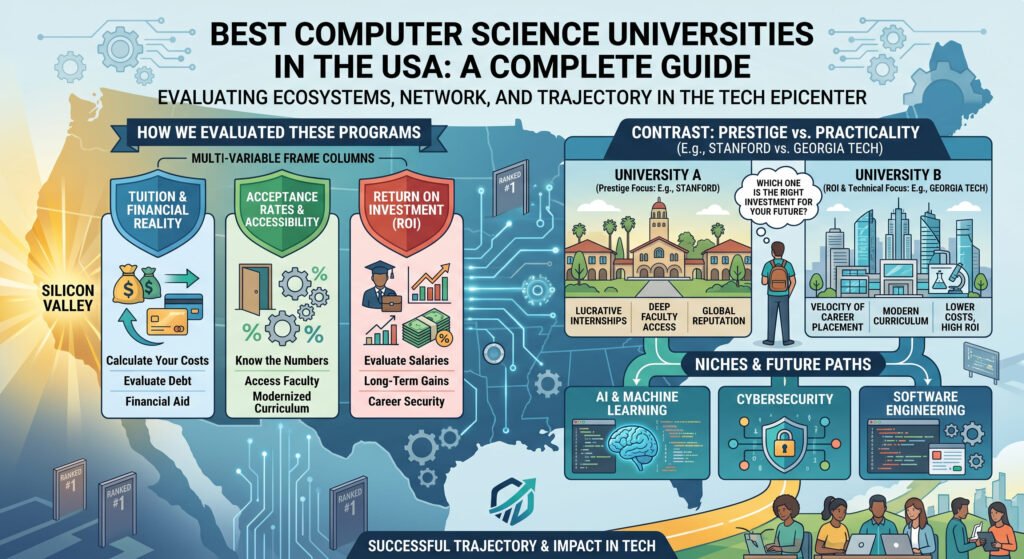
However, the “best” is subjective. It depends on your financial reality, your learning style, and your specific niche—whether that is artificial intelligence, cybersecurity, or raw software engineering. This guide is designed to cut through the marketing noise. We are going to dissect the top programs in the country, looking at the hard numbers: tuition, acceptance rates, and return on investment.
By the end of this article, you will know exactly what separates a Stanford from a Georgia Tech, and more importantly, which one is the right investment for your future.
How We Evaluated These Programs
Rankings are often vanity metrics. A university might be ranked first in “research output” but fail to place undergraduates in lucrative internships. To provide a holistic view, we evaluated these institutions based on a multi-variable framework.
We did not just look at prestige. We looked at the velocity of career placement, the accessibility of the faculty, the modernization of the curriculum, and the raw financial return for the student.
Evaluation Criteria
- Academic Rigor: The depth of the core curriculum in algorithms, systems, and theory.
- Research Output: Funding and publications in high-impact areas like AI and quantum computing.
- Industry Connectivity: Proximity to tech hubs and the strength of the alumni network.
- Accessibility: Acceptance rates, availability of online options, and financial aid generosity.
- Outcomes: Median starting salaries and employment rates within six months of graduation.
Expert Tip: Do not choose a university based on a single rank. A rank is an average. You are an individual. Look at the specific sub-field (e.g., Computer Vision vs. Database Systems) where the school excels.
Comparison Snapshot: The Big Picture
| University | Known For | General Vibe | Cost Level (Out-of-State/Private) |
|---|---|---|---|
| Stanford | Startups, AI, Entrepreneurship | Flexible, Sunny, Risk-Taking | Very High |
| MIT | Theory, Engineering, Robotics | Intense, Collaborative, Technical | Very High |
| Carnegie Mellon | Robotics, AI, Software Engineering | Focused, Niche, Rigorous | High |
| UC Berkeley | Systems, Theory, Data Science | Activist, Competitive, Large | High (Out-of-State) |
| Georgia Tech | Engineering, Online Learning, Systems | Practical, High-Tech, Value | Medium/High |
| University of Illinois | Systems, Software, Research | Traditional, Powerful, Balanced | Medium/High |
| Purdue | Security, Systems, Engineering | Gritty, Comprehensive, Value | Medium |
| ASU | Online Scale, Innovation, Inclusion | Flexible, Massive, Modern | Low/Medium |
| UT Austin | AI, Turing Scholars, Industry | Large, Spirited, Connected | Medium/High |
| U. Washington | Systems, HCI, Cloud (Proximity to MSFT/AMZN) | Collaborative, Urban, Employed | Medium/High |
Stanford University
Located in the heart of Silicon Valley, Stanford is less of a school and more of a launchpad. The symbiosis between the Computer Science department and the tech industry is unmatched. If you want to build a startup or join a unicorn, there is no better soil to plant yourself in.
CS Programs Offered
Stanford offers a Bachelor of Science in Computer Science, a Master of Science in CS, and a Ph.D. program. The curriculum is famous for its flexibility; it allows students to pivot into tracks like Human-Computer Interaction (HCI), Artificial Intelligence, or Biocomputation without excessive bureaucratic friction.
Tuition and Financial Aid
Stanford is expensive. The annual tuition hovers around $62,000, with total cost of attendance exceeding $85,000 when housing and living expenses are included. However, the financial aid is generous. For families earning less than $150,000, tuition is typically fully covered.
Admissions and Acceptance
The acceptance rate is devastatingly low, sitting around 4%. Admissions officers look for more than perfect SAT scores (usually 1500+). They want to see “intellectual vitality.” This means personal projects, research, or a demonstrable obsession with problem-solving.
Warning: Do not assume a 4.0 GPA and 1600 SAT guarantees entry. Stanford rejects thousands of “perfect” students every year. Your essays and extracurricular narrative are the differentiators.
Online Options and Specializations
While the undergraduate degree is strictly in-person, Stanford excels in professional education. The Stanford Online platform offers graduate certificates in areas like Artificial Intelligence and Cybersecurity. These are not full degrees, but they carry the Stanford weight in the industry.
Internships and Careers
The “Stanford Bubble” is real. Recruiters from Google, Meta, and Apple are effectively on speed dial. The median starting salary for a Stanford CS graduate is among the highest in the nation, often exceeding $130,000 base salary, not including bonuses and equity.
Massachusetts Institute of Technology (MIT)
MIT is the realm of the purist. If Stanford builds products, MIT builds the science that makes products possible. The Computer Science program here is merged with Electrical Engineering in a unique structure (EECS), making it the hardest engineering challenge in the world.
Curriculum and Rigor
The MIT curriculum is famously brutal. It is not just about coding; it is about the mathematical proof behind the code. You will be pushed to understand signal processing, thermodynamics (if you go the hardware route), and advanced algorithm theory.
Tuition and Value
Tuition is comparable to Stanford (around $60,000). However, MIT practices need-blind admissions and meets 100% of demonstrated need. The ROI is virtually guaranteed, though the entry barrier is the highest in the world.
Admissions Philosophy
MIT looks for “makers.” They love students who have built robots, contributed to open-source projects, or participated in rigorous math olympiads. The acceptance rate sits around 4-5%.
Career Opportunities
MIT graduates often dominate quant finance (Jane Street, Citadel) and hardcore engineering (SpaceX, Boston Dynamics, NASA). If you want to work on the bleeding edge of robotics or AI research, MIT is the destination.
Pro Tip: If you are aiming for MIT, focus on your Math scores (SAT Math 800 or ACT Math 36 is essentially the expectation) and demonstrate a history of self-directed engineering projects.
Carnegie Mellon University
Carnegie Mellon (CMU) is the undisputed heavyweight champion of pure Computer Science. While it doesn’t have the “university” fame of Harvard or Stanford to the layperson, within the tech industry, a CMU degree is often regarded as the single most impressive technical credential you can hold.
The School of Computer Science
Unlike many schools where CS is a department within Engineering, CMU has a dedicated School of Computer Science. This autonomy allows for hyper-focused research in Robotics (RI), Language Technologies (LTI), and Machine Learning.
Tuition and Admissions
Tuition is high, nearing $63,000. The admission process is highly selective, with an acceptance rate for the SCS (School of Computer Science) often lower than 7%. They look for extremely high GPAs and evidence of logical thinking.
Financial Aid and Scholarships
CMU is not need-blind for all applicants (it can be need-aware for international students), which means your financial status can play a role in the final decision. However, the return on investment is substantial.
Curriculum and Internships
The curriculum is deep. You will live in Wean Hall, grinding through courses like “Great Theoretical Ideas in Computer Science” (15-251). The co-op and internship program is strong, but the workload often means students do not have time to interview until their junior year.
Important Note: CMU is the best place in the world to study Robotics. If your dream is to build self-driving cars or autonomous drones, CMU should be at the top of your list.
University of California, Berkeley
UC Berkeley is the public counterweight to the private elites. It is massive, chaotic, and brilliant. The Electrical Engineering and Computer Sciences (EECS) program is notoriously difficult to enter, but the newer College of Computing, Data Science, and Society (CDSS) provides an alternate path for students interested in data science.
Programs and Admission Tiers
There is a critical distinction here: EECS (highly selective, direct admit) and L&S CS (broader, requires a GPA cap to declare). Due to budget constraints and student demand, Berkeley has moved to a direct-admit model for most CS pathways, making it harder to transfer in from within the university.
Tuition
For California residents, it is a steal (around $15,000). For out-of-state students, it is pricey (around $48,000). The competition for out-of-state slots is fierce.
Industry Connections
Berkeley feeds directly into the San Francisco tech scene. It has a slightly more “activist” and less “corporate” culture than Stanford, but the employment outcomes are elite. Graduates earn top dollar and often found companies rooted in data science and AI.
Online and Extension
Berkeley offers a Master of Information and Data Science (MIDS) online. It is expensive but highly regarded for working professionals looking to pivot into data science leadership.
Expert Tip: Pay close attention to the application pathway at Berkeley. Applying to the College of Letters & Science vs. Engineering can drastically change your odds and your required coursework.
Georgia Institute of Technology
Georgia Tech has completely disrupted the Computer Science education market. Not only is its on-campus program ranked in the top 10 nationally, but its Online Master of Science in Computer Science (OMSCS) is the gold standard for affordable, scalable tech education.
On-Campus vs. Online
On-campus, Georgia Tech offers a traditional, rigorous environment in Atlanta. The threads-based curriculum (e.g., Intelligence, Devices, People) allows students to customize their degree deeply.
The OMSCS Revolution
The online program costs less than $7,000 total. That is not a typo. For a top-10 education. It has single-handedly changed the lives of thousands of working professionals. It is not easier, but it is flexible and affordable.
Tuition and ROI
In-state tuition is very reasonable (under $12,000), and out-of-state is lower than most private competitors. The ROI is arguably the best in the nation when comparing cost to median salary.
Admissions
Acceptance is competitive but less “holistic” than Stanford. Georgia Tech relies heavily on GPA (often 3.8+) and standardized test scores. They value demonstrated ability in math and physics.
University of Illinois Urbana-Champaign
The Grainger College of Engineering at UIUC is a powerhouse. It is the birthplace of the modern web browser (Mosaic/Netscape) and continues to pump out elite software engineers to both the West Coast and Chicago’s growing tech scene.
CS + X Degrees
UIUC is famous for its “CS + X” degrees. You can major in CS + Linguistics, CS + Economics, or CS + Advertising. This is brilliant for students who love technology but do not want a pure engineering lifestyle.
Curriculum and Research
The core CS program is massive and tough. The research output in parallel computing and compiler optimization is legendary. Companies like NVIDIA and Intel recruit heavily from UIUC.
Admissions and Tuition
Acceptance into pure CS (Engineering) is very selective (often below 10%). Tuition for out-of-state students is around $36,000-$40,000. It is a bargain compared to MIT, but equally rigorous in specific technical areas.
Did You Know? UIUC has one of the highest populations of students going on to found startups in the Midwest, and PayPal’s early engineering team was seeded with UIUC talent.
Purdue University
Purdue is the “workhorse” of Midwestern tech. It does not have the flash of the coasts, but it has a reputation for producing reliable, hard-working, and incredibly competent engineers. The Computer Science department is housed within the College of Science, though it collaborates heavily with Engineering.
Tuition Freeze
Purdue is famous for freezing tuition. While other schools raise costs yearly, Purdue has held its base tuition steady for over a decade. This makes it one of the most affordable high-tier programs in the country.
Admissions
The acceptance rate for CS is competitive (around 20-30% for the specific major). They value consistency in grades and strong math backgrounds. Test scores are required (as of recent policies), so prepare accordingly.
Career Path
Purdue grads are heavily recruited by defense contractors (Lockheed Martin, Northrop Grumman), automotive (Cummins, GM), and traditional enterprise tech (Salesforce, Microsoft). If you want stability and a deep understanding of systems, Purdue is a safe bet.
Arizona State University
ASU has transformed from a “party school” into a legitimate academic powerhouse focused on innovation and inclusion. Led by President Michael Crow, ASU has embraced online education and scale without sacrificing quality in its core programs.
Scale and Accessibility
The School of Computing and Augmented Intelligence (SCAI) offers massive online and on-campus programs. ASU accepts a wider range of students, focusing on a “New American University” model where access is prioritized.
Curriculum and Tracks
ASU offers strong tracks in Cybersecurity (often designated as a Center of Academic Excellence by the NSA) and Software Engineering. Their Project-based learning model ensures you have a portfolio before you graduate.
Tuition and Aid
ASU is significantly cheaper than the coastal elites. In-state students benefit from low costs, while out-of-state students still find ASU cheaper than many equivalents. The scholarship portal is also vast—there are thousands of micro-scholarships available.
Best Practice: ASU is an excellent choice for transfer students. They have articulation agreements with many community colleges, making it an affordable path to a top-tier name.
University of Texas at Austin
UT Austin is the tech giant of the South. With Austin becoming a major tech hub (Tesla, Apple, Google, Oracle HQ), UT students have incredible local internship opportunities without the cost of living of San Francisco or New York.
The Turing Scholars Program
For elite students, UT offers the Turing Scholars Program. This is an honors track within CS that provides small class sizes, dedicated research advisors, and a fast track to top Ph.D. programs or elite startups.
Admissions Hooks
UT is unique: state law guarantees admission to Texas high school students in the top 6% of their class. However, that does not guarantee a spot in Computer Science. The CS major remains highly competitive (top 10-15% of applicants).
Curriculum
UT is massive (one of the largest CS departments). This offers incredible variety in electives—from Game Development to Quantum Computing. However, it also requires students to be self-advocates for resources.
University of Washington
The Paul G. Allen School of Computer Science & Engineering at UW sits in the shadow of Amazon and Microsoft headquarters. This proximity creates an employment pipeline that is the envy of the world.
Direct to Major
UW recently changed its admission policy. You must now be admitted “Direct to Major” for Computer Science. It is incredibly difficult to get in from within the university if you weren’t admitted to CS initially. This makes high school applications extremely high stakes.
Specializations
UW is world-renowned for Human-Computer Interaction (HCI), Systems, and Ubiquitous Computing. Their research on health informatics and accessibility is changing the world.
Tuition and Careers
Out-of-state tuition is around $43,000, but the internship pipeline is so strong that many students graduate with multiple job offers in Seattle’s ecosystem. The “Husky Network” is a real, tangible asset in the Pacific Northwest.
Pro Tip: If you are applying to UW from out of state, your academic profile must be pristine. The direct-to-major policy means there is no “back door” into the CS program.
Deep Dive: AI, Machine Learning, and Data Science
Computer Science is no longer a monolith. The modern degree is a maze of specializations. Choosing your niche early can help you select the right university, as “best CS school” does not mean “best for Bioinformatics.”
Artificial Intelligence and Machine Learning
This is the rocket fuel of the current economy. Courses focus on neural networks, deep learning, natural language processing, and computer vision.
- Top Picks: Stanford, Carnegie Mellon, MIT, Berkeley.
- Curriculum Focus: Heavy mathematics (Linear Algebra, Probability), Python, PyTorch/TensorFlow.
Cybersecurity
With global threats rising, cybersecurity professionals are in white-hot demand. This field requires a mind for adversarial thinking and system vulnerabilities.
- Top Picks: Purdue (CERIAS), ASU, Georgia Tech, Carnegie Mellon (CyLab).
- Curriculum Focus: Cryptography, Network Security, Digital Forensics, Operating Systems.
Software Engineering vs. Computer Science
This is a critical distinction. Computer Science is the theory (algorithms, data structures, math). Software Engineering is the practice (scalability, testing, deployment, lifecycle). Some schools (like CMU) offer distinct degrees for both.
| Specialization | Best Schools | Core Skill Set | Average Entry Salary |
|---|---|---|---|
| Artificial Intelligence | Stanford, CMU, MIT | Python, Math, Neural Nets | $140,000+ |
| Cybersecurity | Purdue, CMU, ASU | Networking, OS, Cryptography | $110,000+ |
| Data Science | Berkeley, UW, ASU | R, SQL, Statistics | $115,000+ |
| Systems Engineering | UIUC, Georgia Tech | C/C++, Hardware, OS | $125,000+ |
The Rise of Online CS Degrees
The stigma surrounding online education is dead. The advent of platforms like Georgia Tech’s OMSCS and ASU Online has proven that remote learning can rival in-person quality at a fraction of the cost.
Why Go Online?
The primary reason is flexibility. If you are a working parent or a professional looking to pivot careers, quitting your job to move to a campus is often impossible. Online degrees allow you to earn while you learn.
Comparing Online Programs
| University | Degree Type | Total Estimated Cost | Time to Complete | Reputation |
|---|---|---|---|---|
| Georgia Tech | M.S. Computer Science | $6,500 – $7,000 | 2-3 years | Excellent |
| ASU | B.S. / M.S. CS | $500-$600 per credit hour | 4 years (BS) / 2 years (MS) | Very Good |
| University of Illinois | M.C.S. (Professional) | $20,000 – $25,000 | 1-3 years | Excellent |
| University of Texas | M.S. Computer Science | $10,000 | 2 years | Excellent |
| Stanford | Graduate Certificate | $15,000 – $20,000 | 1-2 years | Prestigious |
Warning: Online degrees require immense self-discipline. The dropout rate for MOOCs is high. Before enrolling in an online Master’s, ensure you have a dedicated study schedule and a support system to keep you accountable.
Career Paths and Salary Expectations
Why are you spending four years and thousands of dollars? For a career. Understanding the landscape of post-graduation life is essential for choosing the right school.
The Big Five and Beyond
The “Big Five” (Google, Amazon, Meta, Apple, Microsoft) are the dream employers. However, the finance sector (Goldman Sachs, Hudson River Trading) often pays even more for CS graduates with strong math skills.
Common Career Tracks
- Frontend/Backend Engineer: The core of web development. High demand, steady work.
- Machine Learning Engineer: Focuses on deploying AI models. Requires advanced math and often a Master’s degree.
- Site Reliability Engineer (SRE): The intersection of software and operations. Heavy systems knowledge required (Linux, networking).
- Data Scientist: Uses code to analyze and visualize data. Heavy statistics focus.
- Security Analyst: Penetration testing, compliance, and threat hunting.
Salary by Role (2026 Estimates)
| Role | Entry Level (0-2 yrs) | Mid Level (3-5 yrs) | Senior Level (5+ yrs) |
|---|---|---|---|
| Software Engineer | $110,000 | $150,000 | $200,000+ |
| Data Scientist | $105,000 | $140,000 | $190,000+ |
| Cybersecurity Engineer | $95,000 | $130,000 | $180,000+ |
| Machine Learning Eng. | $130,000 | $175,000 | $250,000+ |
Expert Tip: Do not forget equity. In the tech industry, your base salary is only half the story. At senior levels at public companies, stock grants can double your total compensation.
Internship Opportunities
Internships are the gateway to full-time offers. Schools with strong co-op programs (like Georgia Tech and Purdue) allow you to graduate with a year or more of experience on your resume.
- West Coast Schools: Summer internships at FAANG companies in the Bay Area or Seattle.
- Midwest/East Schools: Strong pipelines to defense, finance, and enterprise software (e.g., Bloomberg, JPMorgan, Lockheed).
Calculating Your Degree ROI
Return on Investment (ROI) is the cold, hard math of education. A degree from a top school like CMU might cost $250,000 over four years. A degree from ASU might cost $100,000. Is the CMU degree worth $150,000 more?
The Formula
ROI = (Lifetime Earnings Increase) – (Cost of Education + Opportunity Cost)
For a high school student, the “Opportunity Cost” is low (they wouldn’t earn much without a degree). For a professional considering a Master’s, the opportunity cost (lost salary while studying) can be huge. This is why online degrees are so valuable for professionals—they eliminate opportunity cost.
High ROI Picks
- Georgia Tech (OMSCS): Unbeatable for career switchers.
- Purdue (In-State): Elite reputation at a public price.
- ASU (Online): Stackable credentials and accessibility.
- University of Illinois: High starting salaries in high finance/tech for mid-tier costs.
How to Choose a CS University
This is the most personal decision you will make in your early career. Here is a step-by-step guide to making the right call.
Step 1: Define Your Financial Reality
If you require significant financial aid, target private schools with massive endowments (Stanford, MIT) or your in-state public flagships. Avoid out-of-state public schools that charge premium tuition with little aid (e.g., UC Berkeley for non-Californians).
Step 2: Niche vs. Breadth
Do you know exactly what you want? If you want Robotics, go to CMU. If you want HCI, go to UW. If you are unsure, choose a school with a broad, flexible curriculum like Stanford or UT Austin.
Step 3: Consider Learning Style
Do you thrive in small, intimate classes? The Turing Scholars at UT or a small private school might be best. Do you prefer to be anonymous in a large lecture hall and learn independently? Berkeley or UIUC will work.
Step 4: Location, Location, Location
Tech is a relationship business. Being near a tech hub (Silicon Valley, Seattle, Austin, New York) means more frequent internships during the school year, not just summer. This can accelerate your career by years.
Best Practice: Visit the campus if you can. Talk to the students. Ask them if they are happy, or just surviving. The “vibe” of a place matters more than a ranking list implies.
Common Mistakes to Avoid
- Chasing the Name: Do not pick MIT just because it is MIT. If you hate pure theory and math, you will be miserable.
- Ignoring “CS + X”: You do not have to be a pure coder. Programs like UIUC’s CS + Music or Stanford’s Symbolic Systems allow you to blend tech with art.
- Overlooking Community College: Going to a community college for two years and transferring to a top school can save $80,000 and yield the same diploma.
Frequently Asked Questions
1. Do I need a Master’s degree to get a good job in CS?
No. For most software engineering roles, a Bachelor’s degree is sufficient. However, a Master’s is becoming increasingly valuable (and sometimes required) for specialized roles in Machine Learning, AI Research, and Data Science. It also helps international students secure H1B visas.
2. What is the hardest university to get into for CS?
Statistically, Stanford and MIT are the most selective, with acceptance rates below 5%. However, CMU’s School of Computer Science and Berkeley’s EECS program are often considered just as competitive due to the volume of highly technical applicants.
3. Is an online CS degree respected by employers?
Yes, provided the university is accredited and has a known name. Degrees from Georgia Tech’s OMSCS, ASU Online, or UIUC’s online MCS are largely indistinguishable from their on-campus counterparts to employers. The skills you demonstrate matter more than the delivery method.
4. What is the difference between a B.A. and B.S. in Computer Science?
A B.S. typically requires more rigorous math, science, and engineering courses. A B.A. allows for more flexibility to take humanities and social science courses alongside your CS core. Employers generally value the skills over the specific letter, but B.S. is preferred for hardcore engineering roles.
5. How important are personal projects for CS admissions?
Extremely important. At top schools (Stanford, MIT, CMU), almost all applicants have high GPAs and test scores. Personal projects—apps, games, robots, or open-source contributions—show “intellectual vitality” and separate you from the pack.
6. Can I switch into Computer Science if I was admitted as a different major?
It is getting harder. Many schools (UW, Berkeley, UIUC) have moved to “direct admit” policies because demand exceeds capacity. It is now very difficult to transfer into CS internally at the top 10 schools. If you get a direct admit elsewhere, strongly consider taking it.
7. What is the cheapest way to get a top-tier CS education?
The absolute cheapest path is an online Master’s from Georgia Tech (<$7,000). For undergraduate, in-state tuition at a school like Berkeley, UT Austin, or Georgia Tech offers elite education at a fraction of private school costs.
8. Which US city has the best job market for CS grads?
San Francisco/Silicon Valley still has the highest concentration of jobs and salary, but it comes with a high cost of living. Seattle, Austin, New York, and Boston are extremely strong markets that often offer a better “real” take-home pay due to lower taxes/rent.
9. How important is accreditation?
ABET accreditation is standard for engineering, but many top CS programs (which are in science colleges) are not ABET accredited (e.g., Stanford). What matters more is the regional accreditation of the university and the reputation of the specific department.
10. What programming language should I learn before applying?
Python is the best starting point for AI, ML, and general scripting. However, schools like MIT and CMU focus heavily on C/C++ and Java to teach memory management and systems. Logic is transferable; focus on learning to solve problems, not just syntax.
11. Are coding bootcamps better than a CS degree?
Generally, no. A bootcamp teaches you specific tools (like React) quickly. A CS degree teaches you the fundamentals that allow you to learn any tool. While some bootcamp grads get jobs, degree holders have higher earning ceilings and more career stability.
12. What is the acceptance rate for out-of-state students at public universities?
It is often much lower than the general acceptance rate. For example, UT Austin is capped by law to accept 90% of students from Texas. This means out-of-state applicants are competing for a tiny number of slots, making it as competitive as an Ivy League school.
13. Is Computer Science a saturated field?
Entry-level is very competitive for “generic” coding jobs. However, specialized skills in AI, Cybersecurity, and High-Performance Computing are deeply under-supplied. The key is to specialize and not just be a generic CRUD app developer.
14. How much debt is too much for a CS degree?
A good rule of thumb: do not take on more total debt than your expected first-year salary. If you expect to make $100,000 out of school, $100,000 in debt is manageable (though painful). $250,000 in debt for a low-tier school is a financial death sentence.
15. What are “Turing Scholars” or Honors Programs?
These are elite sub-programs within larger universities. UT Austin’s Turing Scholars, Purdue’s CS Honors, and similar programs offer small class sizes, priority registration, and dedicated research. They often have the resources of a small private college inside a big public school.
Key Takeaways: The Final Verdict
Choosing a Computer Science university is the first major engineering decision of your career. Treat it with the same logic you would apply to a complex algorithm: define your constraints, evaluate the options, and optimize for success.
If you want prestige and unicorn startups, go to Stanford. If you want theoretical depth and robotics, go to CMU. If you want value and flexibility, go to Georgia Tech or ASU. If you want the purest engineering challenge, go to MIT.
The technology field rewards skill, not pedigree. A degree from a top ten school opens doors, but only your ability allows you to walk through them.
Start building. Start coding. Choose the school that fits your budget, your style, and your ambition. The future of computing is waiting for you.