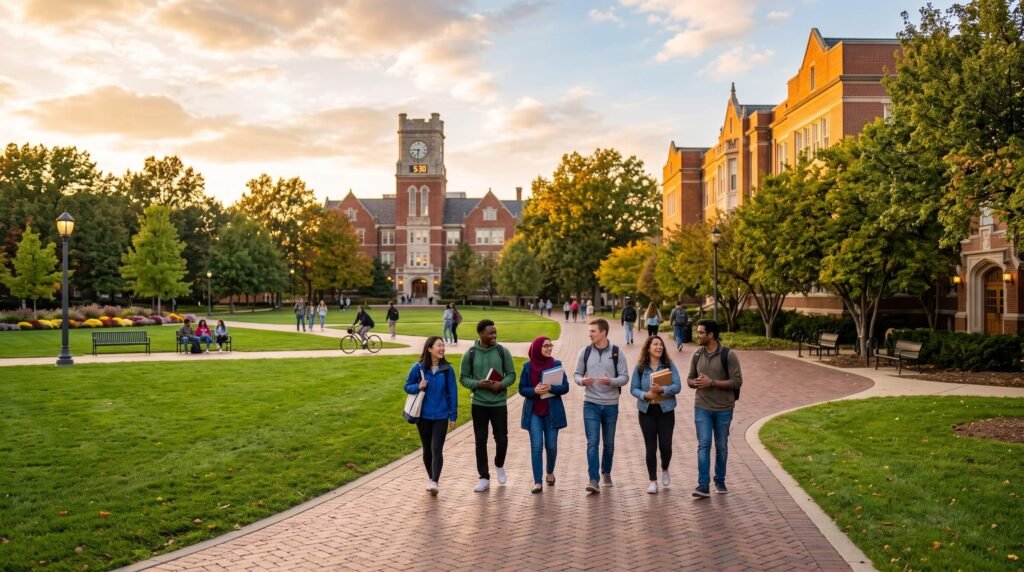
Every year, more than a million international students arrive in the United States to pursue their academic dreams. They come from every corner of the globe, drawn by the promise of world-class education, cutting-edge research opportunities, and a credential that opens doors worldwide.
But there is one obstacle that stops countless other students before they even begin: the cost.
The United States has a reputation for being the most expensive study destination on the planet. Elite private universities publish sticker prices exceeding $65,000 per year for tuition alone. When you add housing, food, books, insurance, and personal expenses, a single year at some institutions can approach six figures.
That reputation, however, tells only part of the story. What many international students never discover is that the American higher education system is incredibly diverse. Alongside the Harvards and Stanfords, there are hundreds of accredited, high-quality institutions where international students can earn a respected American degree for a fraction of the cost — sometimes less than $10,000 per year in tuition.
This guide is your roadmap to finding those institutions. Whether you are a high school student planning your first degree, a professional considering a master’s program, or a parent researching options for your child, you will find the information you need here.
We will explore the cheapest universities in the USA for international students, break down the true costs of attendance, explain how the 2+2 community college pathway can save you tens of thousands of dollars, and reveal the scholarship and assistantship opportunities that can bring your expenses down even further.
By the end of this article, you will understand exactly how to make an American education affordable — and where to find the best-value programs in 2026.
Why the USA Can Still Be Affordable for International Students
The first step toward finding an affordable education in the United States is understanding why costs vary so dramatically from one institution to another.
Unlike many countries where tuition is set nationally or regionally, U.S. universities operate independently. Each institution sets its own tuition rates, fees, and cost-of-attendance figures. This creates enormous variation across the system.
At the top end, elite private universities charge whatever the market will bear. They compete on prestige, research output, and exclusive networks. At the other end, public universities and community colleges serve their state populations and receive government funding, allowing them to keep tuition relatively low.
International students almost always pay the out-of-state rate at public universities, which is higher than what state residents pay. But even that higher rate is often dramatically lower than private university tuition.
There is another crucial factor: location. Living costs in the United States vary wildly by region. A student in Lincoln, Nebraska, or Bowling Green, Ohio, can comfortably live on $1,500 per month or less. The same lifestyle in Manhattan or downtown Boston can cost double that.
Quick Fact: The College Board estimates the average annual budget for full-time undergraduate students in the United States ranges from approximately $50,900 at public four-year institutions for out-of-state students to $65,500 at private nonprofit institutions. However, these are averages — some institutions offer total costs below $20,000 per year.
The Three Tiers of U.S. Higher Education
| Institution Type | Typical Annual Tuition (International) | Typical Total Annual Cost | Key Characteristics |
|---|---|---|---|
| Community Colleges | $6,000 – $12,000 | $15,000 – $25,000 | Two-year associate degrees; 2+2 transfer pathway; smaller class sizes |
| Public State Universities | $15,000 – $35,000 | $25,000 – $50,000 | Four-year degrees; research opportunities; regional accreditation |
| Private Universities | $40,000 – $65,000+ | $60,000 – $90,000+ | Prestige; smaller student-faculty ratios; generous financial aid for some |
The key takeaway is that the United States offers options at every price point. Finding the cheapest universities in the USA for international students is not about sacrificing quality. It is about knowing where to look.
The Cheapest Universities in the USA for International Students: A Comprehensive Ranking
What makes a university “cheap” for an international student? The answer is not as simple as looking at the tuition number alone.
Total cost of attendance includes tuition, mandatory fees, housing, food, books, supplies, health insurance, and personal expenses. A university with low tuition but an expensive location may end up costing more than a university with slightly higher tuition in an affordable town.
To create this guide, we have analyzed data from U.S. News & World Report, university official websites, and reputable education databases. The institutions listed below represent the most affordable options for international students in 2026, based on total annual cost.
Important: Tuition and fees change annually. Always verify current costs on the official website of each university before applying. The figures in this guide are based on 2025-2026 and 2026-2027 academic year data.
Top 20 Cheapest Universities in the USA for International Students (Total Annual Cost)
This ranking, based on U.S. News data for institutions that enrolled at least 25 international students, shows the 20 most affordable universities when all costs — tuition, fees, housing, food, books, and transportation — are included. None of these institutions exceeds $27,630 per year in total cost.
| Rank | University | State | U.S. News Ranking | Total Annual Cost (USD) |
|---|---|---|---|---|
| 1 | Delta State University | Mississippi | 50 (Regional) | $18,600 |
| 2 | University of the Cumberlands | Kentucky | 395-434 (National) | $19,200 |
| 3 | California State University, Fresno | California | 183 (National) | $19,700 |
| 4 | Western Carolina University | North Carolina | 257 (National) | $20,400 |
| 5 | Fayetteville State University | North Carolina | 52 (Regional) | $22,200 |
| 6 | Dakota State University | South Dakota | 61 (Regional) | $22,500 |
| 7 | Northern State University | South Dakota | 61 (Regional) | $23,200 |
| 8 | Valley City State University | North Dakota | 15 (Regional) | $23,400 |
| 9 | Southern Arkansas University | Arkansas | 67 (Regional) | $23,700 |
| 10 | Talladega College | Alabama | 60 (Regional) | $23,700 |
| 11 | Livingstone College | North Carolina | 67 (Regional) | $25,100 |
| 12 | Slippery Rock University of Pennsylvania | Pennsylvania | 55 (Regional) | $25,500 |
| 13 | Coppin State University | Maryland | 150-164 (Regional) | $25,900 |
| 14 | Rogers State University | Oklahoma | 27 (Regional) | $26,600 |
| 15 | University of Wisconsin-Parkside | Wisconsin | 118 (Regional) | $26,800 |
| 16 | South Dakota School of Mines and Technology | South Dakota | 20 (Regional) | $27,100 |
| 17 | Lake Superior State University | Michigan | 19 (Regional) | $27,200 |
| 18 | University of Wisconsin-Whitewater | Wisconsin | 31 (Regional) | $27,600 |
| 19 | University of Wisconsin-La Crosse | Wisconsin | 14 (Regional) | $27,600 |
| 20 | Cameron University | Oklahoma | 98 (Regional) | $27,600 |
What stands out in this ranking is the geographic concentration. More than one-third of these institutions are located in the Dakotas and North Carolina. The Midwest and South dominate the list because of lower operating costs, lower cost of living, and state policies that keep public university tuition accessible.
Expert Tip: A regional university ranking does not mean lower quality. Many of these institutions offer strong programs in specific fields, smaller class sizes, and personalized attention that larger research universities cannot match. For undergraduate education, regional universities can provide excellent value.
Universities with the Lowest Tuition for International Students (Under $10,000/Year)
If tuition is your primary concern, these institutions offer some of the lowest annual tuition rates in the country for international students. Note that these figures represent tuition and mandatory fees only, not total cost of attendance.
| University | State | Annual Tuition (USD) | Accreditation |
|---|---|---|---|
| University of the People | California (Online) | $2,460 | DEAC Accredited |
| Alcorn State University | Mississippi | $7,164 | SACSCOC |
| Minot State University | North Dakota | $7,606 | HLC Accredited |
| Wayne State College | Nebraska | $8,500 | HLC Accredited |
| Eastern New Mexico University | New Mexico | $8,748 | HLC Accredited |
| Southeast Missouri State University | Missouri | $8,925 | HLC Accredited |
| Indian River State College | Florida | $9,420 | SACSCOC |
| Nicholls State University | Louisiana | $10,500 | SACSCOC |
| Wichita State University | Kansas | $9,810 | HLC / AACSB |
| Delta State University | Mississippi | $7,501 | SACSCOC |
| Mississippi University for Women | Mississippi | $7,425 | SACSCOC |
| Bemidji State University | Minnesota | $7,630 | HLC Accredited |
| Henderson State University | Arkansas | $8,640 | HLC Accredited |
| Southwest Minnesota State University | Minnesota | $7,496 | HLC Accredited |
Warning: University of the People is an online, tuition-free institution with a unique model. It is accredited by the Distance Education Accrediting Commission (DEAC), which is recognized by the U.S. Department of Education. However, because it operates online, it does not issue Form I-20 documents for F-1 visas. International students seeking to study in the United States on an F-1 visa should focus on the physical campuses listed above.
The institutions above demonstrate that a U.S. education does not have to cost a fortune. Several of them offer tuition under $8,000 per year — less than what many students pay for a single semester at a private university.
Public Universities with the Best Value for International Students
Beyond the absolute cheapest options, there are larger public universities that offer excellent value when you consider reputation, program quality, and career outcomes. These institutions charge moderate tuition rates but provide resources, research opportunities, and alumni networks that can significantly enhance your career prospects.
| University | State | Annual Tuition (International) | Notable Strengths |
|---|---|---|---|
| University of Texas at El Paso | Texas | $12,000 – $16,000 | Engineering, Business, Health Sciences |
| University of Texas Rio Grande Valley | Texas | $11,000 – $15,000 | Medicine, Engineering, Education |
| South Dakota State University | South Dakota | $13,000 – $19,000 | Agriculture, Engineering, Pharmacy |
| University of South Dakota | South Dakota | $13,000 – $19,000 | Business, Law, Health Sciences |
| Idaho State University | Idaho | $15,000 – $20,000 | Health Sciences, Engineering, Pharmacy |
| New Mexico State University | New Mexico | $14,000 – $18,000 | Engineering, Agriculture, Business |
| University of Wyoming | Wyoming | $14,000 – $20,000 | Energy, Engineering, Agriculture |
| University of North Dakota | North Dakota | $15,000 – $21,000 | Aviation, Engineering, Health Sciences |
| Missouri State University | Missouri | $16,000 – $22,000 | Business, Education, Health Sciences |
| University of Central Missouri | Missouri | $14,000 – $18,000 | Technology, Business, Education |
| Western Kentucky University | Kentucky | $18,000 – $24,000 | Journalism, Business, Engineering |
| Florida International University | Florida | $18,000 – $22,000 | Business, Engineering, International Relations |
Pro Tip: When comparing public universities, always calculate the total cost of attendance, not just tuition. Some universities in low-cost states like South Dakota, Mississippi, and Arkansas offer total annual costs below $25,000. The same tuition in a high-cost city could result in a total cost of $40,000 or more.
The 2+2 Pathway: How Community Colleges Can Cut Your Costs Dramatically
Perhaps the single most powerful strategy for reducing the cost of an American education is the 2+2 transfer pathway. This approach involves completing your first two years of undergraduate study at a community college and then transferring to a four-year university to complete your bachelor’s degree.
The financial impact can be transformative.
Community college tuition for international students typically ranges from $6,000 to $12,000 per year — 40% to 60% less than what you would pay at most four-year universities. By completing your general education requirements at a community college and transferring to a university for your final two years, you can save $30,000 to $80,000 or more on your bachelor’s degree.
Quick Fact: The number of international students studying at U.S. community colleges increased 8% between the 2023-24 and 2024-25 school years, according to the 2025 Open Doors Report. More than 1,000 community colleges across the United States enroll international students.
Why the 2+2 Pathway Works
Community colleges focus on teaching, not research. Their faculty are hired primarily for their ability to teach, and class sizes are often smaller than at large universities. The first two years of most bachelor’s degree programs consist of general education courses — English, math, history, social sciences — that are largely the same regardless of where you take them.
Many community colleges have articulation agreements with four-year universities in their state. These agreements guarantee that credits earned at the community college will transfer and apply toward your bachelor’s degree. Some states have common course numbering systems that make transfer seamless.
Community Colleges with Low International Student Tuition
| Community College | State | Annual Tuition (International) | Transfer Pathway Strength |
|---|---|---|---|
| Green River College | Washington | $11,946 | University of Washington, Washington State |
| Seattle Colleges | Washington | $11,283 | University of Washington, regional universities |
| Santa Monica College | California | $11,789 | UC system, CSU system |
| Fullerton College | California | $8,000 – $11,000 | UC and CSU transfer tracks |
| De Anza College | California | $8,000 – $11,000 | Strong UC transfer record |
| Pasadena City College | California | $8,000 – $11,000 | High UC transfer acceptance |
| Valencia College | Florida | $9,576 | University of Central Florida |
| Bellevue College | Washington | $10,000 – $13,000 | University of Washington |
| Highline College | Washington | $13,000 (3 quarters) | University of Washington |
| Ivy Tech Community College | Indiana | $4,967 per semester | Indiana University, Purdue |
| Riverside City College | California | Varies | UC and CSU systems |
Expert Tip: Before enrolling in a community college, confirm that it is SEVP-certified and can issue a Form I-20 for the F-1 visa. Also verify that your target four-year university accepts the community college’s credits for your intended major. Not all credits transfer to all universities.
A Real-World Example of 2+2 Savings
Consider a student who wants to study computer science at the University of Washington, where international student tuition is approximately $43,000 per year. By completing the first two years at Highline College for approximately $13,000 per year and then transferring, the student would save nearly $60,000 in tuition alone — enough to cover nearly two additional years of living expenses.
The savings become even more dramatic when compared to private universities. A student who completes two years at a community college and transfers to a private university for the final two years can save well over $80,000 compared to attending the private university for all four years.
Cheapest States in the USA for International Students
Your choice of state has a profound impact on the total cost of your education. Tuition at public universities varies significantly by state, and living costs can differ by a factor of two or more between expensive coastal cities and affordable college towns in the Midwest and South.
The states listed below offer the best combination of low tuition, low living costs, and quality educational institutions for international students.
Mississippi
Mississippi consistently ranks as one of the most affordable states in the nation for higher education. The state’s public universities offer some of the lowest tuition rates in the country for international students, and the cost of living — particularly housing and food — is well below the national average.
Featured institutions: Delta State University, Alcorn State University, Mississippi University for Women, Jackson State University, Mississippi State University.
Delta State University offers one of the lowest total annual costs in the entire country at approximately $18,600, including tuition, fees, housing, food, books, and transportation. The university is located in Cleveland, Mississippi, a small town where living costs are modest.
South Dakota
South Dakota offers a compelling combination of low tuition, low cost of living, and strong programs in engineering, technology, and agriculture. The state’s public universities are well-funded and have invested in facilities and faculty that rival much larger institutions.
Featured institutions: South Dakota State University, Dakota State University, Northern State University, South Dakota School of Mines and Technology, University of South Dakota.
The South Dakota School of Mines and Technology, located in Rapid City, is particularly notable. It offers strong engineering and science programs at a total annual cost of approximately $27,100 — less than half the cost of many private engineering schools.
North Dakota
North Dakota is home to several affordable public universities with low tuition rates and a cost of living that remains well below the national average. The state has a strong economy and a relatively low population density, which keeps housing and transportation costs down.
Featured institutions: Minot State University, Valley City State University, University of North Dakota, North Dakota State University.
Minot State University offers annual tuition of just $7,606 for international students — among the lowest in the nation. The university offers programs in business, education, nursing, and technology.
Texas
Texas offers a wide range of affordable public universities, particularly in the western and southern parts of the state. The University of Texas at El Paso and the University of Texas Rio Grande Valley both offer international student tuition in the $11,000 to $16,000 range, making them among the most affordable options for a four-year degree in a large public university system.
Featured institutions: University of Texas at El Paso, University of Texas Rio Grande Valley, Texas A&M Kingsville, West Texas A&M University.
El Paso and Edinburg are affordable cities with low housing costs. Both universities serve large Hispanic populations and offer strong programs in engineering, health sciences, and business.
Oklahoma
Oklahoma combines low tuition with a low cost of living, making it an attractive option for budget-conscious international students. The state’s regional universities and public universities offer a range of programs at accessible prices.
Featured institutions: Cameron University, Rogers State University, University of Central Oklahoma, Oklahoma Panhandle State University.
The University of Central Oklahoma, located in Edmond (a suburb of Oklahoma City), offers total annual costs of approximately $30,000 before scholarships. With merit-based scholarships of up to $4,000 per year, the total can drop to $26,000 or less.
Missouri
Missouri offers a strong combination of affordable tuition, diverse institutions, and a moderate cost of living. The state’s public universities serve a wide range of students, from first-generation college students to international scholars.
Featured institutions: Southeast Missouri State University, Missouri State University, University of Central Missouri, Northwest Missouri State University.
Southeast Missouri State University offers international student tuition of approximately $8,925 per year — among the lowest in the state. The university is located in Cape Girardeau, a small city on the Mississippi River with a low cost of living.
Arkansas
Arkansas has emerged as an increasingly popular destination for international students seeking affordable education. The state’s public universities offer low tuition rates, and cities like Fayetteville, Jonesboro, and Arkadelphia offer affordable housing and living costs.
Featured institutions: Southern Arkansas University, Henderson State University, Arkansas State University, University of Central Arkansas.
Southern Arkansas University, located in Magnolia, offers a total annual cost of approximately $23,700 for international students. The university offers programs in business, engineering, and agriculture.
Kansas
Kansas offers several affordable public universities with strong programs in engineering, aviation, and agriculture. The cost of living in Kansas college towns is significantly lower than in coastal cities.
Featured institutions: Wichita State University, Kansas State University, University of Kansas, Fort Hays State University.
Wichita State University offers international student tuition of approximately $9,810 per year for undergraduate programs. The university is known for its engineering and business programs and its strong ties to the local aerospace industry.
Important: The cost of living in a state is not uniform. A university in a major city will have higher living costs than a university in a rural college town. Always research the specific city where your university is located, not just the state.
Cost of Living in the USA for International Students: A State-by-State Breakdown
Tuition is only one part of the financial equation. For many international students, living expenses — housing, food, transportation, and health insurance — represent a significant portion of their total annual budget.
Understanding the cost of living in different regions of the United States is essential for accurate financial planning and for securing your F-1 visa, which requires proof of funds sufficient to cover both tuition and living expenses.
Average Monthly Living Costs by Region
| Region | Typical Monthly Cost (USD) | Annual Estimate (USD) | Notes |
|---|---|---|---|
| Midwest (small college towns) | $900 – $1,400 | $10,800 – $16,800 | Affordable housing, low food costs, limited public transit |
| South (small to mid-sized cities) | $1,000 – $1,500 | $12,000 – $18,000 | Low rents, moderate food costs, car often needed |
| Mid-Atlantic (excluding NYC) | $1,200 – $1,800 | $14,400 – $21,600 | Moderate costs, good public transit in some areas |
| West Coast (excluding SF/LA) | $1,200 – $1,800 | $14,400 – $21,600 | Higher housing costs, good public transit in cities |
| New York City / Boston / San Francisco | $2,000 – $3,500+ | $24,000 – $42,000+ | Very high rents, expensive food and transportation |
Detailed Monthly Budget Breakdown for a Mid-Sized U.S. City
For a single international student living off campus in a mid-sized U.S. city in 2026, a realistic monthly budget looks like this:
| Expense Category | Typical Monthly Cost (USD) | Notes |
|---|---|---|
| Rent (shared apartment) | $700 – $1,200 | On-campus housing and major cities cost more |
| Utilities and internet | $100 – $200 | Electricity, heating, water, Wi-Fi |
| Groceries | $250 – $400 | Home cooking; add $150–$250 for regular takeout |
| Public transportation | $40 – $100 | Monthly transit pass; higher if commuting long distance |
| Health insurance | $100 – $250 | University SHIP plans; varies with school and age |
| Phone and personal | $150 – $300 | SIM plan, toiletries, clothing, entertainment |
| Total Monthly | $1,340 – $2,450 | Annual: $16,080 – $29,400 |
Housing: The Biggest Variable
Housing is the single largest living expense after tuition. On-campus room and board typically runs $10,000 to $16,000 for a full academic year, paid as a lump sum through the university.
Off-campus, a shared apartment averages $700 to $1,200 per month in most college towns. A one-bedroom apartment can range from $600 in a rural area to $3,000 or more in Boston.
Pro Tip: Renting with two to four roommates typically cuts rent by around 30% compared to living alone. Many international students find housing through university housing offices, student Facebook groups, or websites like Zillow and Apartments.com. Start your search at least two months before your program begins.
Food: How to Eat Well on a Budget
Grocery costs vary significantly by state, from an average of $387 per month in New York to $168 in Wyoming. Cooking at home is the single most effective way to reduce food costs. A student who cooks most meals can spend $200 to $300 per month on groceries. Eating out regularly can easily double or triple that amount.
Many universities offer meal plans for on-campus students. While convenient, meal plans are often more expensive per meal than cooking for yourself. Students living off campus generally find that cooking at home is significantly more economical.
Health Insurance: A Mandatory Expense
Most U.S. universities require international students to have health insurance. Many institutions offer a Student Health Insurance Plan (SHIP) that is automatically billed to your student account unless you can demonstrate equivalent coverage from another provider.
SHIP plans typically cost $1,000 to $2,500 per year, depending on the university and the level of coverage. Some universities allow students to waive the SHIP if they have comparable coverage from their home country or through a private insurer.
Warning: Do not assume that your home country’s health insurance will cover you in the United States. Most national health systems do not provide coverage abroad. Even if you are healthy, medical care in the United States is extremely expensive without insurance. Always maintain adequate health coverage while studying in the U.S.
Scholarships and Financial Aid for International Students
One of the most persistent myths about studying in the United States is that international students cannot receive scholarships or financial aid. This is simply not true.
While it is correct that international students are not eligible for federal financial aid such as Pell Grants or federal student loans, hundreds of U.S. universities offer their own institutional scholarships to international students. These awards can range from a few thousand dollars per year to full tuition, fees, housing, and meals.
Types of Scholarships Available to International Students
| Scholarship Type | Description | Typical Award Range | How to Apply |
|---|---|---|---|
| Merit-Based Scholarships | Awarded for academic achievement, test scores, or talent | $2,000 – $25,000 per year | Automatic consideration with admission application |
| Need-Based Aid | Awarded based on demonstrated financial need | Varies widely; some cover full need | Requires separate financial aid application (CSS Profile) |
| Leadership Scholarships | Awarded for leadership experience and community service | $5,000 – $11,300 per year | Separate application and interview |
| Departmental Scholarships | Offered by specific academic departments or programs | $1,000 – $10,000 per year | Contact department directly |
| Athletic Scholarships | For recruited student-athletes | Partial to full tuition | Through athletic recruitment process |
| External Scholarships | Offered by foundations, corporations, and organizations | $1,000 – $30,000 | Separate application to each organization |
Examples of Generous International Student Scholarships
University of Central Oklahoma: UCO offers automatic merit scholarships to international students based on incoming GPA. Students with a 3.25 GPA or higher receive $4,000 per year, reducing the total annual cost to approximately $26,000. Students with a 3.00 GPA receive $3,000 per year. The university also offers a competitive leadership scholarship worth up to $11,300 per year, which can bring total annual costs down to approximately $18,700.
University of Findlay: Findlay offers substantial merit scholarships to international students, ranging from $18,500 to $25,000 per year. These scholarships are awarded automatically upon admission based on GPA and test scores. A student with a 4.0 GPA receives $25,000 per year, while a student with a 3.3 GPA receives $20,000.
Southern Illinois University Edwardsville: SIUE offers several need- and merit-based scholarships for undergraduate students, including the prestigious Meridian Scholarship, which includes full tuition, mandatory fees, housing, and a meal plan for four years.
Governors State University: GSU offers a generous housing scholarship covering 1.5 years of on-campus accommodation for up to 20 undergraduate international students. The university also offers block tuition of $21,908 per year, allowing students to take extra courses at no additional cost.
University of West Georgia: UWG offers the Sylvia Shortt Global Excellence Scholarship and undergraduate out-of-state tuition waivers to international students on a competitive basis.
Smith College: Smith has expanded its free tuition program to include international students. Beginning in fall 2026, qualified enrolled undergraduates from families earning up to $150,000 annually will receive free tuition, with financial aid packages that include grants instead of loans.
Expert Tip: Merit scholarships at many regional universities are awarded automatically based on your GPA and test scores. You do not need to submit a separate application. Focus on maintaining a strong academic record and submit your admission application early to maximize your scholarship eligibility.
Graduate Funding: Assistantships and Fellowships
For graduate students, the most valuable form of financial support is often a teaching assistantship (TA) or research assistantship (RA). These positions typically provide a tuition waiver plus a stipend in exchange for teaching undergraduate courses or assisting faculty with research.
Assistantships are more common at research universities and in STEM fields, but they are available in many disciplines. A full teaching assistantship typically includes:
- Full or partial tuition waiver
- Monthly stipend of $1,500 to $2,500 or more
- Health insurance coverage
- In-state tuition classification in some cases
At Texas A&M University, for example, the Doctoral Research Excellence Assistantships provide a $40,000 annual stipend for eligible doctoral students, including international students. At the University at Buffalo, RA/TA positions include a stipend of at least $24,000 per academic year plus a full tuition waiver.
Quick Fact: Assistantship positions are competitive, especially for international students whose first language is not English. Most universities require international teaching assistants to demonstrate English proficiency through a test such as TOEFL or IELTS, or through an institutional teaching assistant training program.
How to Reduce Your Costs: Practical Strategies for International Students
Beyond choosing an affordable university and applying for scholarships, there are many practical steps you can take to reduce your overall costs while studying in the United States.
Strategy 1: Start at a Community College and Transfer
The 2+2 pathway is the single most effective cost-reduction strategy for undergraduate students. By completing your first two years at a community college, you can save $30,000 to $80,000 compared to attending a four-year university for all four years.
Strategy 2: Apply for Every Scholarship You Qualify For
Many international students leave money on the table because they assume they are not eligible for scholarships. In reality, hundreds of U.S. universities offer scholarships specifically for international students. In addition, there are external scholarships offered by foundations, corporations, and organizations.
Common Mistake: Applying only to famous, expensive universities and hoping for a scholarship. Many of the most generous scholarship programs for international students are at regional universities and public institutions that are already affordable. These universities are eager to attract international students and often offer substantial awards.
Strategy 3: Choose a Low-Cost State
Your choice of state has a significant impact on your total costs. States in the Midwest and South — such as Mississippi, South Dakota, North Dakota, Arkansas, Missouri, Kansas, and Oklahoma — offer lower tuition and lower living costs than coastal states.
Strategy 4: Work On Campus
F-1 students are permitted to work on campus for up to 20 hours per week during the academic term and up to 40 hours per week during official school breaks. On-campus jobs — in the library, dining services, recreation center, or administrative offices — typically pay $10 to $15 per hour.
While on-campus work alone is unlikely to cover all your expenses, it can significantly reduce the amount you need to withdraw from savings or borrow. Working 20 hours per week at $12 per hour for 30 weeks generates approximately $7,200 per year.
Strategy 5: Consider Off-Campus Housing with Roommates
Sharing an apartment with two to four roommates can reduce your rent by 30% or more compared to living alone. In many college towns, a room in a shared house or apartment costs $400 to $700 per month, compared to $800 to $1,200 for a one-bedroom apartment.
Strategy 6: Cook Your Own Meals
Food is one of the most controllable expenses in your budget. Cooking at home rather than eating out can save you $200 to $400 per month. Budget-friendly strategies include meal planning, buying in bulk, and taking advantage of student discounts at local grocery stores.
Strategy 7: Buy Used Textbooks
Textbooks can cost $500 to $1,200 per year. Buying used books, renting textbooks, or accessing digital versions can reduce this cost significantly. Many university libraries also have course reserves — copies of required textbooks available for short-term loan.
Strategy 8: Use Public Transportation or Bike
Owning and maintaining a car is expensive. If you study in a city or college town with good public transit or bike infrastructure, you can avoid the costs of car payments, insurance, fuel, and parking. A monthly transit pass typically costs $40 to $100.
Strategy 9: Take Advantage of Student Discounts
Your student ID card is a powerful tool for saving money. Many businesses offer student discounts, including movie theaters, museums, restaurants, and software companies. Always ask if a student discount is available.
Strategy 10: Plan Your Studies to Graduate on Time
Every extra semester you spend in school adds thousands of dollars to your total cost. Work with your academic advisor to plan your course sequence carefully so you can graduate within the expected timeframe for your program. Some universities offer block tuition rates that allow you to take extra courses at no additional cost — take advantage of these if they apply to your institution.
How to Evaluate the True Cost of a University
When comparing universities, it is easy to focus on the tuition number. But the true cost of attendance includes much more. To make an informed decision, you need to calculate the total annual cost for each institution you are considering.
The Total Cost of Attendance Formula
Total Cost of Attendance = Tuition + Mandatory Fees + Housing + Food + Books and Supplies + Health Insurance + Transportation + Personal Expenses
Most universities publish an estimated cost of attendance on their website. This figure is also listed on your Form I-20, which your school issues after you are admitted. The I-20 figure is the amount you must demonstrate you can cover for the first academic year.
Questions to Ask When Comparing Universities
- What is the total cost of attendance, including all mandatory fees?
- How much will housing and food cost, both on campus and off campus?
- Is health insurance included, or is it an additional expense?
- What scholarships or grants are available to international students?
- Are there opportunities for assistantships or on-campus employment?
- What is the cost of living in the surrounding area?
- Does the university offer a tuition freeze or guaranteed tuition rate?
- What is the graduation rate, and can I realistically finish in four years?
Expert Tip: When comparing universities, create a spreadsheet that lists the total cost of attendance for each institution after subtracting any scholarships or grants. This will give you a clear picture of the actual out-of-pocket cost for each option.
Common Mistakes to Avoid When Choosing an Affordable University
Finding an affordable university requires careful research and critical thinking. Many international students make mistakes that end up costing them thousands of dollars or derailing their plans entirely.
Mistake 1: Focusing Only on Tuition
A university with the lowest tuition may not be the most affordable overall. A low-tuition university in an expensive city may cost more in total than a slightly higher-tuition university in an affordable town. Always calculate the total cost of attendance.
Mistake 2: Assuming All Cheap Universities Are Low Quality
Cost and quality are not directly correlated in U.S. higher education. Many regional universities and public institutions offer excellent programs, small class sizes, and strong career outcomes at a fraction of the cost of elite private schools. Accreditation is the key indicator of quality — not price.
Mistake 3: Ignoring Scholarship Opportunities
Many international students do not apply for scholarships because they assume they are not eligible. This is a costly mistake. Hundreds of universities offer automatic merit scholarships to international students based on GPA and test scores.
Mistake 4: Choosing a University Without Checking SEVP Certification
To issue a Form I-20 and enroll F-1 students, a university must be certified by the Student and Exchange Visitor Program (SEVP). Not all U.S. institutions are SEVP-certified, particularly some online and unaccredited schools. Always verify that your chosen university is SEVP-certified before applying.
Mistake 5: Underestimating Living Costs
Many students budget carefully for tuition but underestimate living expenses. Rent, food, transportation, and health insurance can add $15,000 to $25,000 or more per year to your costs. Make sure your financial plan accounts for these expenses.
Mistake 6: Not Planning for Currency Fluctuations
If you are funding your education from a country whose currency fluctuates against the U.S. dollar, your costs can increase unexpectedly. Build a buffer into your budget to account for exchange rate changes.
Warning: Be cautious of any university or recruiter that promises impossibly low costs or guarantees a visa. If an offer sounds too good to be true, it probably is. Always verify information directly with the university and with official U.S. government sources.
Frequently Asked Questions
What is the cheapest university in the USA for international students?
Based on total annual cost, Delta State University in Mississippi is the cheapest university for international students among ranked institutions, with a total annual cost of approximately $18,600. However, “cheapest” depends on your definition — if you look only at tuition, University of the People charges $2,460 per year, but it is an online institution that does not issue F-1 visas. Among physical campuses, Alcorn State University, Minot State University, and Wayne State College offer some of the lowest tuition rates for international students.
Can international students study in the USA for free?
Truly “free” education for international students in the United States is rare, but it does exist. A small number of elite institutions — such as MIT, Harvard, Princeton, and Smith College — offer need-blind or need-based financial aid that can cover the full cost of attendance for international students from low-income families. University of the People is tuition-free, but it is an online institution. For most international students, the realistic goal is to find a low-cost university combined with scholarships and on-campus work to minimize out-of-pocket expenses.
How much does it cost to study in the USA for international students?
The total annual cost for international students ranges from approximately $15,000 to $90,000 or more, depending on the institution and location. Community colleges typically cost $15,000 to $25,000 per year, including living expenses. Public universities cost $25,000 to $50,000 per year. Private universities cost $60,000 to $90,000 or more. However, the cheapest universities in the USA for international students offer total costs below $20,000 per year.
Which US state is cheapest for international students?
Mississippi, South Dakota, North Dakota, Arkansas, Missouri, Kansas, and Oklahoma are among the cheapest states for international students. These states offer low tuition at public universities and a low cost of living. Mississippi, in particular, has some of the lowest tuition rates and living costs in the country.
Are community colleges in the USA good for international students?
Yes. Community colleges offer a high-quality, affordable pathway to a U.S. bachelor’s degree. They provide smaller class sizes, dedicated teaching faculty, and transfer agreements with four-year universities. International students who complete the 2+2 pathway can save $30,000 to $80,000 on their bachelor’s degree. More than 1,000 community colleges in the United States enroll international students.
Can international students get scholarships in the USA?
Yes. Many U.S. universities offer merit-based scholarships to international students, ranging from $2,000 to $25,000 or more per year. These scholarships are often awarded automatically based on GPA and test scores. Some universities also offer need-based aid, leadership scholarships, and departmental scholarships. External scholarships are also available from foundations and organizations.
Can international students work while studying in the USA?
Yes, with restrictions. F-1 students may work on campus for up to 20 hours per week during the academic term and up to 40 hours per week during school breaks. Off-campus employment requires prior authorization through Curricular Practical Training (CPT) or Optional Practical Training (OPT). Working without authorization is a violation of F-1 status.
What is the 2+2 pathway, and how much can it save?
The 2+2 pathway involves completing two years at a community college and then transferring to a four-year university to complete your bachelor’s degree. Because community college tuition is 40% to 60% lower than four-year university tuition, students can save $30,000 to $80,000 or more on their degree. Many community colleges have transfer agreements with state universities that guarantee credit transfer.
How do I prove I can afford to study in the USA?
When applying for an F-1 visa, you must demonstrate that you have sufficient funds to cover the cost of attendance for your first academic year. Acceptable proof includes bank statements, bank certificates, education loan approval letters, scholarship award letters, and sponsor affidavits with supporting financial documentation. The amount you must demonstrate is listed on your Form I-20.
What are the hidden costs of studying in the USA?
Hidden costs can include health insurance (if not included in your tuition), textbooks and supplies, transportation, personal expenses, and currency exchange fees. Additionally, some universities charge international student fees, orientation fees, and technology fees. Always review the full cost of attendance and ask about mandatory fees that may not be included in the tuition figure.
Is it cheaper to study in the USA or the UK?
In general, the United States offers a wider range of price points. The cheapest U.S. universities for international students cost less than many UK universities, especially for undergraduate programs. However, the most expensive U.S. private universities cost more than most UK institutions. The key difference is that U.S. bachelor’s degrees are typically four years, while UK bachelor’s degrees are three years, which can affect the total cost.
Can I get a full scholarship to study in the USA?
Full scholarships for international students are available but highly competitive. Some universities, such as MIT, Harvard, and Smith College, offer need-based aid that can cover the full cost of attendance. Other universities offer full-tuition scholarships or full-ride scholarships based on merit. To maximize your chances, maintain a strong academic record, apply to a range of universities, and submit all required financial aid applications by the deadlines.
What is the cheapest way to get a US degree as an international student?
The cheapest way to get a U.S. degree is to complete your first two years at a community college and then transfer to an affordable public university for your final two years. Combine this with merit scholarships, on-campus work, and living in a low-cost state. This strategy can reduce the total cost of a bachelor’s degree to $40,000 to $60,000 or less, compared to $200,000 or more at a private university.
Are there any tuition-free universities in the USA for international students?
University of the People is a tuition-free, accredited online university that serves students worldwide, but it does not issue F-1 visas. For in-person study, a small number of elite institutions offer need-based financial aid that can cover full tuition for international students from low-income families. These include MIT, Harvard, Princeton, Yale, and Smith College. However, admission to these institutions is highly competitive.
How do I choose between a cheap university and a more expensive one with a better reputation?
The answer depends on your goals. If your priority is to minimize debt and enter the workforce quickly, an affordable university with strong career services and internship opportunities may be the better choice. If your goal is to pursue a career in academia, research, or a field where prestige matters, a more expensive university with a strong reputation in your field may be worth the investment. Consider the return on investment — the difference in expected earnings over your career relative to the additional cost.
Key Takeaways
- The cheapest universities in the USA for international students offer total annual costs below $20,000, including tuition, fees, housing, food, and transportation.
- Community colleges offer the most affordable pathway to a U.S. degree through the 2+2 transfer model, saving students $30,000 to $80,000 or more.
- States in the Midwest and South — including Mississippi, South Dakota, North Dakota, Arkansas, Missouri, Kansas, and Oklahoma — offer the lowest tuition and living costs.
- Hundreds of U.S. universities offer merit-based scholarships to international students, ranging from $2,000 to $25,000 per year.
- Graduate students can often secure teaching or research assistantships that include tuition waivers and stipends.
- On-campus work, shared housing, cooking at home, and buying used textbooks are effective ways to reduce living expenses.
- Always calculate the total cost of attendance, not just tuition, when comparing universities.
- Verify that your chosen university is SEVP-certified and can issue a Form I-20 for the F-1 visa.
- Start planning early, apply for scholarships, and submit your applications well before deadlines.
- A U.S. education is within reach for students at every budget level — the key is knowing where to look and how to plan.
Conclusion
The United States remains the most popular destination for international students, and for good reason. American universities offer unparalleled diversity of programs, world-class research opportunities, and a credential that is recognized and respected around the globe.
But the cost of a U.S. education does not have to be overwhelming. As this guide has demonstrated, there are hundreds of accredited, high-quality institutions where international students can earn a degree at a fraction of the cost of elite private universities.
From Delta State University in Mississippi, where total annual costs are under $19,000, to the community colleges of Washington and California that offer seamless transfer pathways to top universities, the options are more accessible than most students realize.
The key is to approach your search strategically. Start by calculating the total cost of attendance, not just tuition. Explore the 2+2 community college pathway. Apply for every scholarship you qualify for. Choose a low-cost state. And take advantage of on-campus work opportunities to offset your living expenses.
Your American education is an investment in your future. With careful planning and the right information, that investment can be both affordable and transformative. The cheapest universities in the USA for international students are waiting — and your journey starts with a single step.
Take the time to research your options, reach out to the international student offices at the universities that interest you, and ask questions. The information in this guide gives you a strong foundation. Now it is time to build your future.