Every living cell is an astonishingly complex metropolis populated by millions of microscopic molecular machines called proteins. These intricate biomolecules digest food, replicate genetic code, fire neurotransmitters across cerebral synapses, and defend against viral pathogens. Yet for more than half a century, a single fundamental riddle stymied modern science: how does a linear, one-dimensional string of chemical building blocks spontaneously fold into a precise, functioning three-dimensional shape?
Historically, determining the physical architecture of a single protein required years of grueling wet-lab experimentation, hundreds of thousands of dollars in specialized reagents, and unpredictable cycles of trial and error using X-ray crystallography or cryogenic electron microscopy. Many medically vital proteins—especially those embedded inside cellular membranes—resisted structural analysis altogether, leaving critical blind spots in disease biology and pharmacology.
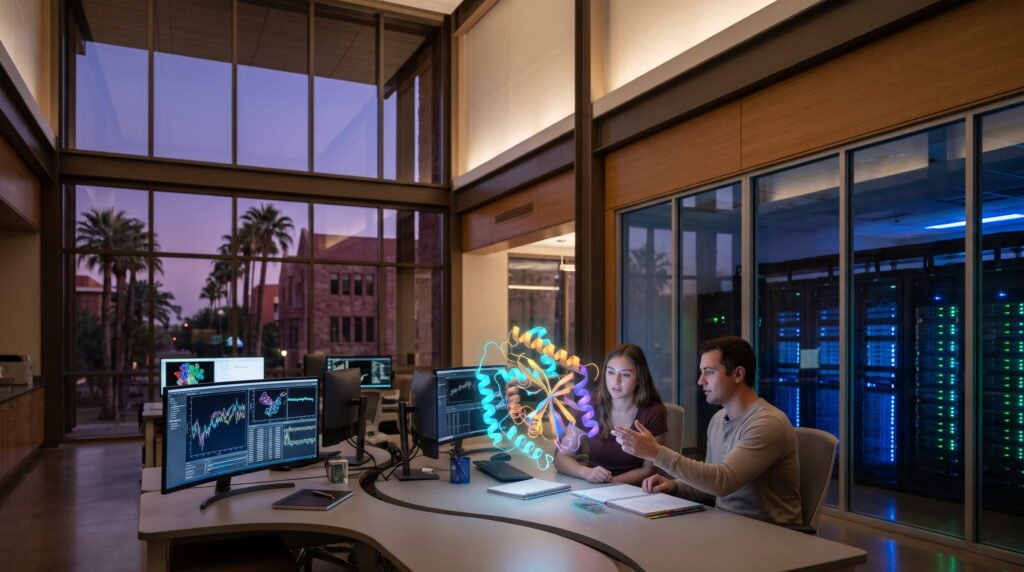
At Arizona State University, students are systematically dismantling this historical bottleneck. Powered by campus supercomputing infrastructure, deep neural network algorithms, and interdisciplinary research laboratories, undergraduate and graduate scholars are resolving molecular geometries in seconds rather than decades. By turning biological research into an accessible, high-performance computational science, ASU is training a generation of scientific innovators who are designing targeted cancer drugs, engineering plastic-degrading enzymes, and solving structural biology’s greatest puzzles.
The Molecular Enigma: Levinthal’s Paradox and the Protein Folding Challenge
To grasp the scale of the computational challenge that student researchers are tackling, one must understand how proteins are formed. Inside biological ribosomes, genetic instructions transcribe messenger RNA into linear chains of twenty distinct amino acids. Once assembled, this flexible polypeptide chain twists, turns, and collapses into a unique three-dimensional conformation dictated solely by thermodynamic and chemical forces.
A protein’s final physical shape determines its biological function. If a protein folds correctly, its catalytic clefts, receptor grooves, and binding surfaces fit perfectly with matching target molecules, functioning like a precision physical key inside a molecular lock. If it misfolds, the protein can become non-functional or form toxic aggregates, causing devastating neurodegenerative diseases like Alzheimer’s, Parkinson’s, and Huntington’s.
In 1969, biophysicist Cyrus Levinthal articulated what is now known as “Levinthal’s Paradox.” Levinthal calculated that if a modest polypeptide chain containing just one hundred amino acids were to randomly sample every conceivable physical conformation until reaching its lowest energy state, it would have to evaluate approximately 10300 possible structural arrangements.
Quick Fact: Even if a molecular chain sampled a new geometric shape every picosecond (one-trillionth of a second), exploring all possible configurations at random would take longer than the entire age of the universe. Yet biological cells routinely fold complex proteins in fractions of a millisecond.
This paradox proved that protein folding is not a random trial-and-error process; it is governed by predictable, highly coordinated physical and chemical rules. The grand challenge of computational biophysics has been writing mathematical and computational models capable of decoding those hidden folding principles from primary amino acid sequences alone.
| Investigation Method | Physical Mechanism | Average Time to Resolve Structure | Primary Limitations & Constraints |
|---|---|---|---|
| X-Ray Crystallography | Diffracts high-intensity X-ray beams through purified, crystallized protein lattices to compute electron density maps. | 6 months to several years | Requires pure, stable protein crystals; fails on flexible or membrane-bound proteins. |
| Cryogenic Electron Microscopy (Cryo-EM) | Flashes liquid nitrogen to vitrify proteins in thin ice, capturing hundreds of thousands of individual particle snapshots. | Weeks to months | Extremely expensive capital equipment ($5M–$10M); complex image reconstruction processing. |
| Nuclear Magnetic Resonance (NMR) | Applies radiofrequency pulses to sample nuclear magnetic moments in strong magnetic fields. | Several months | Effective only for small proteins in solution; cannot resolve large macromolecular complexes. |
| Supercomputing Structural Prediction | Deploys deep neural networks and evolutionary attention maps to predict atomic coordinates directly from amino acid sequences. | Minutes to hours | Requires massive parallel GPU computing power; captures static ground states rather than flexible dynamics. |
The Supercomputing Engine: ASU’s Sol HPC Cluster and Research Computing
Accurate structural prediction and all-atom molecular dynamics calculations require staggering volumes of computational performance. Simulating the nanosecond-by-nanosecond trajectory of a multi-protein complex suspended in a virtual water box requires calculating electrostatic attractions, van der Waals repulsions, and hydrogen bond vibrations across millions of individual atoms at every femtosecond timestep.
To empower student researchers to execute these calculations without leaving campus, Arizona State University deployed “Sol,” its flagship high-performance computing (HPC) cluster managed by ASU Research Computing. Engineered from the ground up for high-throughput scientific computing and deep learning workloads, Sol provides students with supercomputing performance comparable to elite national research laboratories.
Sol features thousands of high-performance central processing cores paired with high-density GPU acceleration nodes interconnected via ultra-low-latency InfiniBand networks. These specialized GPUs possess specialized matrix-multiplication hardware designed specifically for deep neural network inference, transformer attention layers, and fast Fourier transform calculations.
Pro Tip: Any ASU student enrolled in faculty-mentored research can obtain free computing allocations on the Sol cluster. Taking the Research Computing onboarding workshops qualifies students to submit Slurm batch scripts and launch distributed GPU jobs within days.
On Sol, students run advanced deep learning frameworks including AlphaFold, OpenFold, ColabFold, and ESMFold. Where researchers once had to wait months for compute credits on remote national servers, ASU students can launch dozens of parallel structural predictions simultaneously, testing structural hypotheses in real time during a single afternoon.
Furthermore, Sol hosts petabytes of high-throughput parallel storage. This capacity allows students to run continuous all-atom molecular dynamics trajectories for microsecond durations, generating massive multidimensional trajectory files that reveal how proteins flex, twist, and breathe in dynamic physiological environments.
The Algorithmic Revolution: How Modern Computational Models Predict Structures
The breakthrough that transformed protein folding from an intractable physical problem into a solvable computational task was the development of deep neural network architectures that leverage evolutionary genomics. Student researchers at ASU do not treat these algorithms as opaque black boxes; they study the mathematical mechanics of how these systems predict atomic coordinates.
The core computational insight rests on Multiple Sequence Alignment (MSA). Over billions of years of biological evolution, random genetic mutations occur across living organisms. If a mutation alters a single amino acid in a way that disrupts the protein’s physical shape, the organism generally fails to survive.
However, if a second, complementary mutation occurs in an adjacent amino acid that restores physical balance or electrostatic attraction, the structural stability is preserved. By analyzing evolutionary databases containing hundreds of millions of sequenced genetic codes across bacteria, plants, and animals, deep learning algorithms detect these paired evolutionary mutations.
Important: Co-evolutionary analysis means that if two amino acids separated by hundreds of steps in a linear chain mutate together across thousands of species, those two residues almost certainly touch each other in the folded 3D physical structure.
Modern predictive software processes these inputs through specialized neural layers:
- Evoformer Processing: An attention-based neural network architecture that continuously refines pairwise spatial relationships and evolutionary alignments, passing information back and forth between 1D sequences and 2D spatial distance matrices.
- Structural Module: A 3D spatial transformation layer that takes abstract representations and constructs explicit three-dimensional coordinates (x, y, z) for every carbon, nitrogen, and oxygen atom in the protein backbone and side chains.
- Equivariant Graph Neural Networks: Networks that ensure physical predictions obey rotational and translational symmetries, meaning a molecule has the identical physical energy regardless of its orientation in 3D coordinate space.
- Quality Metric Scoring (pLDDT): The algorithm calculates a confidence score (predicted Local Distance Difference Test) for every individual amino acid residue, showing researchers exactly which domains are rigid and reliable and which are intrinsically flexible.
By mastering these algorithmic mechanics, ASU students are not merely running automated prediction scripts; they are engineering customized pipeline variations, optimizing loss functions, and modifying source algorithms to handle challenging structural edge cases.
The ASU Research Ecosystem: Interdisciplinary Discovery at the Biodesign Institute
High-performance computing clusters provide the computational muscle, but transformative scientific discoveries require integration with biological, chemical, and medical domain expertise. At ASU, this integration thrives within the world-renowned Biodesign Institute.
The Biodesign Institute houses numerous specialized centers where computational modeling directly informs laboratory discovery. Foremost among them is the Biodesign Center for Applied Structural Discovery (CASD), an internationally recognized hub for biophysical characterization, structural biology, and synchrotron crystallography.
In CASD, students work directly with faculty pioneers to solve high-impact biological structures. Rather than segregating dry-lab programmers from wet-lab biochemists, ASU encourages an integrated hybrid approach. A student researcher can spend their morning writing Python scripts on the Sol cluster to predict a membrane receptor’s active state, and spend their afternoon in a wet lab synthesizing that exact protein in cell culture for biochemical validation.
Expert Tip: Purely computational predictions are hypotheses, not finalized scientific truths. The gold standard of structural biology requires validating computer-generated molecular models against experimental laboratory benchmarks such as cryo-EM density maps or enzyme activity assays.
Complementing CASD is the Biodesign Center for Molecular Design and Biomimetics, where students explore de novo protein design—the science of creating entirely new, custom proteins that have never existed in nature. Using generative computational modeling, students program synthetic enzymes engineered to bind specific industrial toxins or catalyze synthetic chemical reactions.
Furthermore, ASU’s School of Molecular Sciences (SMS) and the School of Biological and Health Systems Engineering (SBHSE) provide students with robust theoretical foundations in thermodynamics, statistical mechanics, and physical chemistry, ensuring they understand the physical laws governing molecular behaviors.
Real-World Student Breakthroughs: From Environmental Enzymes to Cancer Therapeutics
The computational research conducted by ASU students addresses urgent global challenges spanning human medicine, environmental restoration, and biosecurity. These are not synthetic classroom exercises; they are faculty-mentored, peer-reviewed investigations that advance the global body of scientific knowledge.
Consider four prominent domains where ASU students are deploying supercomputing tools to drive laboratory breakthroughs:
1. Designing Plastic-Degrading Enzymes (Enzymatic Bioremediation)
Modern industrial plastic pollution—particularly polyethylene terephthalate (PET)—threatens ecosystems worldwide because plastic polymers take centuries to degrade naturally. Students in ASU chemical and environmental engineering labs are using supercomputers to engineer hyper-stable mutant variations of natural PETase enzymes.
By simulating enzyme-substrate docking interactions on Sol, students identify precise amino acid substitutions that expand the enzyme’s catalytic pocket and enhance its thermal stability. This allows the engineered enzyme to digest commercial plastic bottles into reusable chemical monomers at elevated industrial temperatures in hours rather than centuries.
2. Targeted Oncology Therapeutics and Kinase Inhibitors
Many aggressive cancers are driven by mutated protein kinases—enzymatic switches that become permanently locked in an “on” state, signaling cancer cells to proliferate uncontrollably. Developing drugs that deactivate these mutated kinases without harming healthy enzymes is an immense challenge.
Undergraduate researchers use deep learning models to predict the structural differences between mutated oncogenic kinases and healthy wild-type proteins. They then deploy molecular docking software to virtually screen millions of small drug compounds, identifying candidate molecules that bind exclusively to the tumor-specific mutation with minimal side effects.
3. Overcoming Bacterial Antimicrobial Resistance
The rise of antibiotic-resistant superbugs represents one of the most severe public health emergencies of our time. Many pathogenic bacteria survive antibiotics by deploying specialized membrane proteins known as “efflux pumps” that physically vacuum drug molecules out of the bacterial cell before they can take effect.
ASU students use molecular dynamics simulations to analyze the mechanical pumping action of these bacterial transport proteins. By uncovering the mechanical hinges that control the pump’s opening and closing, students design small-molecule “blockers” that jam the pump mechanism, rendering resistant bacteria vulnerable to conventional antibiotics once again.
4. Viral Surface Glycoproteins and Vaccine Design
Viruses such as SARS-CoV-2, influenza, and respiratory syncytial virus (RSV) infect human cells using flexible spike glycoproteins coated in complex sugar molecules called glycans. These dynamic glycan shields continuously change shape to evade detection by human immune antibodies.
Students use supercomputing clusters to model the full all-atom dynamics of glycosylated viral spike proteins in physiological environments. Simulating how the viral spike bends and opens allows researchers to pinpoint conserved, unshielded vulnerable regions, informing the design of broad-spectrum universal vaccines.
| Student Research Area | Biological Target / System | Computational Tools Deployed | Tangible Laboratory Outcome |
|---|---|---|---|
| Plastic Remediation | Bacterial PETase and MHETase enzymes | ColabFold, GROMACS, PyMOL, Rosetta | Synthesized mutant enzymes with 3x higher plastic degradation rates at 60°C. |
| Cancer Drug Discovery | Mutant epidermal growth factor receptor (EGFR) | AlphaFold-Multimer, AutoDock Vina, AMBER | Identified two novel small-molecule inhibitors showing selective cancer cell apoptosis. |
| Antibiotic Resistance | Gram-negative bacterial AcrB multidrug efflux pump | OpenFold, NAMD, VMD trajectory analysis | Mapped cryptic allosteric binding pocket for targeted mechanical pump inhibitors. |
| Viral Vaccine Design | Flavivirus and Coronaviridae surface envelope spikes | ESMFold, CHARMM-GUI, CryoSPARC | Resolved glycan shield movements, identifying durable neutralizable epitope targets. |
| Neurodegenerative Research | Amyloid-beta and alpha-synuclein oligomer aggregates | Replica-Exchange Molecular Dynamics, Sol HPC | Tracked early-stage misfolding transitions responsible for synaptic toxicity. |
The Scientific Pipeline: From Sequence Code to Wet-Lab Validation
How does an ASU student actually take a raw string of genetic letters and turn it into a verified physical discovery? In university research programs, students execute a rigorous five-stage computational and experimental pipeline.
This systematic workflow mirrors the research operations used by premier biotechnology and pharmaceutical enterprises worldwide:
- Target Identification and Sequence Retrieval:The student begins by identifying a biological target associated with a disease or environmental challenge. They query global genomics repositories—such as the National Center for Biotechnology Information (NCBI) and UniProt—to extract the primary FASTA amino acid sequence, evaluating evolutionary conservation across related species.
- Deep Neural Structure Prediction on Sol:The student logs into the ASU Sol supercomputer via secure shell (SSH) or Open OnDemand web portals. They configure a Slurm batch script requesting multiple GPU nodes and launch automated predictive pipelines. Within thirty minutes to two hours, the system generates high-confidence 3D atomic coordinates (PDB files) accompanied by residue-by-residue pLDDT confidence maps.
- Equilibrium and All-Atom Molecular Dynamics:Because static structures represent an instantaneous, frozen snapshot, the student imports the folded coordinates into molecular dynamics software packages like GROMACS or AMBER. They immerse the protein in a virtual water bath containing physiological sodium chloride concentrations, apply thermodynamic thermostats, and simulate hundreds of nanoseconds of real-world motion.
- Virtual Ligand Screening and Molecular Docking:With the dynamic conformational ensembles mapped, the student utilizes automated docking programs to computationally test thousands of drug-like chemical molecules against the target’s active binding site. Algorithms compute binding affinities and free energy calculations (ΔG), ranking the most promising molecules.
- In Vitro Wet-Lab Expression and Validation:The student brings their top computational candidates into the Biodesign Institute’s physical laboratories. Using recombinant DNA technology, they insert the engineered gene into bacterial or yeast expression cultures, purify the resulting physical protein using chromatography, and conduct functional assays to verify that the real molecule behaves precisely as the supercomputer predicted.
Common Mistake: Relying exclusively on high pLDDT confidence scores without checking for steric clashes or electrostatic anomalies. A structural prediction can score well computationally while harboring chemically impossible bond overlaps that invalidate subsequent drug design.
Undergraduate Research Opportunities: FURI, SPARK, and Barrett Theses
One of Arizona State University’s most distinctive institutional strengths is its deliberate policy of opening elite research facilities to early-career undergraduate students. At many traditional universities, multi-million-dollar supercomputers and structural biology laboratories are reserved exclusively for doctoral candidates and post-doctoral researchers.
At ASU, undergraduate students actively lead their own computational research projects through formalized, well-funded research programs. The most prominent of these is the Fulton Undergraduate Research Initiative (FURI), overseen by the Ira A. Fulton Schools of Engineering.
FURI provides undergraduate scholars with a competitive paid stipend, dedicated research supply budgets, and semester-long faculty mentorship. Students submit competitive technical proposals describing how they plan to use computational modeling to solve specific engineering and biological problems. The semester culminates in a public scientific symposium where undergraduates present their research findings to industry recruiters, graduate deans, and academic peers.
Pro Tip: Prospective undergraduate researchers do not need to wait for a professor to post a formal job opening. Browse the faculty directories at the Biodesign Institute or Fulton Schools, read three recent publications from a lab that excites you, and send a concise email detailing your technical interests and willingness to learn computational biophysics.
For students enrolled in Barrett, The Honors College, computational structural biology offers an exceptional foundation for the required undergraduate Honors Thesis. Working over two to three semesters under the guidance of a faculty thesis committee, Barrett students routinely produce original computational findings that lead directly to first-author publications in respected scientific journals.
Additionally, programs like the SPARK Labs and the Edson Entrepreneurship + Innovation Institute provide students who design novel proteins with the intellectual property guidance and venture pitch funding needed to spin their computational discoveries out into commercial biotechnology startups.
Overcoming Challenges: What Computational Models Cannot Yet Solve
While the computational revolution has transformed structural biology, severe biophysical and algorithmic challenges remain. Honest scientific inquiry requires understanding where automated predictions succeed and where they fail.
Students working in ASU laboratories learn to recognize the clear limitations of current neural structural models. Understanding these boundary conditions prevents researchers from making flawed medical assumptions based on incomplete computational simulations.
The primary challenges confronting computational structural biology include:
- Intrinsically Disordered Proteins (IDPs): Up to forty percent of human proteins lack a rigid, stable 3D shape. These molecules function as flexible, shape-shifting ribbons that adopt structure only when interacting with cellular partners. Standard prediction models struggle with IDPs, often yielding low-confidence, uninterpretable predictions.
- Post-Translational Modifications (PTMs): Inside human cells, proteins undergo chemical modifications after synthesis, such as phosphorylation, ubiquitination, and extensive glycosylation (sugar coating). Most foundational computational models predict structures based on naked amino acid chains alone, overlooking modifications that dictate biological function.
- Multi-Protein Complex Dynamics: Predicting how a single isolated protein folds is far simpler than predicting how dozens of different proteins assemble into a colossal molecular machine, such as the human nuclear pore complex or a viral replisome.
- Energy Landscapes and Rare Transitions: Many proteins function by toggling between multiple distinct physical shapes (such as open and closed states of ion channels). Deep learning models typically output only the single most thermodynamically stable conformation, concealing the intermediate functional states essential for drug design.
Warning: Never design a pharmaceutical molecule based on a single static predicted protein structure without performing molecular dynamics simulations to verify whether the drug binding pocket remains open and accessible in physiological fluid motion.
By actively confronting these difficult edge cases, ASU students contribute to the ongoing refinement of structural algorithms. Students train specialized neural architectures capable of predicting conformational ensembles, modeling glycan positions, and decoding the physics of disordered molecular regions.
The Economic and Educational Impact: Preparing the Future Biotech Workforce
The convergence of high-performance computing, deep machine learning, and molecular biology is driving unprecedented demand for a new category of professional: the bilingual scientist who speaks both the language of high-performance software code and the language of molecular biology.
Historically, the pharmaceutical and biotechnology industries suffered from a cultural and technical divide between computer scientists who had never held a pipette and molecular biologists who had never written a Python script. ASU’s integrated computational research model directly bridges this talent gap.
Graduates who have mastered supercomputing cluster management, molecular dynamics software, and wet-lab validation assays are being hired at rapid rates by major biotechnology enterprises, global pharmaceutical companies, national research laboratories, and elite medical institutions.
| Career Trajectory | Target Industry Sectors | Essential Technical Competencies | Typical Early-Career Salary Range |
|---|---|---|---|
| Computational Biologist | Pharmaceutical Giants, Biotech Startups | Python, R, Structural Bioinformatics, PDB Analysis, Genomics | $95,000 – $130,000 |
| Molecular Dynamics Specialist | Drug Discovery, Nanomaterials, Chemical Design | GROMACS, AMBER, NAMD, Slurm, C++, Statistical Thermodynamics | $100,000 – $140,000 |
| Bioinformatics Software Engineer | Cloud Computing, Genomic Sequencing Tech | Nextflow, Docker, Distributed GPU Computing, AWS/Azure, Python | $110,000 – $150,000 |
| Structural Biology Researcher | Academic Institutes, National Laboratories | Cryo-EM, X-ray Crystallography, AlphaFold, PyMOL, Protein Purification | $75,000 – $105,000 (Post-doc / Staff Scientist) |
| Enzyme Design Engineer | Synthetic Biology, Sustainable Agriculture | Rosetta, Directed Evolution, De Novo Design, Recombinant Expression | $90,000 – $125,000 |
Furthermore, this computational revolution dramatically lowers the financial barrier of scientific discovery. A student research team with access to a university supercomputer can screen tens of thousands of prospective drug targets virtually for a few dollars in electrical power, eliminating millions of dollars in wasted physical wet-lab reagents and accelerating the drug development lifecycle by years.
Step-by-Step Guide: How a Student Gets Started in Computational Structural Biology at ASU
Entering the field of computational biophysics does not require a lifetime of software engineering experience. ASU provides structured, accessible pathways that guide students from absolute beginners to accomplished computational researchers.
Follow this step-by-step roadmap to launch your research journey in supercomputing and protein folding:
- Master Foundational Programming and Math:Enroll in introductory programming courses in Python (such as CSE 110 or special topics in biomedical informatics). Focus heavily on mathematical literacy, particularly multivariable calculus, linear algebra, and basic classical mechanics.
- Take the ASU Research Computing Workshop Series:ASU Research Computing offers free, hands-on training workshops every semester. Complete the modules on Linux Command Line Basics, Introduction to HPC and the Slurm Scheduler, and GPU Accelerated Deep Learning.
- Gain Literacy in Molecular Visualization:Download free academic visualization software like PyMOL or UCSF ChimeraX on your personal laptop. Practice downloading experimental structure files from the Worldwide Protein Data Bank (RCSB PDB) and familiarize yourself with measuring bond angles, viewing secondary structures, and mapping surface electrostatic charges.
- Request a Compute Allocation on the Sol Cluster:Under the sponsorship of a faculty mentor or research course instructor, apply for an account on the Sol high-performance computing cluster. Practice submitting simple batch jobs, running local instances of ColabFold, and monitoring CPU/GPU resource utilization.
- Apply for Formal Research Funding (FURI or MORE):Collaborate with a faculty member at the Biodesign Institute, School of Molecular Sciences, or Fulton Schools of Engineering to draft an independent research proposal. Secure institutional funding through the Fulton Undergraduate Research Initiative (FURI) or the Master’s Opportunity for Research in Engineering (MORE) program to turn your project into a paid, credit-bearing academic milestone.
Expert Tip: When submitting your initial batch scripts to the supercomputing cluster, always specify accurate walltime and GPU memory requests. Over-requesting resources causes your job to sit unnecessarily long in the scheduling queue, while under-requesting causes the system to terminate your simulation mid-calculation.
Frequently Asked Questions
Do I need to be a Computer Science major to research protein folding at ASU?
No. Computational structural biology is deeply interdisciplinary. Students majoring in Biochemistry, Biomedical Engineering, Chemistry, Physics, Applied Mathematics, and Biological Sciences actively lead computational research teams. Software development tools and Python scripting are taught as practical tools within the research laboratories.
How does the Sol supercomputer differ from standard desktop computers?
A high-end personal laptop typically contains 8 to 16 CPU cores and a single consumer graphics chip. The Sol supercomputer unites thousands of high-performance computing cores and hundreds of enterprise data-center GPUs interconnected by high-speed InfiniBand networking. This architecture enables massive parallel processing, solving in minutes simulations that would crash or take months on a personal desktop.
Can high school students or transfer students access ASU supercomputing resources?
Yes. High school students participating in summer research internships (such as the SCENE program at the Biodesign Institute) and incoming community college transfer students enrolled in research bridge programs can receive computing allocations when sponsored by an active ASU faculty laboratory director.
Is AlphaFold available for all students to use on campus?
Yes. ASU Research Computing maintains pre-configured, optimized software modules for AlphaFold, OpenFold, ColabFold, and related predictive frameworks on the Sol cluster. Students can load these tools directly via module load commands or interact with them through graphical web interfaces like Open OnDemand without manually configuring complex software dependencies.
What is the difference between protein structure prediction and molecular dynamics?
Structure prediction algorithms (such as AlphaFold) use deep neural networks and evolutionary genomics to predict a single, static 3D atomic snapshot representing the most probable ground state of a protein. Molecular dynamics (using software like GROMACS or AMBER) simulates the continuous physical motion, conformational flexing, and thermodynamic behavior of that structure over time in simulated liquid solutions.
How do students verify that a computer-predicted protein is accurate?
Students use both internal computational metrics and direct wet-lab experiments. Computationally, they inspect pLDDT confidence scores and predicted aligned error (PAE) matrices. Experimentally, they express and purify the protein in laboratory culture and validate its structural dimensions using circular dichroism spectroscopy, X-ray crystallography, or cryo-EM imaging.
Are student discoveries in protein design protected as intellectual property?
Yes. Students who design novel synthetic proteins, engineered enzymes, or drug candidate molecules collaborate with Skysong Innovations—ASU’s intellectual property and technology transfer enterprise—to file provisional patent applications and explore commercial licensing or venture formation.
What are intrinsically disordered proteins, and why are they hard to fold?
Intrinsically disordered proteins (IDPs) are functional proteins that do not settle into a single stable 3D shape. Instead, they dynamically shift through an ensemble of fluctuating conformations. Predictive models designed to identify a single rigid structural state often yield low-confidence results for IDPs, requiring advanced ensemble modeling and replica-exchange simulations.
How does supercomputing accelerate the timeline of creating new medical drugs?
Traditional drug discovery requires physically synthesizing and testing thousands of chemical compounds against live cellular targets, a process taking many years. Supercomputing allows researchers to perform virtual high-throughput screening on millions of candidate drug molecules in days, filtering out ineffective compounds before any physical chemicals are purchased.
What software packages are most essential for students to learn?
Students should prioritize learning Linux command line navigation, Python, PyMOL or UCSF ChimeraX for molecular visualization, ColabFold/AlphaFold for structure prediction, and GROMACS or AMBER for molecular dynamics simulations. Familiarity with the Slurm workload manager is also critical for scheduling supercomputing jobs.
Is working on supercomputing clusters expensive for students?
No. Arizona State University provides computational resources on the Sol cluster free of direct charge to students conducting academic coursework or sponsored research under faculty mentorship. Computing time is supported through institutional investments and federal research infrastructure grants.
Can synthetic enzymes designed by students really help break down environmental waste?
Yes. Synthetic biology teams at ASU and globally have successfully engineered mutant enzymes that degrade complex synthetic plastics, break down PFAS “forever chemicals,” and neutralize agricultural pesticide runoff. These computational designs demonstrate how rational protein engineering provides scalable, biological solutions to environmental crises.
The Horizon of Molecular Discovery: Science at the Speed of Computation
Humanity stands at the threshold of a new scientific era. For centuries, the biological sciences were predominantly observational and descriptive. Scientists documented what nature had created, cataloging flora, fauna, and cellular structures without possessing the tools to fundamentally comprehend or reshape the underlying physical machinery.
Today, through the convergence of high-performance supercomputing, deep learning mathematics, and experimental biophysics, biology has transformed into an engineering discipline. At Arizona State University, the historic mystery of protein folding has evolved from an insurmountable theoretical obstacle into an active playground for student discovery.
By placing supercomputing power directly into the hands of undergraduate and graduate scholars, ASU is cultivating scientists who do not wait for the future to happen—they calculate it, atom by atom. From synthesizing life-saving oncology medicines to engineering biological solutions for planetary waste, these students are proving that when human curiosity is amplified by supercomputing infrastructure, the molecular secrets of life become engines for global transformation.