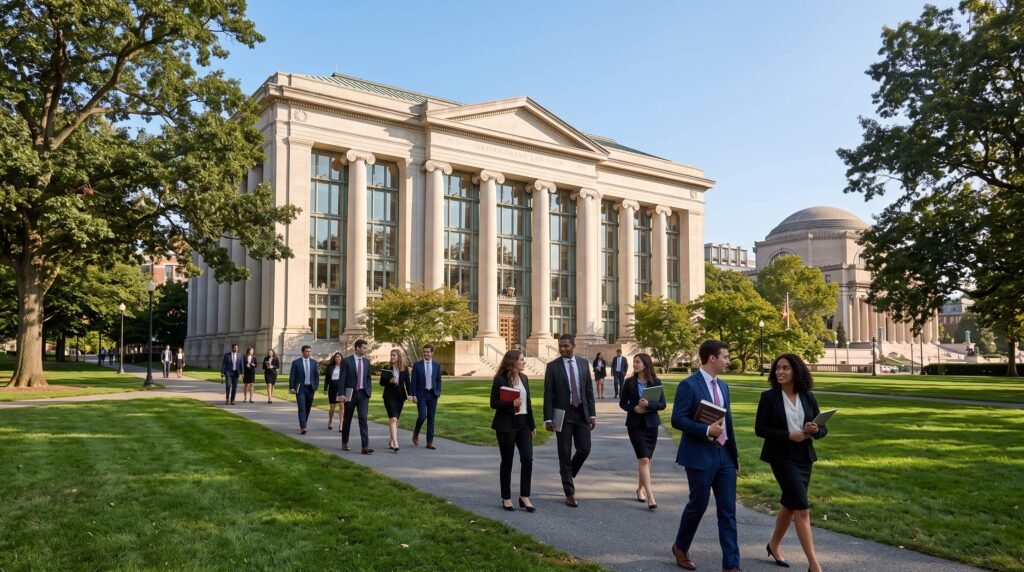
Every year, tens of thousands of aspiring lawyers apply to law schools across the United States. They come from every background and every corner of the globe, drawn by the promise of a profession that combines intellectual rigor, advocacy, and the opportunity to make a meaningful impact. But the path to a legal career in America is neither simple nor inexpensive.
In 2026, the landscape of legal education is more competitive and more complex than ever. Applications to law schools grew by 18% in 2025 and are up nearly 12% so far in 2026, according to SurePoint’s 2026 Law School Hiring Report. Median LSAT scores at top schools remain in the 170s, and total tuition at elite private institutions exceeds $200,000 for a three-year JD program.
At the same time, the return on investment for a law degree remains strong. Law graduates saw their average income rise from approximately $55,000 before enrollment to over $132,000 after completing their programs. First-year associates at elite law firms earn starting salaries of $225,000 or more, and the national median salary for the Class of 2025 reached a record high of $100,000.
The challenge is navigating the gap between aspiration and reality. Not all law schools offer the same opportunities. The school you attend affects your access to clerkships, BigLaw, government service, and public interest work. It affects your earning potential, your professional network, and the trajectory of your career for decades to come.
This guide is designed to help you make that decision with confidence. We will explore the best law schools in the USA for 2026, break down admission requirements in detail, compare tuition costs across institution types, and provide a comprehensive look at career outcomes and salary expectations. Whether you are targeting a T14 program or exploring more affordable regional options, this article gives you the information you need to invest wisely in your legal education.
Understanding Legal Education in the USA: Degrees and Pathways
Legal education in the United States operates on a graduate-level model. Unlike undergraduate law programs in many other countries, American legal education requires a bachelor’s degree before admission to law school. The primary law degree is the Juris Doctor (JD), which is required to sit for the bar exam in most states.
The Juris Doctor (JD)
The JD is a three-year, full-time graduate degree program. It is the standard credential for practicing law in the United States. The curriculum typically includes required courses in the first year — civil procedure, constitutional law, contracts, criminal law, legal writing, property, and torts — followed by electives and specialized courses in the second and third years.
Most JD programs require 88 to 90 credit hours for graduation. Students may also pursue joint degrees, such as a JD/MBA, JD/MPP, or JD/PhD, which add one or more years to the program.
Other Law Degrees
| Degree | Duration | Purpose | Who It Is For |
|---|---|---|---|
| JD (Juris Doctor) | 3 years | Practice law in the U.S. | Students pursuing a legal career |
| LLM (Master of Laws) | 1 year | Specialization or U.S. law training | Foreign-trained lawyers, JD holders seeking specialization |
| SJD (Doctor of Juridical Science) | 3+ years | Academic research and teaching | Scholars pursuing legal academia |
| JD/MBA | 4 years | Law and business | Students pursuing corporate law, entrepreneurship |
| JD/MPP or JD/MPA | 4 years | Law and public policy | Students pursuing government, policy, public interest |
Quick Fact: The JD is a professional doctorate, not a research doctorate. It is the required degree for bar admission in nearly all U.S. jurisdictions. The LLM is most commonly pursued by international lawyers who wish to practice in the United States or by JD holders seeking specialized expertise.
The Best Law Schools in the USA: 2026 Rankings
Several ranking systems evaluate law schools, each using different methodologies. U.S. News & World Report remains the most widely cited source, though its influence has declined in recent years as some schools have withdrawn from the rankings and as the methodology has been criticized. Other respected rankings include those from Above the Law, Vault, and the Social Science Research Network.
U.S. News & World Report 2026 Best Law Schools: Top 20
The 2026 U.S. News law school rankings delivered a historic shift. Stanford Law School claimed the No. 1 spot for the first time on its own, ending Yale Law School’s decades-long reign at the top. Yale dropped to No. 2, tied with the University of Chicago Law School, which moved up one spot.
The University of Pennsylvania Carey Law School and the University of Virginia School of Law tied at No. 4, while Harvard Law School held at No. 6. Among the top 20, Cornell Law School and Boston College Law School each made the biggest jumps, moving up five spots.
| Rank | Law School | University | Location |
|---|---|---|---|
| 1 | Stanford Law School | Stanford University | Stanford, CA |
| 2 (tie) | Yale Law School | Yale University | New Haven, CT |
| 2 (tie) | University of Chicago Law School | University of Chicago | Chicago, IL |
| 4 (tie) | University of Pennsylvania Carey Law School | University of Pennsylvania | Philadelphia, PA |
| 4 (tie) | University of Virginia School of Law | University of Virginia | Charlottesville, VA |
| 6 | Harvard Law School | Harvard University | Cambridge, MA |
| 7 (tie) | Duke University School of Law | Duke University | Durham, NC |
| 7 (tie) | New York University School of Law | New York University | New York, NY |
| 9 (tie) | Columbia Law School | Columbia University | New York, NY |
| 9 (tie) | Northwestern University Pritzker School of Law | Northwestern University | Chicago, IL |
| 9 (tie) | University of Michigan Law School | University of Michigan | Ann Arbor, MI |
| 12 | Vanderbilt University Law School | Vanderbilt University | Nashville, TN |
| 13 (tie) | Cornell Law School | Cornell University | Ithaca, NY |
| 13 (tie) | UCLA School of Law | University of California, Los Angeles | Los Angeles, CA |
| 13 (tie) | Washington University School of Law | Washington University in St. Louis | St. Louis, MO |
| 16 (tie) | UC Berkeley School of Law | University of California, Berkeley | Berkeley, CA |
| 16 (tie) | University of Texas School of Law | University of Texas at Austin | Austin, TX |
| 18 (tie) | Georgetown University Law Center | Georgetown University | Washington, DC |
| 18 (tie) | University of North Carolina School of Law | University of North Carolina at Chapel Hill | Chapel Hill, NC |
| 20 (tie) | Boston College Law School | Boston College | Newton, MA |
| 20 (tie) | Notre Dame Law School | University of Notre Dame | Notre Dame, IN |
The 2026 rankings also highlighted significant movement among lower-ranked schools. The University of Miami School of Law and the University of Louisville Brandeis School of Law each moved up 22 spots, to 70th and 124th place respectively. Meanwhile, Cleveland State University College of Law fell the most, down 15 slots to 136th place.
Important: The U.S. News rankings are based on 10 factors, including job outcomes 10 months after graduation (33%), bar passage rate (18%), peer assessment (12.5%), and lawyer/judge assessment (12.5%). They do not measure everything that matters — including faculty accessibility, clinical opportunities, or quality of life. Use them as one input among many.
The T14: A Closer Look
The “T14” refers to the 14 law schools that have historically occupied the top of the U.S. News rankings. The term was coined when U.S. News first began ranking law schools, and it has stuck even as the composition of the top 14 has shifted slightly over time.
The T14 law schools are widely regarded as the most prestigious in the country. They dominate BigLaw hiring, federal clerkship placements, and legal academia. For students who aspire to these outcomes, attending a T14 school provides a significant advantage.
| Law School | Median LSAT | Median GPA | Acceptance Rate | Annual Tuition (2026) |
|---|---|---|---|---|
| Stanford University | 173 | 3.96 | 6.1% | $79,707 |
| Yale University | 174 | 3.96 | 4.1% | $78,961 |
| University of Chicago | 174 | 3.97 | 9.7% | ~$77,000 |
| University of Pennsylvania | 173 | 3.95 | 8.1% | ~$76,000 |
| University of Virginia | 173 | 3.99 | 10.2% | ~$72,000 (in-state) / ~$78,000 (out-of-state) |
| Harvard University | 174 | 3.96 | 9.2% | $78,692 |
| New York University | 172 | 3.92 | 13.4% | ~$79,000 |
| Duke University | 171 | 3.91 | 12.9% | ~$75,000 |
| Columbia University | 173 | 3.92 | 11.8% | ~$80,000 |
| Northwestern University | 173 | 3.96 | 12.3% | ~$76,000 |
| University of Michigan | 171 | 3.88 | 8.6% | ~$68,000 (in-state) / ~$73,000 (out-of-state) |
| Vanderbilt University | 170 | 3.91 | 13.3% | ~$70,000 |
| Cornell University | 172 | 3.87 | 17.4% | ~$75,000 |
| UC Berkeley | 170 | 3.90 | ~12% | ~$68,000 (in-state) / ~$77,000 (out-of-state) |
What stands out in this table is the extraordinary selectivity of the T14. Median LSAT scores range from 170 to 174, placing admitted students in the top 1% to 3% of all test-takers. Median GPAs are in the 3.87 to 3.99 range, reflecting near-perfect undergraduate records.
Quick Fact: Yale Law School has the lowest acceptance rate of any law school in the country at 4.1%. Stanford follows at 6.1%. By contrast, the average acceptance rate across all ABA-accredited law schools is approximately 45%.
Law School Admission Requirements: What You Need to Get In
Admission to law school is competitive and holistic. Schools evaluate applicants on a combination of academic credentials, standardized test scores, personal statements, letters of recommendation, and work or leadership experience.
Academic Requirements: GPA
Your undergraduate GPA is one of the two most important quantitative factors in law school admissions. The other is your LSAT score. Together, they form an “index score” that many schools use to predict first-year law school performance.
Median GPAs at T14 schools range from 3.87 to 3.99. At other top-50 schools, median GPAs typically range from 3.5 to 3.8. For regional and lower-ranked schools, median GPAs may range from 3.0 to 3.5.
However, GPA is not evaluated in isolation. Admissions committees consider the rigor of your undergraduate institution, the difficulty of your major, and any upward or downward trends in your grades. A strong junior and senior year can partially offset a weaker freshman year. A graduate degree can also demonstrate academic capability.
Standardized Tests: LSAT and GRE
The Law School Admission Test (LSAT) is the most common standardized test for law school admission. It is administered by the Law School Admission Council (LSAC) and is offered multiple times per year. The test measures reading comprehension, analytical reasoning, and logical reasoning.
A growing number of law schools now accept the Graduate Record Examination (GRE) in lieu of the LSAT. However, the LSAT remains the preferred test for most schools, and some admissions committees may view the GRE less favorably because it is not designed specifically for law school.
| Section | Number of Questions | Time Allotted | What It Measures |
|---|---|---|---|
| Logical Reasoning (2 sections) | ~51 total | 35 minutes each | Ability to analyze arguments and identify assumptions |
| Reading Comprehension | ~27 | 35 minutes | Ability to read and understand complex texts |
| Unscored Experimental Section | ~23 | 35 minutes | Used for test development; not scored |
| Writing Sample | 1 prompt | 35 minutes | Argumentative writing; unscored but sent to schools |
LSAT scores range from 120 to 180. The median score across all test-takers is approximately 152. A score of 160 places you in the top 20% of test-takers. A score of 170 places you in the top 3%.
Pro Tip: If you are applying to T14 schools, aim for an LSAT score at or above the school’s median. A score within 2-3 points of the median is competitive, but a score at or above the median significantly improves your chances. If your GPA is below the median, a higher LSAT score can help compensate.
Application Components
In addition to GPA and test scores, law school applications typically include the following components:
- Personal Statement: A 2-3 page essay that introduces who you are, why you want to attend law school, and what you will contribute. This is your opportunity to stand out beyond your numbers.
- Letters of Recommendation: Typically 2-3 letters from professors, employers, or supervisors who can speak to your academic ability, work ethic, and character.
- Resume: A one-page document summarizing your education, work experience, extracurricular activities, and skills.
- Diversity Statement (Optional): Many schools offer the opportunity to describe how your background, identity, or experiences will contribute to the law school community.
- Addenda (Optional): Brief explanations of any anomalies in your application, such as a low GPA semester, a gap in employment, or a character and fitness issue.
Important: As of the 2025-2026 admissions cycle, Harvard Law School no longer accepts a single personal statement. Instead, it requires a Statement of Purpose (why law, why now, and why you) and a Statement of Perspective (how your background will shape your contributions at HLS and beyond). Other schools may have similar requirements. Always check each school’s specific instructions.
Application Deadlines
Most law schools use a rolling admissions process, meaning applications are reviewed as they are received. Applying early — ideally by November or December — can significantly improve your chances, as more seats and scholarship funds are available earlier in the cycle.
| Application Round | Typical Deadline | Notes |
|---|---|---|
| Early Decision | October – November | Binding commitment; best for applicants certain about their top choice |
| Regular Decision (Priority) | December – January | Best chance for admission and scholarships |
| Regular Decision (Final) | February – March | Seats and scholarship funds may be limited |
| Late Admission | April – June | Very competitive; limited seats |
Columbia Law School, for example, opened applications for the fall 2026 class on September 15, 2025, with a regular decision deadline of February 15, 2026. Early Decision applicants had to take the LSAT no later than October 2025.
Law School Tuition and Costs: How Much Does a JD Really Cost?
The cost of a law degree in the United States is substantial and continues to rise. Understanding the full cost of attendance — tuition, fees, living expenses, and opportunity cost — is essential for financial planning.
Average Law School Tuition (2026)
| Institution Type | Average Annual Tuition & Fees | Estimated Annual Cost of Attendance |
|---|---|---|
| Public Law Schools (In-State) | $32,314 | $57,350 |
| Public Law Schools (Out-of-State) | $45,901 | $70,938 |
| Private Law Schools | $59,171 | $88,681 |
These figures represent averages across all ABA-accredited law schools. At the top of the market, private law school tuition exceeds $78,000 per year, and total cost of attendance — including living expenses in high-cost cities like New York, Boston, or the Bay Area — can exceed $100,000 per year.
Tuition at Top Law Schools
The following table compares annual tuition and fees at selected top law schools for the 2026-2027 academic year.
| Law School | Annual Tuition | Estimated Total Annual Cost |
|---|---|---|
| Stanford University | $79,707 | ~$105,000+ |
| Yale University | $78,961 | ~$103,000+ |
| Harvard University | $78,692 | ~$102,000+ |
| Columbia University | ~$80,000 | ~$105,000+ |
| New York University | ~$79,000 | ~$100,000+ |
| University of Chicago | ~$77,000 | ~$98,000+ |
| University of Pennsylvania | ~$76,000 | ~$96,000+ |
| Duke University | ~$75,000 | ~$92,000+ |
| Cornell University | ~$75,000 | ~$90,000+ |
| University of Michigan (In-State) | ~$68,000 | ~$83,000+ |
| University of Michigan (Out-of-State) | ~$73,000 | ~$88,000+ |
| University of Virginia (In-State) | ~$72,000 | ~$85,000+ |
| University of Virginia (Out-of-State) | ~$78,000 | ~$91,000+ |
| UC Berkeley (In-State) | ~$68,000 | ~$88,000+ |
| UC Berkeley (Out-of-State) | ~$77,000 | ~$97,000+ |
Warning: The total cost of attendance figures include tuition, fees, living expenses, books, supplies, health insurance, and personal expenses. They do not include the opportunity cost of foregone income during the three years of law school. When evaluating the return on investment, factor in both the direct costs and the income you could have earned during those years.
Public vs. Private Law Schools: A Cost Comparison
Public law schools — particularly for in-state residents — offer significant cost savings compared to private institutions. The difference can amount to $25,000 or more per year in tuition alone, translating to $75,000 or more over three years.
| Category | Public In-State | Public Out-of-State | Private |
|---|---|---|---|
| Average Annual Tuition | $32,314 | $45,901 | $59,171 |
| 3-Year Tuition (Total) | ~$97,000 | ~$138,000 | ~$178,000 |
| Estimated 3-Year COA | ~$172,000 | ~$213,000 | ~$266,000 |
For students who are residents of a state with a strong public law school — such as the University of Michigan, UC Berkeley, the University of Virginia, or the University of Texas — the in-state option can provide excellent value. However, admission to these schools is competitive, and out-of-state students face higher tuition.
Funding and Scholarships
Despite the high sticker price, many law students receive scholarships and financial aid. Merit-based scholarships are the most common form of aid, awarded based on LSAT scores, GPA, and other factors. Need-based aid is also available at some schools, particularly those with generous endowments.
| Scholarship Type | Description | Typical Award Range |
|---|---|---|
| Merit-Based Scholarships | Awarded based on LSAT, GPA, and application strength | $10,000 – Full Tuition |
| Need-Based Aid | Awarded based on demonstrated financial need | Varies; some cover full need |
| Public Interest Scholarships | For students committed to public interest careers | Full Tuition + Stipend |
| Diversity Scholarships | For students from underrepresented backgrounds | $10,000 – Full Tuition |
| Named Fellowships | Donor-funded awards with specific criteria | Varies |
Yale Law School, for example, awarded 89 Hurst Horizon Scholarships for the 2026-27 academic year, covering full tuition for students from low-income families. UC Berkeley Law’s Public Interest Scholars program provides full tuition and fees for students committed to public interest careers. NYU School of Law’s Hauser Global Scholars program awards full-tuition scholarships and living stipends to 10 outstanding international LLM students each year.
Expert Tip: Merit scholarships at many law schools are negotiable. If you receive a scholarship offer from one school, you can use it to negotiate a better offer from another. Schools are competitive for top applicants, and a polite, professional request for reconsideration can yield significant additional funding.
Law School Curriculum and Specializations
The JD curriculum is designed to provide a foundation in legal reasoning and core doctrinal subjects, followed by opportunities for specialization. The first year is typically prescribed, while the second and third years offer significant flexibility.
The First-Year Curriculum
The first year of law school is rigorous and demanding. Students take a set of required courses that cover the foundational areas of law.
| Course | Credits | Description |
|---|---|---|
| Civil Procedure | 3-4 | Rules governing federal and state court litigation |
| Constitutional Law I | 3-4 | Structure of government, separation of powers, federalism |
| Contracts | 3-4 | Formation, interpretation, and enforcement of agreements |
| Criminal Law | 3-4 | Elements of crimes, defenses, and criminal responsibility |
| Legal Research & Writing | 2-4 | Research methods and legal writing skills |
| Property | 3-4 | Ownership, possession, and transfer of property |
| Torts | 3-4 | Civil wrongs and liability for harm |
Most first-year programs also include a legal writing and research component, often taught in small sections to ensure individualized feedback.
Upper-Level Curriculum and Specializations
In the second and third years, students choose from a wide range of elective courses and may pursue concentrations or certificates in specific areas. Common specializations include:
- Corporate and Commercial Law: Mergers and acquisitions, securities regulation, corporate governance, bankruptcy.
- Litigation and Dispute Resolution: Trial advocacy, evidence, negotiation, arbitration, mediation.
- Public Interest Law: Civil rights, environmental law, immigration, housing, criminal defense.
- Intellectual Property: Patent, trademark, copyright, technology licensing.
- International and Comparative Law: International trade, human rights, comparative constitutional law.
- Health Law: FDA regulation, bioethics, healthcare policy, medical malpractice.
- Tax Law: Corporate taxation, international tax, estate planning.
Clinical and Experiential Learning
Clinical legal education is a hallmark of American legal training. Law schools offer clinics where students represent real clients under the supervision of faculty, gaining hands-on experience in areas such as criminal defense, immigration, housing, and small business law.
Most schools also require or strongly encourage externships, where students work for judges, government agencies, or nonprofit organizations and receive academic credit. Moot court and trial advocacy programs offer opportunities to develop oral advocacy skills.
Pro Tip: When evaluating law schools, look beyond the rankings to the strength of the clinical program. For students interested in public interest law, a school with a robust clinical program and strong public interest career support may be a better fit than a higher-ranked school without those resources.
Career Opportunities After Law School
A law degree opens doors to a remarkably wide range of careers. While the traditional path of practicing law at a firm remains the most common, law graduates work in government, business, academia, nonprofits, and entrepreneurship.
Employment Outcomes: The NALP Data
The National Association for Law Placement (NALP) reports employment and salary data for law school graduates. According to the Class of 2025 findings, released in 2026, the employment outcomes were strong despite a challenging market.
- Overall Employment Rate: 92.8% (second highest in NALP history)
- Bar Admission Required/Anticipated Jobs: 84.6% (record high)
- Private Practice Employment: 60.9% of employed graduates
- Firms of 501+ Lawyers: 33.2% of law firm jobs
- Federal Clerkships: Continued to be highly competitive
The entry-level legal market contracted by approximately 2,700 jobs compared to the previous year, but the graduating class was also smaller, helping to offset the impact. Large law firms remain the dominant employer of new graduates, accounting for more than one in five employed graduates.
Salary Outcomes
Law school salaries are bimodal. A significant proportion of graduates earn moderate salaries in public interest, government, or small firms, while a smaller proportion earn exceptionally high salaries at large law firms.
| Employment Setting | Median Salary | Notes |
|---|---|---|
| All Graduates (National Median) | $100,000 | Record high for Class of 2025 |
| Firms of 1-10 Lawyers | $84,000 | Small firm practice |
| Firms of 501+ Lawyers | $225,000 | BigLaw starting salary |
| Public Interest | $60,000 – $75,000 | Varies widely by organization |
| Government | $60,000 – $85,000 | Varies by agency and location |
| Federal Clerkships | $70,000 – $80,000 | Prestigious; often leads to BigLaw or academia |
The bimodal distribution means that approximately 50% of graduates earn between $60,000 and $85,000, while around 23% earn between $215,000 and $225,000. The gap between these two groups reflects the difference between BigLaw and other employment settings.
Quick Fact: First-year associates at elite law firms earn around $225,000, while equity partners at major firms can earn nearly $1.9 million on average. The path to partnership is long and competitive, but the financial rewards at the top of the profession are substantial.
BigLaw Hiring: Which Schools Place the Most Graduates?
Large law firms — those with more than 500 lawyers — are the most sought-after employers for law school graduates, primarily because of their high salaries and the training they provide. However, BigLaw hiring is concentrated among a small number of schools.
Nineteen law schools produce only 16% of annual law school graduates but fill 53% of all pipeline positions at large firms, according to NALP data. This concentration means that attending a T14 or other highly ranked school significantly improves your chances of landing a BigLaw position.
The T14 law schools consistently place the highest percentage of graduates in BigLaw. Columbia, NYU, Harvard, and Penn typically have the highest BigLaw placement rates, with many schools sending 50% or more of their graduating classes to firms of 500+ lawyers.
Alternative Career Paths
Not all law graduates practice law. Many pursue careers in business, consulting, finance, technology, journalism, politics, and higher education. A law degree provides training in analytical reasoning, writing, and advocacy that is valuable in many fields.
- Management Consulting: Law graduates are recruited by firms like McKinsey, Bain, and BCG for their analytical and problem-solving skills.
- Investment Banking and Finance: Law graduates work in compliance, regulatory affairs, and investment roles.
- Technology and Entrepreneurship: Many law graduates start companies or work in product, policy, or legal roles at tech companies.
- Government and Politics: Law degrees are common among elected officials, policy advisors, and civil servants.
- Higher Education: Law graduates teach at law schools, colleges, and universities, often after earning an LLM or SJD.
Choosing the Right Law School: A Decision Framework
With nearly 200 ABA-accredited law schools in the United States, choosing the right one requires careful research and honest self-assessment. Here is a framework for making an informed decision.
1. Define Your Career Goals
Your career goals should drive your school selection. If you want to work at a large law firm, attending a school with strong BigLaw placement is essential. If you are committed to public interest law, look for schools with generous loan repayment assistance programs and strong clinical programs. If you want to practice in a specific region, attending a school in that region can give you a networking advantage.
2. Evaluate Employment Outcomes
Look beyond the overall employment rate to the types of jobs graduates obtain. What percentage of graduates get bar-required jobs? What percentage go to firms of 500+ lawyers? What is the median salary? These metrics tell you more about a school’s value than its ranking alone.
3. Calculate the Return on Investment
Law school is expensive, and the financial calculus matters. Compare the total cost of attendance (tuition plus living expenses) against your expected salary after graduation. A scholarship to a lower-ranked school may produce a better return on investment than paying full price at a higher-ranked one, especially if your career goals do not require the prestige of a T14 degree.
4. Visit and Connect with Students
Visit the campuses of your top choices if possible. Sit in on a class, talk to current students, and meet with career services staff. Ask about the culture, the competitiveness, the accessibility of faculty, and the quality of life in the surrounding area.
5. Consider Location
Where you go to law school often determines where you begin your legal career. Regional schools have strong networks in their home markets, while national schools like Harvard, Yale, and Stanford have alumni networks that span the country. If you know where you want to practice, consider attending school in that region.
6. Evaluate Financial Aid and Scholarships
Do not choose a school based on sticker price alone. Many schools offer substantial merit scholarships that can reduce your cost dramatically. Compare net cost after scholarships, and consider the terms and conditions of any aid you receive (some scholarships have GPA requirements for renewal).
Common Mistake: Choosing a law school based solely on its ranking. Rankings are a useful signal of reputation and employment outcomes, but they do not capture everything that matters — including culture, location, clinical opportunities, and financial fit. A school ranked 25th may be the perfect fit for your goals, while a school ranked 10th may leave you with debt that is difficult to manage.
Frequently Asked Questions
What is the best law school in the USA in 2026?
Stanford Law School is ranked No. 1 in the 2026 U.S. News & World Report rankings, followed by Yale Law School and the University of Chicago Law School in a tie for second. The University of Pennsylvania and the University of Virginia tied for fourth, and Harvard Law School ranked sixth.
What LSAT score do I need to get into a top law school?
Median LSAT scores at T14 schools range from 170 to 174. A score of 170 or above is generally competitive for top-14 schools, while a score of 173 or above is competitive for the very top programs. For other top-50 schools, median LSAT scores typically range from 160 to 168.
How much does law school cost in the USA?
Average annual tuition is $32,314 for in-state students at public law schools, $45,901 for out-of-state students at public law schools, and $59,171 for private law schools. Total cost of attendance, including living expenses, ranges from approximately $57,000 to over $105,000 per year depending on the school and location.
Do I need to take the LSAT or can I take the GRE?
Most law schools require the LSAT, though a growing number accept the GRE. However, the LSAT remains the preferred test for most admissions committees. If you have a strong GRE score and a compelling reason not to take the LSAT, check the specific policies of your target schools.
What is the T14 and why does it matter?
The T14 refers to the 14 law schools that have historically been ranked at the top by U.S. News & World Report. These schools dominate BigLaw hiring, federal clerkships, and legal academia. Attending a T14 school provides significant advantages in the job market, but it is not the only path to a successful legal career.
Can I get a scholarship to law school?
Yes. Many law schools offer merit-based scholarships based on LSAT scores, GPA, and other factors. Need-based aid is also available at some schools. Scholarship awards can range from partial tuition to full tuition. It is common to negotiate scholarship offers between schools.
How competitive is law school admission?
Admission to top law schools is highly competitive. Acceptance rates at T14 schools range from 4% to 17%. The average acceptance rate across all ABA-accredited schools is approximately 45%. A strong GPA, a high LSAT score, compelling essays, and strong letters of recommendation are essential for admission to top programs.
What can I do with a law degree besides practice law?
Law graduates pursue careers in management consulting, investment banking, technology, government, politics, journalism, higher education, and entrepreneurship. The analytical, writing, and advocacy skills developed in law school are valuable in many fields.
How long does law school take?
A full-time JD program takes three years to complete. Part-time programs typically take four years. Joint degree programs, such as a JD/MBA or JD/MPP, take four years.
What is the employment rate for law school graduates?
The overall employment rate for the Class of 2025 was 92.8%, with 84.6% securing jobs for which bar admission is required or anticipated. The national median salary for the Class of 2025 was $100,000.
Are there law schools that do not require the LSAT?
A small number of law schools have experimented with admitting students without the LSAT or GRE, but this remains rare. Most ABA-accredited schools require a standardized test score for admission. Some schools offer test waivers in limited circumstances.
What is the best law school for public interest law?
There is no single best school for public interest law. Schools with strong public interest programs and generous loan repayment assistance include Yale, Harvard, NYU, UC Berkeley, and Georgetown. The key is to look for schools with robust clinical programs, public interest career support, and loan repayment assistance programs (LRAPs).
How do I write a strong law school personal statement?
A strong personal statement tells a compelling story about who you are, why you want to attend law school, and what you will contribute. Choose a narrow topic, be authentic, write clearly and concisely, and revise multiple times. Get feedback from mentors, advisors, or current law students.
Key Takeaways
- Stanford Law School is ranked No. 1 in the 2026 U.S. News rankings, followed by Yale and the University of Chicago in a tie for second.
- Median LSAT scores at T14 schools range from 170 to 174; median GPAs range from 3.87 to 3.99.
- Average annual tuition is $32,314 for in-state public law schools, $45,901 for out-of-state public schools, and $59,171 for private law schools.
- The employment rate for the Class of 2025 was 92.8%, with 84.6% securing bar-required jobs.
- The national median salary for law graduates reached a record high of $100,000, with a bimodal distribution: 50% earn $60,000-$85,000, while 23% earn $215,000-$225,000.
- BigLaw hiring is concentrated among a small number of schools: 19 schools fill 53% of pipeline positions at large firms.
- Merit-based scholarships are widely available and can be negotiated between schools.
- The T14 designation matters for BigLaw, federal clerkships, and legal academia, but strong careers are possible from a wide range of schools.
- Choosing the right law school requires balancing career goals, employment outcomes, cost, location, and financial aid.
- The legal job market remains strong, though it is evolving with shifts in BigLaw hiring and growth in alternative legal careers.
Conclusion
The best law schools in the United States offer exceptional training, powerful networks, and pathways to some of the most rewarding careers in the profession. But the decision of where to attend — and whether to attend at all — is deeply personal and requires careful consideration of your goals, your finances, and your values.
The 2026 rankings confirm what many have long known: Stanford, Yale, Chicago, and the other T14 schools remain the most prestigious and most selective programs in the country. Their graduates dominate BigLaw, federal clerkships, and legal academia. But these schools are not the only path to a successful legal career.
Regional law schools, public universities, and schools with strong clinical or public interest programs produce excellent lawyers who serve their communities, build successful practices, and make meaningful contributions to the profession. The key is to find the school that aligns with your goals and provides the best return on your investment of time, money, and effort.
As you research schools, look beyond the rankings. Examine employment outcomes. Talk to current students and alumni. Visit campuses. Calculate your net cost after scholarships. And be honest with yourself about what you want from your career and your life.
The legal profession is challenging, competitive, and demanding. But it is also intellectually stimulating, financially rewarding, and profoundly impactful. The right law school can help you build the career you envision. The time to start planning is now.