The boundary between classical computational modeling and physical reality is dissolving rapidly. As traditional silicon architectures approach thermodynamic and quantum tunneling limits, the demand for entirely new paradigms of information processing has shifted from theoretical physics departments into mainstream computational engineering.
Arizona State University has positioned itself at the epicenter of this technological renaissance. Through massive strategic investments, nationwide research consortia, and cross-disciplinary academic programs, the university is systematically dismantling the traditional silos separating artificial intelligence, quantum information science, and undergraduate education.
For prospective and current students, this institutional commitment translates into an unprecedented ecosystem of laboratory access, industry apprenticeships, and funded investigative pathways. Whether developing fault-tolerant quantum algorithms or training neuromorphic machine learning models, students at Arizona State University are no longer merely passive consumers of technological theory; they are active architects of the post-silicon era.
The Convergence of Intelligence and Physics: The New Computational Horizon
Modern computational science faces a dual challenge. On one front, complex machine learning systems require astronomical volumes of electrical power and mathematical operations to optimize billions of scalar weights. On the other front, nanoscale device fabrication confronts the fundamental quantum limits of classical semiconductor materials.
The resolution to these twin bottlenecks lies in the convergence of machine intelligence and quantum computing. Rather than treating artificial intelligence and quantum hardware as isolated disciplines, researchers increasingly leverage quantum mechanical phenomena—such as superposition, entanglement, and quantum interference—to accelerate complex mathematical optimization.
Simultaneously, advanced machine learning architectures are deployed to stabilize fragile quantum hardware. Neural networks actively detect phase drift, calibrate superconducting circuits, and optimize quantum error correction codes faster than human laboratory technicians ever could.
Quick Fact: Quantum machine learning (QML) combines the feature-mapping power of Hilbert-space quantum states with the optimization algorithms of deep learning, offering exponential speedups for specialized chemical, financial, and logistical simulations.
This technological intersection is fundamentally redefining what constitutes computational literacy in higher education. Students entering the workforce over the next two decades must understand both the probabilistic calculus of neural network optimization and the linear algebraic mechanics of quantum state vectors.
Arizona State University has recognized that preparing students for this transition requires moving cutting-edge experimental platforms out of classified corporate facilities directly into undergraduate and graduate instructional environments.
| Computational Dimension | Classical Artificial Intelligence | Quantum Information Systems | Convergent Quantum-AI Systems |
| Core Information Unit | Binary Bit (0 or 1) | Quantum Bit / Qubit (|0⟩, |1⟩, or Superposition) | Hybrid Quantum-Classical Parameterized States |
| Primary Mathematical Framework | Nonlinear Multivariable Calculus & Matrix Algebra | Complex Vector Spaces & Unitary Transformations | Quantum Hilbert Space Kernel Embeddings |
| Optimization Mechanism | Stochastic Gradient Descent & Backpropagation | Quantum Annealing & Variational Quantum Eigensolvers | Hybrid Feedback Loops (Classical Optimizer + Quantum Circuit) |
| Dominant Hardware Platform | High-Density GPUs, TPUs, & Neuromorphic ASICs | Superconducting Circuits, Trapped Ions, & Neutral Atoms | Co-located Cryogenic QPUs Integrated with Classical Clusters |
| Primary Engineering Barrier | Thermal Dissipation & Memory Bandwidth Bottlenecks | Quantum Decoherence & High Gate Error Rates | Low-Latency Control Electronics & Cryogenic Interconnects |
The ASU Quantum Collaborative: A National Framework for Discovery
At the center of Arizona State University’s quantum research footprint is the Quantum Collaborative. Established as an agile, multi-institutional alliance, this initiative brings together academic research universities, national laboratories, and leading private-sector hardware developers under a unified operational umbrella.
Unlike traditional academic consortia that prioritize abstract theoretical publications, the Quantum Collaborative focuses heavily on workforce democratization, technology translation, and open-access infrastructure. It ensures that students across diverse socioeconomic and academic backgrounds gain direct operational access to commercial-grade quantum processors.
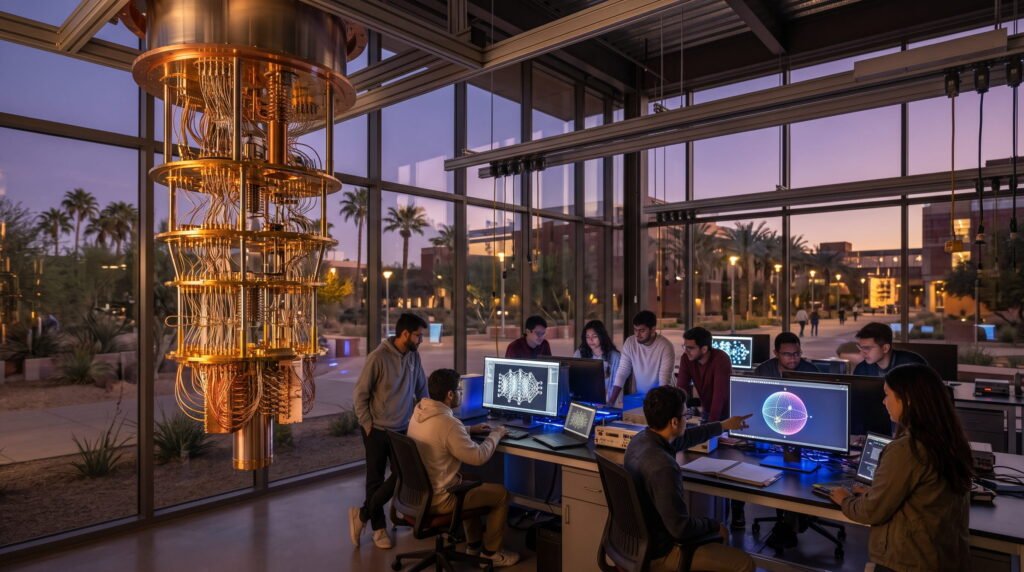
Through strategic partnerships with quantum hardware pioneers—including IBM, Quantinuum, and regional technology leaders—the initiative provides students with real-time access to cloud-accessible quantum computing clusters. Undergraduates write algorithms in Python-based environments and execute them on physical superconducting systems located across the nation.
Important: Access to physical quantum hardware via the Quantum Collaborative is not reserved exclusively for post-doctoral researchers. Undergraduates enrolled in introductory quantum engineering courses routinely execute custom circuits on live quantum hardware.
The Collaborative also plays an instrumental role in bridging academia and government policy. As federal investments from the National Quantum Initiative Act and the CHIPS and Science Act flow into regional economies, Arizona State University acts as a primary workforce development hub for the emerging Southwest semiconductor and quantum corridor.
This operational model guarantees that student research remains tightly coupled to the technical roadmaps of industrial leaders, transforming laboratory discoveries into commercial reality.
High-Performance Classical Infrastructure: The Sol Supercomputing Cluster
Cutting-edge artificial intelligence and hybrid quantum simulation cannot function without massive classical supercomputing power. Simulating a modest forty-qubit quantum system requires terabytes of random-access memory and petaflops of continuous double-precision floating-point performance.
To support this intense computational workload, Arizona State University deployed “Sol,” a flagship high-performance computing (HPC) cluster managed by ASU Research Computing. Engineered specifically to handle intensive data analytics, neural architecture search, and quantum circuit state-vector emulation, Sol provides students with industrial-tier computing muscle.
Equipped with thousands of high-end graphical processing units (GPUs) and interconnected via ultra-low-latency InfiniBand networking, the Sol cluster allows student researchers to train foundation models, run molecular dynamics simulations, and simulate noise models for fault-tolerant quantum error correction.
Pro Tip: Any enrolled student conducting sponsored or faculty-guided research can request an allocation on the Sol supercomputing cluster. Taking the free Research Computing workshop series dramatically accelerates your project onboarding time.
The availability of Sol eliminates the compute barriers that traditionally constrain student-led experimentation. A student team competing in international autonomous systems competitions or training custom reinforcement learning models can scale their training runs across distributed GPU nodes with zero personal hardware expenditure.
Furthermore, Sol serves as the classical co-processor in hybrid variational algorithms. In these architectures, classical algorithms executed on Sol optimize parameters, while quantum routines run on networked hardware, demonstrating the exact workflows modern technology companies use in production.
Key Academic Units and Research Centers Leading the Charge
The institutional engine driving these developments spans several schools and specialized institutes across the university’s campuses. Foremost among them is the Ira A. Fulton Schools of Engineering, the largest and most comprehensive engineering enterprise in the United States.
Within the Fulton Schools, two primary academic units cultivate the technical talent driving computational advancements: the School of Computing and Augmented Intelligence (SCAI) and the School of Electrical, Computer and Energy Engineering (ECEE). Each school tackles the computing continuum from complementary physical and algorithmic perspectives.
Complementing the engineering schools are university-wide interdisciplinary research centers that apply computational breakthroughs to pressing global challenges:
- The Biodesign Institute: Researchers here deploy machine learning models and structural prediction algorithms to decode viral genomics, synthesize novel enzymes, and simulate cellular mechanics.
- The Center for Quantum Technologies (CQT): An interdisciplinary hub bringing together physicists, materials scientists, and electrical engineers to design robust solid-state qubits and quantum sensing devices.
- Southwest Advanced Prototyping (SWAP) Hub: A major Department of Defense microelectronics initiative led by ASU that directly connects semiconductor microfabrication, artificial intelligence chip design, and student technician training.
- Global Futures Laboratory: Scientists utilize advanced predictive models and complex computational simulations to evaluate planetary-scale climate interventions, water preservation strategies, and urban heat island mitigation.
| Institution / Center | Primary Research Domain | Core Equipment & Facilities | Primary Student Entry Pathways |
| School of Computing & Augmented Intelligence (SCAI) | Reinforcement Learning, Foundation Models, Quantum Algorithms | Sol Supercomputing Cluster, Cloud QPU Workstations | CS/CSE Capstones, FURI Fellowships, Graduate Seminars |
| School of Electrical, Computer & Energy Eng. (ECEE) | Neuromorphic Hardware, Quantum Photonics, Cryoelectronics | NanoFab Cleanrooms, RF & Microwave Test Laboratories | Undergraduate Laboratory Assistantships, Honors Theses |
| The Biodesign Institute | Biomolecular Simulation, AI Drug Discovery, Synthetic Biology | Cryo-EM Suites, High-Throughput Robotic Screening Platforms | Biodesign Discovery Programs, Interdisciplinary Internships |
| Center for Quantum Technologies | Solid-State Qubits, Quantum Communications, Cryptography | Dilution Refrigerators, Optical Table Laser Interconnects | Physics REU Programs, Master’s Applied Projects |
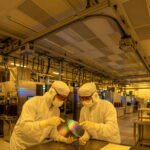
| SWAP Microelectronics Hub | Advanced Packaging, AI Edge Chips, Heterogeneous Integration | Class 10/100 Microfabrication Cleanrooms, Metrology Labs | DoD Microelectronics Fellowships, Cooperative Work Terms |
Undergraduate Research Pathways: From Enrollment to Publication
A chronic limitation of legacy higher education is the relegation of original investigative research to post-graduate studies. Arizona State University has deliberately inverted this model through institutionalized funding mechanisms designed specifically for early-stage undergraduates.
The premier vehicle for engineering undergraduates is the Fulton Undergraduate Research Initiative (FURI). Through FURI, students design their own independent research proposals under the direct mentorship of a tenured or tenure-track faculty member.
Accepted students receive a competitive financial stipend, dedicated research supply budgets, and a structured semester-long curriculum covering experimental methodology, technical writing, and scientific presentation. The program culminates in a public research symposium where students present their findings to corporate recruiters and academic peers.
Expert Tip: When submitting a FURI proposal in emerging fields like machine learning or quantum algorithms, avoid broad speculative claims. Focus on a tightly bounded, reproducible experimental hypothesis with measurable milestones that can be completed within a single semester.
For students in non-engineering disciplines, comparable pathways exist through the Master’s Opportunity for Research in Engineering (MORE) and university-wide initiatives overseen by the Barrett Honors College. Barrett students frequently complete comprehensive creative projects and original research theses in artificial intelligence and quantum physics, often resulting in peer-reviewed journal publications before graduation.
Furthermore, the Grand Challenge Scholars Program (GCSP)—endorsed by the National Academy of Engineering—challenges undergraduates to combine cutting-edge artificial intelligence research with entrepreneurship, global perspectives, and service learning.
Venture Creation and Technology Commercialization: Venture Devils
Scientific discovery without a mechanism for societal deployment often remains trapped in academic journals. To ensure student-developed computational breakthroughs reach the marketplace, Arizona State University operates “Venture Devils,” an elite entrepreneurial support apparatus managed by the J. Orin Edson Entrepreneurship + Innovation Institute.
Venture Devils pairs student, faculty, and alumni founders with seasoned enterprise mentors who have built, scaled, and exited major technology enterprises. Student teams developing proprietary algorithms, quantum software libraries, or specialized hardware controllers receive intense incubation support.
Through bi-annual funding tracks, student ventures compete for non-dilutive grant funding awarded through competitive pitch competitions. These specialized tracks provide tens of thousands of dollars in early-stage capital without taking equity from student founders.
Quick Fact: Multiple student-founded startups originating from university computer science and physics laboratories have secured federal Small Business Innovation Research (SBIR) Phase I and Phase II awards to develop commercial quantum encryption and autonomous edge-computing platforms.
The entrepreneurial ecosystem provides direct support across the full commercialization lifecycle:
- Intellectual Property Guidance: Skysong Innovations—the university’s technology transfer enterprise—assists student inventors in conducting patent searches, drafting provisional patent applications, and navigating software copyright laws.
- Direct Investor Introductions: High-performing student startups pitch directly to regional venture capital networks, angel syndicates, and corporate venture arms specializing in deep-tech investments.
- Physical Co-Working Infrastructure: Founders receive access to modern design spaces, rapid prototyping fabrication laboratories, and meeting suites across the university’s regional innovation campuses.
- Legal and Corporate Structuring: Student entrepreneurs receive pro-bono guidance on corporate formation, equity allocation, and founder agreements from specialized legal clinics.
Curriculum Architecture: Degrees, Minors, and Specialized Concentrations
To match its physical research infrastructure, Arizona State University has modernized its degree curricula to incorporate modern computing realities. Rather than isolating quantum physics in pure science departments and artificial intelligence in software engineering, the university offers cross-disciplinary degree tracks.
Undergraduate students pursuing a Bachelor of Science in Computer Science can select specialized concentrations in software engineering, artificial intelligence, or cybersecurity. Electrical Engineering majors can specialize in microelectronics, photonics, and solid-state hardware systems directly applicable to quantum device manufacturing.
For students seeking explicit quantum literacy, targeted coursework bridges physical chemistry, advanced calculus, linear algebra, and software implementation.
| Course Code & Title | Core Computational Concepts Covered | Laboratory / Practical Component | Prerequisites / Target Level |
| CSE 471: Introduction to Artificial Intelligence | State-Space Search, Probabilistic Reasoning, Game Theory, Logic | Python-based search algorithms and heuristic agents | Upper-Division Computer Science Core |
| CSE 475: Foundations of Machine Learning | Supervised/Unsupervised Learning, Neural Nets, Kernels | Model training and validation on large empirical datasets | Linear Algebra, Multivariate Calculus, Python |
| EEE 498: Quantum Information & Computing | Qubits, Density Matrices, Quantum Gates, Shor’s Algorithm | Cloud execution of quantum circuits on superconducting QPUs | Differential Equations, Advanced Linear Algebra |
| PHY 314: Quantum Physics I & II | Wave Mechanics, Schrödinger Equation, Angular Momentum | Mathematical modeling of potential wells and harmonic oscillators | Modern Physics, Vector Calculus |
| CSE 576: Topics in Natural Language Processing | Transformer Architectures, Attention Mechanisms, Tokenization | Building and fine-tuning distributed transformer models | Graduate Standing or Advanced Senior Standing |
| EEE 598: Quantum Materials & Devices | Topological Insulators, Superconductivity, Cryogenic Metrology | Physical cleanroom microfabrication of Josephson junctions | Solid State Devices, Graduate Engineering Standing |
In addition to traditional degree programs, the university offers micro-credentials and executive education certificates through digital learning platforms. These modular credentials allow working professionals, military veterans, and traditional students to demonstrate specialized competencies in quantum cryptography, applied machine learning, and neuromorphic engineering.
Real-World Research Domains: How Students Impact Critical Industries
The applications explored in university laboratories address immediate national security, industrial, and ecological imperatives. Student researchers do not work on synthetic textbook exercises; they tackle unresolved scientific frontiers funded by federal agencies and global enterprises.
In cybersecurity, the looming transition to quantum-capable adversaries threatens modern public-key cryptography. Students working in institutional security labs are testing post-quantum cryptographic (PQC) standards, deploying lattice-based encryption algorithms to protect municipal water infrastructure, telecommunications, and defense communication networks.
In materials science and clean energy, students utilize machine learning models to predict the crystal structures of novel perovskites for next-generation solar cells. By filtering vast combinatorial chemistry search spaces through neural surrogate models, discovery timelines that once took decades are condensed into weeks.
Pro Tip: Look for research opportunities that interface with the Phoenix biomedical sector. Applying predictive computational models to clinical oncology datasets at the Mayo Clinic and Phoenix Children’s Hospital offers incredible career differentiation for bio-computational students.
Other active student-driven research domains include:
- Autonomous Systems and Robotics: Training robust computer vision and path-planning algorithms capable of operating in degraded desert environments with zero GPS connectivity.
- Neuromorphic Computing: Designing physical spiking neural network architectures that mimic the human brain’s ultra-low power consumption for spaceborne planetary exploration probes.
- Supply Chain and Logistics Optimization: Formulating complex routing problems as quadratic unconstrained binary optimization (QUBO) problems for solution on quantum annealers.
- Genomic Epidemiology: Deploying deep learning architectures to trace viral mutations and anticipate cross-species pathogen spillover events in real time.
Navigating Challenges: Academic Rigor, Prerequisites, and Lab Placement
Breaking into deep-tech fields requires deliberate preparation and intellectual resilience. The mathematical prerequisites for quantum computing and advanced machine learning can feel intimidating to early-stage students who have not yet navigated advanced university mathematics.
Quantum information science demands absolute fluency in complex linear algebra, probability theory, differential equations, and classical mechanics. Artificial intelligence similarly demands mastery of multivariable calculus, optimization theory, and discrete mathematics.
Students who attempt to dive into advanced research without solidifying these mathematical fundamentals often experience frustration when debugging abstract algorithms or interpreting noisy experimental data.
Common Mistake: Waiting until your senior year to seek laboratory placement is a critical error. Faculty laboratories operate on long project lifecycles; securing an entry-level position as a sophomore allows you to master lab protocols and earn co-authorship on major papers before applying to graduate school or industry jobs.
Securing a spot in a premier research group requires a systematic, professional approach. Professors receive dozens of generic inquiry emails every week. To stand out, prospective undergraduate researchers must demonstrate clear intellectual engagement with the lab’s specific published work.
Follow this proven progression when seeking a faculty laboratory placement:
- Read Recent Publications: Carefully read three of the professor’s most recent journal articles. Take detailed notes on their methodology and the computational bottlenecks they encountered.
- Build a Reproducible Portfolio: Implement a small-scale prototype or reproduce a published algorithm on your personal GitHub account. Show that you can write clean, documented, reproducible code.
- Draft a Targeted Inquiry: Write a concise, three-paragraph email explaining precisely which aspect of their ongoing research interests you, what technical skills you bring (e.g., C++, Python, PyTorch, Qiskit), and how many hours per week you can commit.
- Attend Departmental Colloquia: Attend weekly school seminars and guest lectures. Introduce yourself to graduate students and post-docs who often serve as direct day-to-day supervisors in active labs.
Warning: Never send identical copy-pasted emails to multiple faculty members within the same department. Faculty members collaborate frequently, and mass-unsolicited emails will quickly disqualify you from serious consideration.
Industry Career Pipelines and Corporate Co-Ops
The ultimate metric of an institution’s research strength is the professional placement of its graduates. The Phoenix metropolitan area—often referred to as the “Silicon Desert”—has become one of the premier semiconductor, microelectronics, and advanced manufacturing epicenters in North America.
Major investments by semiconductor manufacturers, defense contractors, and technology leaders have created an insatiable demand for engineers who possess computational skills alongside physical hardware literacy. Arizona State University students are recruited directly out of campus laboratories by global technology enterprises.
Through structured cooperative education (Co-Op) programs, students alternate academic semesters with full-time paid engineering positions at leading hardware, aerospace, and software organizations. These experiences provide students with real-world engineering accountability while maintaining continuous progress toward their degrees.
| Target Career Trajectory | Primary Industry Sectors | Essential Technical Skillsets Required | Average Early-Career Compensation Range |
| Quantum Algorithm Engineer | Defense, Banking, Chemical Discovery | Qiskit, Cirq, Complex Linear Algebra, C++, Hamiltonian Simulation | $125,000 – $165,000 |
| Machine Learning Operations (MLOps) | Enterprise SaaS, Autonomous Vehicles, Cloud Tech | Docker, Kubernetes, PyTorch, Distributed Training, CI/CD Pipelines | $115,000 – $155,000 |
| Cryogenic Hardware Engineer | Quantum Hardware, Space Systems, Defense | Microwave Engineering, Dilution Refrigeration, Cleanroom Fabrication | $110,000 – $145,000 |
| Post-Quantum Security Specialist | Federal Agencies, Telecommunications, Fintech | Lattice Cryptography, Network Protocols, C, Assembly, Security Auditing | $120,000 – $160,000 |
| Semiconductor Process Engineer | Microchip Fabrication, Advanced Packaging | Photolithography, Chemical Vapor Deposition, Metrology, Statistical Process Control | $95,000 – $130,000 |
Graduates seeking academic and pure-research careers consistently earn admission to top-tier doctoral programs at institutions like MIT, Stanford, Caltech, and Oxford, or transition directly into civilian scientific roles at national facilities like Sandia, Los Alamos, and Oak Ridge National Laboratories.
Student Organizations, Hackathons, and Peer Innovation
Beyond formal classrooms and faculty-led laboratories, a massive percentage of technical skill acquisition at Arizona State University happens within self-directed student communities. Student organizations provide a low-stakes, collaborative arena where peers mentor one another, construct ambitious open-source projects, and prepare for international technical competitions.
Organizations such as the Software Developers Association (SoDA), the Artificial Intelligence Club, and emerging quantum computing student interest groups host weekly workshops, technical code reviews, and industry speaker panels. These events demystify cutting-edge tools and connect underclassmen with accomplished upperclassmen who have completed prestigious national laboratory fellowships.
A flagship highlight of the academic year is SunHacks, the university’s premier student-run hackathon. Over thirty-six continuous hours, hundreds of collegiate developers, designers, and hardware tinkerers converge to build working prototypes addressing societal problems.
Pro Tip: Major tech companies use collegiate hackathons as primary recruiting venues. Entering a hackathon track focused on quantum circuits or specialized machine learning models is an exceptional way to get your resume directly in front of technical engineering directors.
In addition to local hackathons, student teams regularly compete in prestigious global competitions, including the IBM Quantum Developer Challenge, international Autonomous Vehicle challenges, and Kaggle competitive machine learning circuits. These extracurricular triumphs build personal agency, leadership capabilities, and peer-to-peer technical networks that endure throughout students’ careers.
Frequently Asked Questions
Can first-year undergraduate students join research labs working on artificial intelligence or quantum computing?
Yes. Arizona State University encourages early undergraduate involvement. First-year students with strong programming foundations and disciplined study habits can secure volunteer or shadow positions in faculty laboratories, subsequently applying for formal funding through programs like the Fulton Undergraduate Research Initiative (FURI) once they establish their academic credentials.
Do I need an advanced degree in physics to work on quantum computing research?
No. Quantum computing is inherently cross-disciplinary. Modern quantum teams require software developers to write error-mitigation compilers, electrical engineers to design high-frequency microwave control lines, materials scientists to engineer higher-coherence substrate materials, and mathematicians to optimize algorithmic gate structures.
What physical quantum computing hardware can students access at Arizona State University?
Through the Quantum Collaborative and institutional academic programs, students access commercial-grade superconducting quantum processors via cloud interfaces provided by partners such as IBM and Quantinuum. Additionally, experimental laboratories across the Fulton Schools and the Department of Physics operate physical cryostats, lasers, and dilution refrigerators for device-level characterization.
How does the Sol supercomputer support student researchers?
Sol provides thousands of enterprise-grade GPUs, extensive high-speed storage, and high-memory computing nodes. Students conducting faculty-guided research can request free computing allocations to train complex machine learning models, simulate quantum circuits, and process high-throughput experimental datasets without needing expensive personal hardware.
What are the primary programming languages taught for these fields at ASU?
Python serves as the universal lingua franca across both artificial intelligence and quantum computing, utilizing core libraries such as PyTorch, TensorFlow, NumPy, and Qiskit. For performance-critical hardware drivers, high-speed simulations, and low-level embedded systems, students extensively use C++, C, and Rust.
Are there dedicated scholarships or paid research positions for engineering students?
Yes. The Fulton Undergraduate Research Initiative (FURI) provides a substantial paid semester stipend alongside dedicated research supply funding. Additionally, numerous federal research grants from the National Science Foundation (NSF), Department of Energy (DOE), and Department of Defense (DoD) provide hourly wages for student laboratory assistants and full graduate research assistantships (GRAs).
How does the Southwest Advanced Prototyping (SWAP) Hub benefit undergraduate and graduate students?
The SWAP Hub directly integrates university laboratories with the national semiconductor and microelectronics industrial base. Students gain direct practical experience in state-of-the-art cleanroom fabrication, microelectronic packaging, and hardware-level cybersecurity, creating direct hiring pipelines into leading aerospace, defense, and semiconductor corporations.
What is the difference between computer science and electrical engineering pathways in quantum research?
Computer science pathways generally concentrate on quantum algorithms, complexity theory, software compilers, error-correcting codes, and quantum machine learning. Electrical engineering pathways focus on physical hardware, including microwave control electronics, solid-state device physics, quantum photonics, cryoelectronics, and microchip fabrication.
Can students commercialize algorithms or intellectual property they develop in university labs?
Yes. Through the J. Orin Edson Entrepreneurship + Innovation Institute and Venture Devils, student inventors receive structured mentorship, venture funding competitions, and legal support. Skysong Innovations works closely with student founders to establish licensing agreements and spin out successful deep-tech corporate enterprises.
How do I prepare mathematically in high school or early college for quantum computing?
Prioritize rigorous linear algebra above all else; vector spaces, matrix transformations, eigenvalues, eigenvectors, and inner products form the mathematical language of quantum states. Additionally, master multivariable calculus, probability theory, discrete mathematics, and differential equations.
What resources exist for students from non-engineering majors who want to learn artificial intelligence?
The university offers interdisciplinary certificates, introductory computational minors, and open workshops through the ASU Library Makerspace and Research Computing. These programs teach practical Python programming, basic data science pipelines, and applied machine learning principles to students across the humanities, business, and social sciences.
What role does Barrett, The Honors College play in computing research?
Barrett provides honors students with dedicated research travel grants, specialized honors seminars led by senior research faculty, and the structure to complete a formal Honors Thesis. This thesis project serves as a cornerstone research portfolio piece, demonstrating graduate-level investigative capability to prospective employers and admissions committees.
The Path Forward: Engineering the Next Computational Century
The rapid acceleration of computational capability is redefining the frontiers of human civilization. From synthesizing climate-resilient agricultural molecules to safeguarding national communication networks against asymmetric cyber warfare, the challenges of our century demand computational frameworks that transcend classical limits.
Arizona State University has demonstrated that an elite research enterprise can thrive within an ethos of radical accessibility. By opening multimillion-dollar laboratory facilities, state-of-the-art supercomputing clusters, and live quantum processing units to undergraduate and graduate scholars alike, the university has constructed a vibrant engine of inclusive innovation.
For the aspiring computer scientist, electrical engineer, or applied physicist, the message is unequivocal: the tools necessary to build the future are here. Success requires intellectual curiosity, rigorous mathematical discipline, and the willingness to step out of the lecture hall and into the research laboratory.
By seizing these institutional opportunities, students at Arizona State University are not just studying the future of computing—they are actively writing its code.