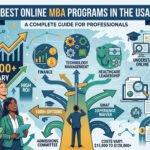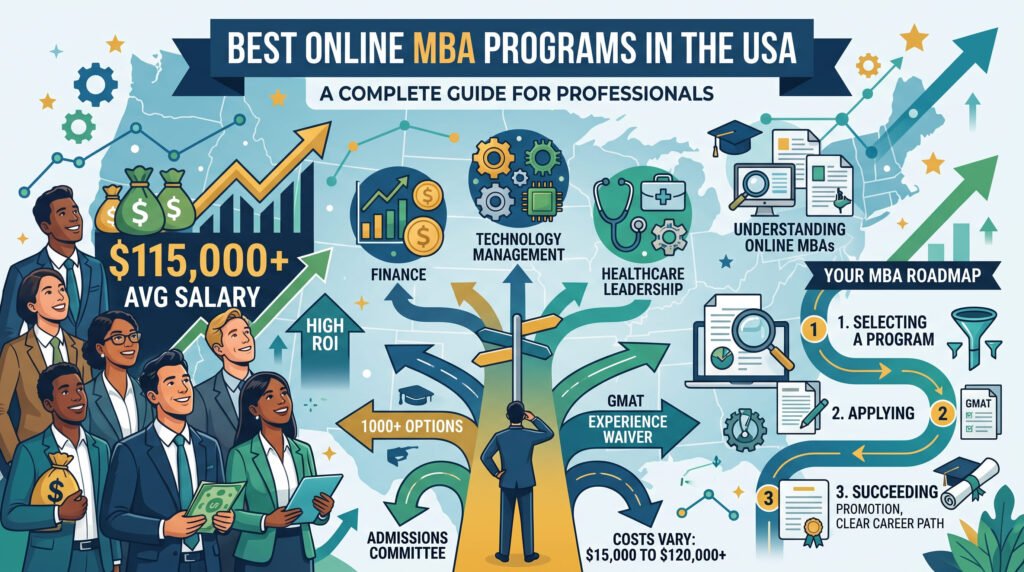
The average salary for MBA graduates in the United States now exceeds $115,000 per year. That number alone explains why thousands of working professionals search for the best online MBA programs every single year. But here is the problem: with over 1,000 universities offering distance-based business degrees, choosing the right program has become overwhelming.
Some programs charge less than $15,000 in total tuition. Others exceed $120,000. Some require the GMAT. Others offer automatic waivers for experienced professionals. Some focus heavily on finance. Others dominate in technology management or healthcare leadership.
This guide cuts through the confusion. You will learn exactly what an online MBA involves, how admissions committees evaluate applicants, what you can expect to pay, where the strongest ROI exists, and which universities consistently rank among the best in the country.
By the time you finish reading, you will have a clear roadmap for selecting, applying to, and succeeding in an online MBA program that actually moves your career forward.
What Is an Online MBA?
An online Master of Business Administration is a graduate-level degree program delivered primarily through digital platforms. Students complete coursework, participate in discussions, submit assignments, and interact with faculty members using learning management systems, video conferencing tools, and collaborative software.
The curriculum mirrors what you would find in a traditional on-campus MBA program. Core courses typically cover accounting, finance, marketing, operations, strategy, leadership, economics, and data analysis. Elective courses allow you to specialize in areas like business analytics, healthcare management, or entrepreneurship.
What makes online programs different is flexibility. You do not need to relocate. You do not need to quit your job. You can watch lectures at midnight or during your lunch break. Many programs follow an asynchronous format, meaning there are no required live class sessions. Others use a synchronous model with weekly live webinars and virtual team meetings.
Quick Fact: According to the National Center for Education Statistics, over 35% of all MBA students in the United States are now enrolled in fully online or hybrid programs.
Accreditation matters enormously in the online MBA space. The gold standard is AACSB accreditation from the Association to Advance Collegiate Schools of Business. Fewer than 6% of business schools worldwide hold this credential. Other respected accreditors include ACBSP and IACBE.
When you earn an MBA online from an AACSB-accredited university, the diploma looks identical to the one awarded to on-campus students. Transcripts do not typically distinguish between online and in-person delivery.
How Online MBA Programs Work
Most online MBA programs operate on a cohort-based or self-paced model. Cohort programs group students together who progress through courses simultaneously. Self-paced programs allow you to complete coursework as quickly or slowly as your schedule permits within set deadlines.
Typical course lengths range from 5 to 16 weeks. Full-time online students often complete the degree in 12 to 24 months. Part-time students usually take 2 to 4 years. Many universities now offer stackable certificates, allowing you to earn credentials along the way.
Group projects remain a core component. You will collaborate with classmates across time zones using tools like Slack, Zoom, Microsoft Teams, and Google Workspace. This mirrors the distributed team environment common in modern corporations.
Who Should Get an MBA?
An MBA is not for everyone. Understanding whether the degree aligns with your career goals can save you years of time and tens of thousands of dollars.
You should seriously consider an online MBA if you fall into one of these categories:
- Mid-career professionals seeking advancement: You have 5 to 10 years of experience and need a credential to move into senior management or director-level roles.
- Career changers: You want to transition from engineering, healthcare, education, or the military into business leadership.
- Entrepreneurs and founders: You need stronger financial, strategic, and operational skills to scale your business.
- Specialists moving into general management: You are an expert in marketing, IT, or finance but want broader responsibility.
- Professionals seeking a salary boost: You want to negotiate a higher compensation package or qualify for roles with six-figure earning potential.
The ideal online MBA candidate is self-motivated, organized, and comfortable with technology. You must be able to manage deadlines without in-person accountability. Strong written communication skills are also essential.
When an MBA Might Not Be Worth It
There are scenarios where pursuing an MBA does not make strategic sense. If you are fresh out of undergrad with zero work experience, most reputable programs will not admit you. You would be better served by gaining 2 to 3 years of professional experience first.
If your industry does not value the MBA credential, the degree may not produce a meaningful ROI. Some technology and creative fields prioritize portfolios, certifications, and demonstrable skills over graduate business degrees.
Expert Tip: Talk to at least five people who currently hold the job you want before applying to any MBA program. Ask them directly whether the degree mattered in their career trajectory. Their answers will tell you more than any ranking list.
MBA vs Master’s Degree: Understanding the Difference
Prospective graduate students often confuse the MBA with other master’s degrees in business. While they share similarities, the target audience, curriculum structure, and career outcomes differ significantly.
A Master of Business Administration is a generalist degree. It provides broad exposure to all functional areas of business. The goal is to develop leaders and managers who can oversee cross-functional teams and make strategic decisions.
A specialized master’s degree, such as a Master of Science in Finance, Master of Accounting, or Master of Business Analytics, dives deep into a single discipline. These programs are often shorter, more technical, and designed for students who want subject-matter expertise rather than general management training.
| Criteria | MBA | Specialized Master’s |
|---|---|---|
| Program Length | 1.5 to 3 years typical | 9 to 18 months typical |
| Work Experience Required | 3 to 8 years average | 0 to 2 years typical |
| Curriculum Focus | General management, leadership, strategy | Deep technical or functional expertise |
| Typical Career Path | Management, consulting, general leadership | Analyst, specialist, individual contributor |
| Average Starting Salary | $115,000 to $135,000 | $75,000 to $95,000 |
| Program Cost Range | $15,000 to $160,000 | $20,000 to $80,000 |
Choose the MBA if you want to manage people, lead organizations, or pivot across industries. Choose a specialized master’s if you want to become an expert practitioner in a specific field like data science, finance, or supply chain management.
Online vs Traditional MBA: Which Format Wins?
The debate between online and traditional MBA formats has shifted dramatically over the past decade. Once viewed as inferior, online programs now attract students from elite backgrounds and produce comparable career outcomes.
That said, each format offers distinct advantages and trade-offs.
Advantages of Online MBA Programs
- Flexibility: Study from anywhere while maintaining full-time employment.
- No relocation costs: Avoid moving expenses, housing changes, and commuting.
- Lower total cost: Online programs often charge lower tuition rates, and you continue earning a salary.
- Immediate application: Apply what you learn at work the next day.
- Diverse network: Connect with classmates from different industries, regions, and countries.
Advantages of Traditional MBA Programs
- In-person networking: Stronger bonds formed through face-to-face interactions and campus events.
- On-campus recruiting: Direct access to employers who recruit specifically from residential programs.
- Immersive experience: Full focus on studies without work distractions.
- Extracurricular activities: Clubs, competitions, conferences, and study abroad opportunities.
| Factor | Online MBA | Traditional MBA |
|---|---|---|
| Total Program Cost | $15,000 to $100,000 | $60,000 to $200,000+ |
| Opportunity Cost | Low (keep working) | High (often full-time, no salary) |
| Networking Quality | Growing but weaker in-person | Strong personal connections |
| Recruiting Access | Limited on-campus events | Extensive on-campus recruiting |
| Time to Complete | 1 to 4 years flexible | 1 to 2 years fixed |
| Best For | Working professionals | Career changers, younger students |
Important Note: The COVID-19 pandemic permanently changed employer perceptions of online education. Most recruiters now evaluate the university’s reputation and accreditation rather than the delivery format.
MBA Admission Requirements
Admission standards vary widely across online MBA programs. Elite universities maintain rigorous application processes similar to their on-campus counterparts. Lower-ranked or newer programs may offer more flexible requirements.
Understanding what admissions committees look for can help you prepare a stronger application.
Core Application Components
- Completed application form: Basic personal and professional information.
- Undergraduate transcripts: Most programs require a bachelor’s degree from an accredited institution. Minimum GPA requirements typically range from 2.5 to 3.0, though competitive programs prefer 3.3 or higher.
- Professional resume: Documented work experience showing progressive responsibility.
- Letters of recommendation: Usually 2 to 3 letters from supervisors, colleagues, or academic references.
- Personal statement or essays: Explanation of career goals, reasons for pursuing the MBA, and fit with the program.
- Standardized test scores: GMAT or GRE scores, though waivers are increasingly common.
- Application fee: Typically $50 to $200.
- Interview: Many programs require a virtual interview with admissions staff or faculty.
Typical Admission Profile
The average admitted student at a reputable online MBA program presents the following profile:
- Age: 28 to 35 years old
- Work experience: 5 to 8 years
- Undergraduate GPA: 3.2 to 3.5
- GMAT score: 550 to 650 (when required)
- Management experience: At least 2 years for executive programs
Stronger programs evaluate your entire application holistically. A lower GPA can be offset by significant career achievements, a compelling essay, or a strong test score.
GMAT/GRE Requirements: What You Need to Know
The GMAT has long been a standard requirement for MBA admission. However, the landscape is changing rapidly. Many online programs now offer test waivers or have eliminated standardized test requirements entirely.
When You Need the GMAT
Elite online MBA programs, including those at top-ranked public universities, often still require the GMAT or GRE. A competitive score strengthens your application, especially if your undergraduate GPA is below average or your work experience is limited.
Typical GMAT score ranges for admitted students:
| Program Tier | Average GMAT Score | Typical Range |
|---|---|---|
| Top 25 Online MBA | 600 to 650 | 550 to 700 |
| Mid-Tier Programs | 550 to 600 | 500 to 650 |
| Accessible Programs | Not required or waived | N/A |
GMAT Waiver Policies
Many universities offer GMAT waivers to applicants who meet certain criteria. Common waiver qualifications include:
- 5 or more years of progressive professional work experience
- A previous master’s or doctoral degree
- An undergraduate GPA of 3.5 or higher in a quantitative field
- Professional certifications like CPA, CFA, or PMP
- Military service with leadership experience
Expert Tip: Always ask the admissions office about waiver opportunities before investing 100+ hours in GMAT preparation. Many schools do not advertise waivers on their websites but grant them generously to experienced professionals.
The GRE is widely accepted as an alternative to the GMAT. If you have already taken the GRE for another graduate program, most business schools will accept those scores.
Work Experience Requirements
Work experience is arguably the most important admissions factor for online MBA programs. Unlike undergraduate degrees or specialized master’s programs, the MBA is designed for professionals who bring real-world context to classroom discussions.
How Much Experience Do You Need?
- Traditional online MBA: 3 to 5 years recommended, though 2 years is sometimes accepted.
- Executive MBA: 8 to 15 years required, with significant management experience.
- Accelerated MBA: 1 to 3 years may suffice, especially for recent graduates or early-career professionals.
Admissions committees are not simply counting years. They evaluate the quality of your experience. Leadership roles, promotions, project management, budget responsibility, and cross-functional collaboration all strengthen your profile.
How to Leverage Your Experience in Applications
Quantify your achievements whenever possible. Instead of writing “managed a team,” write “led a 12-person sales team that increased revenue by 34% over 18 months.” Use concrete numbers that demonstrate impact.
Common Mistake: Too many applicants focus on job duties rather than outcomes. Admissions committees care about what you accomplished, not just what you were responsible for.
MBA Tuition Costs: What You Will Actually Pay
Tuition for online MBA programs in the United States ranges from under $10,000 to over $120,000. Understanding the full cost picture helps you make an informed decision about ROI.
Tuition Ranges by Program Type
| Program Category | Total Tuition Range | Example Universities |
|---|---|---|
| Budget-Friendly | $10,000 to $25,000 | Western Governors, Fitchburg State, LSUS |
| Mid-Range Public | $25,000 to $50,000 | Arizona State, University of Florida, Penn State |
| Premium Public | $50,000 to $80,000 | Indiana University, University of Illinois, UNC |
| Private Elite | $80,000 to $150,000+ | Carnegie Mellon, USC, Rice University |
Hidden Costs Beyond Tuition
- Technology fees: $100 to $500 per semester
- Books and materials: $500 to $1,500 per year
- Residency travel: $1,000 to $3,000 for programs requiring on-campus visits
- Graduation fees: $100 to $300
- Opportunity cost: The salary you could have earned if not studying, though online programs minimize this
Quick Fact: The most expensive online MBA programs cost roughly the same as a new luxury car. The cheapest programs cost less than a used sedan. Both can lead to similar salary outcomes depending on your industry and career goals.
Financial Aid Options for Online MBA Students
Online MBA students qualify for the same federal financial aid options as on-campus students, provided their program is accredited and the university participates in federal aid programs.
Federal Student Loans
The first step is completing the Free Application for Federal Student Aid (FAFSA). This determines your eligibility for:
- Direct Unsubsidized Loans: Up to $20,500 per year for graduate students.
- Grad PLUS Loans: Cover remaining costs up to the full cost of attendance.
Interest rates on federal loans are typically lower than private alternatives. Federal loans also offer income-driven repayment plans, deferment options, and loan forgiveness programs for public service careers.
Private Student Loans
Private lenders offer education loans for MBA students, often with competitive rates for borrowers with excellent credit. However, private loans lack the flexible repayment protections of federal loans.
Payment Plans
Most universities offer semester-based payment plans that allow you to spread tuition costs over several months interest-free. This reduces the need for loans if you can manage the monthly payments from your salary.
MBA Scholarships: Free Money You Should Pursue
Scholarships for online MBA programs are more abundant than most applicants realize. Universities use scholarship awards to attract strong candidates, and many awards go unclaimed due to a lack of applicants.
Types of MBA Scholarships
- Merit-based scholarships: Awarded based on academic achievement, test scores, or professional accomplishments.
- Need-based scholarships: Awarded based on demonstrated financial need through FAFSA data.
- Diversity scholarships: For underrepresented groups in business, including women, minorities, and veterans.
- Industry-specific scholarships: For professionals in healthcare, education, nonprofit, or technology fields.
- Employer-sponsored scholarships: Some companies offer separate scholarship programs for employees pursuing advanced degrees.
Where to Find MBA Scholarships
- Check the university’s business school website for dedicated scholarship pages.
- Search professional associations in your industry (AMA, PMI, AICPA).
- Explore scholarship databases like Fastweb, Scholarships.com, and Bold.org.
- Ask the MBA admissions office directly about available funding.
- Research local community foundations and alumni associations.
Pro Tip: Apply for scholarships even if you think you do not qualify. Many programs struggle to award all available funds because too few students submit applications. The effort takes a few hours and can save you thousands.
Employer Tuition Reimbursement: Leverage This Benefit
Many employers offer tuition assistance programs that can dramatically reduce your out-of-pocket cost for an online MBA. This is one of the most underutilized benefits in American workplaces.
How Employer Reimbursement Works
Under IRS guidelines, employers can provide up to $5,250 per year in tax-free educational assistance. Amounts beyond that threshold are typically taxable as income unless the education qualifies as job-related.
Common employer reimbursement structures include:
- Full tuition coverage: Some companies pay 100% of tuition with no cap.
- Percentage-based: Employers cover 50% to 90% of tuition costs.
- Flat annual amount: Companies provide $5,000 to $10,000 per year regardless of tuition.
- Grade-contingent: Full reimbursement for A grades, less for B grades, nothing for C or below.
Questions to Ask Your HR Department
- Is there a maximum annual or total reimbursement amount?
- Are there required service commitments after completion?
- Must the degree relate directly to your current role?
- Are online programs eligible, or only specific partner universities?
- What documentation is required for reimbursement?
Important Note: Some employers require you to stay with the company for 1 to 3 years after completing your degree. If you leave before that period ends, you may owe partial or full reimbursement. Read the fine print carefully.
Accelerated MBA Programs: Finish Faster
Accelerated MBA programs compress the traditional curriculum into a shorter timeframe, allowing you to earn your degree in as little as 12 months. These programs are intensive but appealing for professionals who want a faster ROI.
What to Expect in an Accelerated Program
- Duration: 12 to 18 months typical
- Course load: 2 to 3 courses per 8-week term
- Time commitment: 20 to 30 hours per week
- Best for: Students with strong academic backgrounds and flexible schedules
Accelerated programs often use 5-week or 8-week course formats. You take fewer breaks between terms, and the pace is relentless. This format works well for disciplined learners who can dedicate significant weekly time to studies.
Advantages and Disadvantages
| Advantages | Disadvantages |
|---|---|
| Finish faster and start earning ROI sooner | Intense workload with little downtime |
| Lower total tuition in some cases | Limited time for deep learning or reflection |
| Quick career progression | Harder to balance with demanding jobs or family |
| Faster networking payoff | Less time for internships or extracurriculars |
Part-Time MBA Programs: Balance Work and Study
Part-time online MBA programs are the most popular option for working professionals. They offer a sustainable pace that allows you to maintain career momentum while advancing your education.
Typical Part-Time MBA Structure
- Duration: 2 to 4 years
- Course load: 1 to 2 courses per term
- Time commitment: 10 to 15 hours per week
- Best for: Professionals with demanding jobs or family responsibilities
Part-time programs provide maximum flexibility. You can accelerate during less busy periods and slow down when work or life demands increase. Most universities allow part-time students up to 5 or 6 years to complete the degree.
Why Part-Time Often Wins
The ability to continue earning a full salary while studying is a massive financial advantage. A full-time MBA student may forgo $100,000 or more in salary over two years. Part-time students avoid that opportunity cost entirely.
Best Practice: Take one course in your first term to gauge the workload before committing to a heavier schedule. Many students overestimate their available time and struggle when they jump into two or three courses simultaneously.
Full-Time MBA Programs: When Going All In Makes Sense
Full-time MBA programs require complete focus on your studies. While less common in the online space, some universities do offer full-time online or hybrid formats.
Full-Time MBA Characteristics
- Duration: 12 to 24 months
- Course load: 3 to 5 courses per term
- Time commitment: 30 to 40+ hours per week
- Best for: Career changers, recent graduates, or professionals between jobs
Full-time programs offer the deepest immersive experience. You build stronger peer relationships, engage in more extracurricular activities, and have access to internships that part-time students cannot pursue.
However, the opportunity cost is significant. The average full-time MBA student gives up two years of salary, which can total $150,000 to $300,000 in lost income depending on your field.
Executive MBA Programs: For Senior Leaders
Executive MBA (EMBA) programs are designed for experienced professionals already in leadership positions. These programs emphasize strategic thinking, executive decision-making, and advanced leadership development.
EMBA Admission Profile
- Work experience: 10 to 15 years average
- Management experience: 5+ years typically required
- Age range: 35 to 50 years old typical
- Current role: Director, VP, or C-suite level
How EMBAs Differ from Traditional MBAs
| Factor | Executive MBA | Traditional Online MBA |
|---|---|---|
| Average Student Age | 38 | 29 |
| Work Experience | 12+ years | 5 years |
| Curriculum Focus | Strategy, leadership, global business | Functional skills, general management |
| Class Schedule | Weekend intensives, fewer sessions | Weekly online courses |
| Employer Sponsorship | Common | Less common |
| Total Cost | $80,000 to $180,000+ | $15,000 to $100,000 |
Expert Tip: Do not pursue an EMBA unless you already hold a leadership title. The value comes from learning alongside other senior executives and tackling complex strategic challenges. The curriculum is less beneficial for early-career professionals.
Best Online MBA Universities in the USA
The following universities consistently rank among the top online MBA programs in national publications like U.S. News & World Report, Poets & Quants, and The Princeton Review. Each program holds AACSB accreditation and offers a rigorous curriculum comparable to on-campus offerings.
Top Online MBA Programs Comparison
| University | Estimated Total Tuition | Program Length | GMAT Required | Specializations Offered |
|---|---|---|---|---|
| Arizona State University (W.P. Carey) | $60,000 to $70,000 | 21 months to 5 years | Waiver available | Finance, Marketing, Analytics, Leadership |
| University of Florida (Warrington) | $48,000 to $58,000 | 16 to 24 months | Required or waiver | Finance, Marketing, Strategy, Analytics |
| Penn State World Campus | $60,000 to $65,000 | 2 to 3 years | Required or waiver | Finance, Marketing, Supply Chain, Strategy |
| Indiana University (Kelley) | $74,000 to $80,000 | 2 to 4 years | Required or waiver | Finance, Marketing, Analytics, Strategy |
| University of Illinois (Gies) | $22,000 to $25,000 | 2 to 3 years | Not required | Finance, Marketing, Analytics, Management |
Arizona State University Online MBA
ASU’s W.P. Carey School of Business consistently ranks in the top 10 for online MBA programs nationally. The program is known for its innovative use of technology, strong faculty, and comprehensive career services.
Key features:
- AACSB accredited with high national rankings
- 45 credit hours with 33 core and 12 elective credits
- No residency requirement for most students
- GMAT waiver available for qualified applicants
- Active alumni network of over 100,000 business school graduates
University of Florida Online MBA
The Warrington College of Business offers one of the most respected online MBA programs in the country. Florida’s program emphasizes experiential learning and strong connections to the business community.
Key features:
- Top 5 national ranking in multiple publications
- 16-month accelerated option or 24-month flexible track
- Two on-campus residencies required
- Optional global immersion experiences
- Dedicated career services team for online students
Penn State Online MBA
Penn State World Campus delivers the Smeal College of Business MBA entirely online. The program emphasizes data-driven decision-making and strategic leadership.
Key features:
- AACSB accredited with strong employer recognition
- Concentrations in finance, marketing, supply chain, and more
- Optional in-person residencies and global experiences
- Strong alumni network of over 700,000 Penn State graduates
- GMAT waiver available for experienced professionals
Indiana University Kelley Online MBA
The Kelley School of Business Direct MBA program is widely regarded as one of the best online MBA options in the world. Kelley is known for its rigorous curriculum and excellent career outcomes.
Key features:
- Consistently ranked #1 or #2 for online MBA programs
- In-person Kelley Connect Week required at start of program
- Integration of live online classes and self-paced coursework
- Seven specialization options
- Strong career coaching and alumni mentorship
University of Illinois Gies Online MBA
The Gies College of Business offers an exceptionally affordable online MBA without sacrificing quality. The program’s low tuition has disrupted the online MBA market.
Key features:
- Total tuition around $22,000 to $25,000
- No GMAT or GRE requirement
- AACSB accredited with strong national reputation
- Stackable certificates available
- High-touch online experience with live sessions
Pro Tip: Do not base your decision solely on rankings. Consider geographic connections, alumni networks in your industry, specialization offerings, and cultural fit. A slightly lower-ranked program with stronger ties to your target employers can produce better outcomes.
MBA Specializations: Choosing Your Focus
Most online MBA programs allow you to customize your degree through concentrations or specializations. These focused tracks differentiate you in the job market and demonstrate expertise in a specific business function.
Finance
A finance specialization prepares you for roles in investment banking, corporate finance, financial planning, and asset management. Core courses include advanced corporate finance, investment analysis, financial modeling, and risk management.
Career outcomes: Financial manager, investment banker, portfolio manager, CFO track.
Marketing
Marketing specializations cover consumer behavior, brand management, digital marketing, market research, and marketing analytics. This track suits professionals who want to lead marketing teams or work in brand strategy.
Career outcomes: Marketing director, brand manager, product marketing manager, CMO track.
Business Analytics
Business analytics is among the fastest-growing MBA specializations. The curriculum focuses on data visualization, predictive modeling, machine learning applications, and data-driven decision-making.
Career outcomes: Analytics manager, data science leader, business intelligence director.
Entrepreneurship
Entrepreneurship specializations teach venture creation, startup funding, innovation management, and small business growth strategies. This track benefits founders and professionals in innovation-driven organizations.
Career outcomes: Startup founder, venture capital analyst, innovation manager, small business consultant.
Healthcare Management
Healthcare management specializations address the unique challenges of the healthcare industry, including policy, operations, finance, and compliance. This track suits clinicians moving into administration and healthcare professionals seeking leadership roles.
Career outcomes: Hospital administrator, healthcare consultant, practice manager, health system executive.
Technology Management
Technology management specializations bridge business strategy and technical operations. The curriculum covers IT strategy, digital transformation, product management, and technology innovation.
Career outcomes: IT director, product manager, digital transformation leader, CTO track.
Specialization Selection Tips
- Align your specialization with your target career path.
- Research job postings in your desired field to identify in-demand skills.
- Talk to professionals already working in that specialization.
- Consider your existing strengths and where you need additional credibility.
- Choose a specialization that complements rather than duplicates your experience.
MBA Career Opportunities: Where the Degree Takes You
An online MBA opens doors to a wide range of career paths across industries. Understanding the most common outcomes helps you evaluate whether the degree aligns with your goals.
Top Industries for MBA Graduates
| Industry | Average Starting Salary | Common Roles |
|---|---|---|
| Consulting | $135,000 to $165,000 | Strategy consultant, management consultant |
| Technology | $125,000 to $155,000 | Product manager, program manager, operations lead |
| Finance | $120,000 to $175,000 | Investment banker, financial manager, portfolio analyst |
| Healthcare | $105,000 to $140,000 | Hospital administrator, healthcare consultant |
| Consumer Goods | $100,000 to $130,000 | Brand manager, marketing director |
| Nonprofit/Government | $75,000 to $110,000 | Program director, policy analyst, operations manager |
Career Advancement for Working Professionals
Most online MBA students use the degree to advance within their current organization rather than switch employers. Common advancement outcomes include:
- Promotion from individual contributor to manager or director
- Transition from functional specialist to general management
- Increased salary and bonus compensation
- Eligibility for executive leadership programs
- Expanded responsibility for P&L management or strategy
Key Takeaway: The MBA is a career accelerator, not a magic wand. Your outcomes depend on how you leverage the credential, build your network, and apply what you learn. Passive degree earners see modest returns. Strategic professionals see transformative results.
ROI Considerations: Is an Online MBA Worth It?
Return on investment is the most important question prospective students ask. The answer depends on your starting salary, program cost, career goals, and industry.
Calculating Your MBA ROI
A simple framework for evaluating ROI:
- Identify your current salary: For example, $70,000 per year.
- Estimate post-MBA salary: Research average salaries for MBA graduates in your field and region. Say $100,000 per year.
- Calculate the salary increase: $30,000 per year in this example.
- Determine total program cost: Include tuition, fees, books, and any travel. Say $50,000.
- Calculate payback period: $50,000 / $30,000 per year = 1.7 years to break even.
After the payback period, the salary premium compounds over your remaining career. A $30,000 annual increase over 20 years totals $600,000 in additional earnings, not accounting for future raises and promotions.
Factors That Improve ROI
- Lower tuition: Programs under $30,000 generate faster payback.
- Employer reimbursement: Reduces out-of-pocket cost to near zero.
- Continued employment: Avoiding lost salary during study.
- Clear career path: A defined promotion track or salary negotiation plan.
- Strong alumni network: Better access to high-paying opportunities.
Factors That Reduce ROI
- High tuition without career advancement: Expensive degrees with no clear plan produce poor returns.
- Debt burden: Large student loans with high interest rates erode salary gains.
- Low-demand industry: Fields with stagnant wages limit the MBA premium.
- No specialization: Generic MBAs without focus may not differentiate you enough.
Warning: Do not assume an MBA automatically leads to a salary increase. Some employers do not adjust compensation for graduate degrees. Research your specific company, industry, and region before investing.
Pros and Cons of an Online MBA
Every educational decision involves trade-offs. Understanding both sides helps you make an informed choice.
Advantages of Online MBA Programs
| Advantage | Explanation |
|---|---|
| Flexibility | Study on your own schedule while working full-time |
| Lower total cost | No relocation, no lost salary, often lower tuition |
| Immediate applicability | Apply concepts at work the next day |
| Geographic freedom | Choose any program in the country without moving |
| Diverse perspectives | Learn with classmates from different industries and regions |
| Technology skills | Develop proficiency with digital collaboration tools |
Disadvantages of Online MBA Programs
| Disadvantage | Explanation |
|---|---|
| Weaker in-person networking | Fewer spontaneous conversations and social bonds |
| Less access to on-campus recruiting | Some employers still recruit primarily in person |
| Self-discipline required | No one is checking whether you attend lectures |
| Screen fatigue | Hours of video content can be exhausting |
| Limited extracurriculars | Fewer clubs, case competitions, and campus events |
| Perception issues | Some hiring managers still prefer traditional programs |
Did You Know? A 2024 survey by the Graduate Management Admission Council found that 86% of employers now view online MBA degrees as equally credible to traditional on-campus degrees. The perception gap is closing rapidly.
Mistakes to Avoid When Choosing an Online MBA
Thousands of professionals choose the wrong online MBA program every year. These mistakes cost time, money, and career momentum.
1. Prioritizing Rankings Over Fit
A top-ranked program may be a poor fit for your industry, specialization needs, or learning style. Research the curriculum and alumni outcomes in your specific field before applying.
2. Ignoring Accreditation
Non-accredited programs may be cheaper, but the degree carries little weight with employers. Always verify AACSB, ACBSP, or IACBE accreditation before applying.
3. Underestimating Time Commitment
Online does not mean easy. Plan for 10 to 15 hours per week per course. Underestimating the workload leads to burnout and course failures.
4. Overlooking Total Cost
Tuition is not the only expense. Factor in fees, books, residency travel, and interest on any loans.
5. Failing to Research Career Outcomes
Request employment reports and alumni salary data from the program. If they cannot provide this information, consider it a red flag.
6. Choosing the Cheapest Program Automatically
Low cost is appealing, but extremely cheap programs may lack resources, career services, or faculty quality. Balance cost with value.
7. Not Talking to Alumni
Reach out to graduates on LinkedIn and ask honest questions about their experience. Alumni perspective reveals what marketing materials hide.
Common Mistake: Many students apply to only one program and hope for the best. Apply to at least 3 to 5 programs across different tiers to increase your options and negotiate scholarship offers.
How to Apply: Step-by-Step Guide
Following a structured application process reduces stress and improves your chances of admission with scholarship funding.
Step 1: Research and Shortlist Programs
Identify 5 to 8 online MBA programs that meet your criteria for cost, specialization, accreditation, and flexibility. Create a spreadsheet comparing key factors.
Step 2: Prepare Application Materials
Update your resume with quantified achievements. Request official transcripts from all undergraduate institutions. Identify 2 to 3 recommenders and brief them on your goals.
Step 3: Write Compelling Essays
Craft essays that connect your past experience to future goals and explain why this specific program fits your needs. Avoid generic statements that could apply to any school.
Step 4: Take the GMAT or Request a Waiver
Determine whether your target programs require standardized tests. If waivers are available, prepare your justification and documentation.
Step 5: Submit Applications Early
Apply in early or priority rounds when more scholarship funding is available. Late applicants face stiffer competition for fewer remaining funds.
Step 6: Prepare for Interviews
Practice common MBA interview questions. Be ready to discuss your career goals, why you want the MBA now, and what you bring to the cohort.
Step 7: Evaluate Offers and Negotiate
Compare admission offers, scholarship packages, and total cost. Do not be afraid to ask for additional funding or mention competing offers.
Building Your Network in an Online MBA
Networking is one of the primary reasons professionals pursue an MBA. Online programs require more deliberate effort to build meaningful connections.
Strategies for Online MBA Networking
- Attend every virtual event: Guest speakers, career panels, and social hours.
- Join program-specific LinkedIn groups: Engage in discussions and share resources.
- Schedule virtual coffee chats: Reach out to classmates individually for one-on-one conversations.
- Participate in group projects actively: Be a reliable, communicative teammate who adds value.
- Attend in-person residencies: If your program offers campus visits or meetups, prioritize them.
- Connect with alumni: Use LinkedIn to find graduates in your target industry or company.
Best Practice: Set a networking goal of one meaningful connection per week during your program. By graduation, you will have built a network of 100+ professionals who know you personally.
Frequently Asked Questions
Is an online MBA respected by employers?
Yes. The vast majority of employers now view online MBAs from accredited universities as equivalent to traditional degrees. What matters most is the university’s reputation and accreditation, not the delivery format. A 2025 employer survey found that 87% of hiring managers have no preference between online and on-campus MBAs when the university is the same.
How long does an online MBA take to complete?
Most online MBA programs take between 18 months and 3 years to complete, depending on your pace. Accelerated programs can be finished in 12 to 16 months. Part-time students who take one course per term may take 3 to 4 years or longer.
Do I need to take the GMAT for an online MBA?
Not always. Many online MBA programs now offer GMAT waivers for applicants with sufficient work experience, strong undergraduate GPAs, or advanced degrees. Some programs, like the University of Illinois Gies MBA, do not require the GMAT at all. Check each program’s specific requirements.
How much does an online MBA cost?
Online MBA tuition ranges from about $10,000 to over $120,000 depending on the university. Mid-range public university programs typically cost between $25,000 and $65,000 in total tuition. Employer reimbursement and scholarships can significantly reduce out-of-pocket costs.
Can I work full-time while pursuing an online MBA?
Yes. The majority of online MBA students work full-time while studying. Programs are designed for working professionals, with flexible schedules that accommodate full-time employment. Expect to dedicate 10 to 20 hours per week to coursework.
Will an online MBA increase my salary?
On average, MBA graduates see a salary increase of 30% to 60% after completing the degree. However, outcomes vary widely by industry, experience level, and how you leverage the credential. Research salary data in your specific field before enrolling.
What is the difference between an online MBA and an Executive MBA?
An online MBA is a generalist business degree for professionals at any career stage, typically requiring 3 to 5 years of work experience. An Executive MBA is designed for senior leaders with 10+ years of experience and significant management responsibility. EMBAs are generally more expensive and focus more on strategy and leadership than functional skills.
Do online MBA students get access to career services?
Most reputable online MBA programs offer career services including resume reviews, interview coaching, job search resources, and alumni networking. Some programs have dedicated career coaches for online students. Verify career services offerings before enrolling.
Is financial aid available for online MBA students?
Yes. Online MBA students at accredited universities qualify for federal student loans through FAFSA. Many programs also offer scholarships, and employers frequently provide tuition reimbursement benefits. Private student loans are another option.
Which online MBA program is best for me?
The best program depends on your career goals, budget, preferred specialization, and schedule flexibility. Consider factors like accreditation, alumni network strength, faculty quality, career outcomes, and total cost. Talk to current students and alumni to gain honest perspectives.
Are online MBA degrees different from on-campus degrees?
No. At most accredited universities, the diploma and transcript are identical whether you completed the program online or on campus. Employers cannot typically tell the difference unless you disclose the delivery format.
Can I complete an online MBA without any business background?
Yes. Many online MBA programs welcome students from non-business backgrounds, including engineering, healthcare, education, and the humanities. Some programs require foundational courses in accounting, statistics, or economics before starting core MBA coursework.
Quick Summary: Key Takeaways
- Best online MBA programs combine AACSB accreditation, strong rankings, and proven career outcomes.
- Tuition ranges from $10,000 to $120,000+, with employer reimbursement and scholarships reducing actual cost.
- Most online MBAs take 18 months to 3 years to complete while working full-time.
- GMAT waivers are increasingly common, especially for experienced professionals.
- Specializations in finance, analytics, healthcare, and technology management can boost career prospects.
- ROI depends on program cost, salary trajectory, industry demand, and how strategically you leverage the degree.
- Top programs include ASU, University of Florida, Penn State, Indiana University, and University of Illinois.
- Networking requires deliberate effort in online programs but produces meaningful connections when done well.
- The online MBA perception gap has largely closed among employers.
- Apply early, compare multiple offers, and negotiate for scholarships.
Final Conclusion: Your Next Step
Choosing the best online MBA program for your career is a significant decision that deserves careful research and honest self-assessment. The right program can accelerate your career trajectory, expand your professional network, and increase your earning potential for decades to come.
The wrong program wastes time and money while providing little return. Avoid that outcome by prioritizing accreditation, evaluating career outcomes, talking to alumni, and aligning your choice with your specific professional goals.
Start by shortlisting three to five programs from this guide. Request information from each, research their curriculum and career services, and speak with at least two alumni per program. Prepare your application materials carefully, apply early, and pursue every scholarship opportunity available.
An online MBA is not the right path for everyone. But for motivated professionals with clear career goals and the discipline to succeed in a self-directed learning environment, it remains one of the most powerful investments you can make in your future.
Your next promotion, career pivot, or leadership opportunity may be closer than you think. The degree alone will not open every door. You have to walk through them. An online MBA gives you the keys.