Earning a bachelor’s degree online has never been more accessible, respected, or valuable. Whether you are a working professional looking to advance, a parent balancing family responsibilities, or someone seeking a flexible path to higher education, online bachelor’s degree programs offer a legitimate and powerful route to achieving your goals.
But with hundreds of options available, how do you choose the right program? Which universities offer the best value? What will it actually cost, and what can you expect to earn after graduation?
This complete guide answers all those questions and more. We break down everything you need to know about earning the best online bachelor’s degrees in the USA, from program structures and costs to career outcomes and university rankings.
What Is an Online Bachelor’s Degree?
An online bachelor’s degree is a four-year undergraduate credential delivered primarily through digital platforms. You complete coursework, interact with professors, and collaborate with peers over the internet rather than in a physical classroom.
These programs mirror their on-campus counterparts in rigor and academic standards. The only real difference is the delivery method. You still earn the same degree, with the same accreditation, and the same respect from employers.
The Evolution of Online Education
Online education has come a long way. In the early 2000s, it was viewed with skepticism. Today, it is a mainstream, highly respected alternative to traditional education.
Top-tier universities have invested heavily in online learning platforms, creating rich, interactive experiences that rival in-person instruction. The pandemic accelerated this shift, forcing institutions to refine their digital offerings and proving that remote learning can be just as effective.
Expert Tip: When researching programs, look for those that have been offering online degrees for five or more years. They tend to have more refined curricula, better support systems, and stronger track records of student success.
Who Is an Online Degree For?
Online bachelor’s degrees are ideal for:
- Working professionals who need to balance employment and education.
- Parents and caregivers who require flexible scheduling.
- Military service members and veterans transitioning to civilian careers.
- Students in rural areas with limited access to physical universities.
- Career changers looking to pivot into a new industry.
- Self-motivated learners who thrive in independent study environments.
How Online Bachelor’s Programs Work
Online bachelor’s programs are designed to be flexible yet structured. Most courses follow a semester or quarter system, with set start dates, assignment deadlines, and final exams.
Course Delivery Formats
Online programs generally use one of three delivery formats:
| Format | Description | Best For |
|---|---|---|
| Synchronous | Live classes at scheduled times via video conferencing. Students must log in at specific hours. | Learners who thrive on structure and real-time interaction. |
| Asynchronous | Pre-recorded lectures and materials available on demand. Students complete work on their own schedule. | Working professionals and those with unpredictable schedules. |
| Hybrid | A combination of live sessions and self-paced work, offering flexibility with some structure. | Students who want a balance of interaction and independence. |
Typical Course Structure
Most online courses follow a weekly rhythm:
- Review pre-recorded lectures or read assigned materials.
- Participate in discussion forums with classmates.
- Complete assignments, quizzes, or projects.
- Attend optional live Q&A sessions or office hours.
- Take proctored exams, often using remote proctoring software.
You can expect to spend 10-15 hours per week per course, depending on the subject matter and your familiarity with the material.
Did You Know? Many online programs now use AI-powered tutoring tools and interactive simulations to enhance learning. These technologies provide personalized feedback and help you master difficult concepts more efficiently.
Student Support Services
Top online programs offer comprehensive support services, including:
- Academic advising to help you stay on track.
- Career counseling with resume reviews and job placement assistance.
- Technical support available 24/7.
- Online tutoring in writing, math, and other subjects.
- Mental health resources and counseling services.
- Library access with digital databases and research tools.
4-Year vs Accelerated Programs
Traditional online bachelor’s degrees take four years of full-time study. But many universities now offer accelerated programs that allow you to graduate faster.
Traditional 4-Year Programs
These follow a standard academic calendar with two semesters per year. You take 12-15 credits per semester and graduate in about four years. This pace is ideal for students who are working part-time or have other commitments.
Accelerated Programs
Accelerated programs compress the curriculum into a shorter timeframe, typically 2.5 to 3 years. They achieve this by:
- Offering shorter, more intensive terms (e.g., 8-week sessions instead of 16-week semesters).
- Allowing year-round study with no summer breaks.
- Increasing the number of courses taken per semester.
| Feature | Traditional 4-Year | Accelerated |
|---|---|---|
| Duration | 4 years | 2.5–3 years |
| Pace | Moderate | Intensive |
| Course load | 12–15 credits/semester | 15–18+ credits/semester |
| Breaks | Summer and winter breaks | Limited or no breaks |
| Best for | Students with other commitments | Highly motivated, full-time learners |
Accelerated programs can save you time and money, but they require intense focus and dedication. If you are working full-time, a traditional pace may be more sustainable.
Pro Tip: If you are considering an accelerated program, look for universities that offer flexible start dates throughout the year. This allows you to begin as soon as you are ready and avoid waiting for the next fall semester.
Accredited Online Degrees
Accreditation is the most important factor to consider when choosing an online bachelor’s degree. It ensures that your education meets established quality standards and that employers and other institutions will recognize your credential.
What Is Accreditation?
Accreditation is a voluntary process in which independent agencies evaluate educational institutions and programs against rigorous standards. Accredited schools have demonstrated that they provide a high-quality education.
Types of Accreditation
- Regional Accreditation: The gold standard. Six regional accrediting bodies oversee colleges and universities in different parts of the United States. Degrees from regionally accredited schools are widely recognized and accepted.
- National Accreditation: Typically applies to vocational, career, and religious institutions. While legitimate, nationally accredited credits may not transfer as easily to regionally accredited schools.
- Programmatic Accreditation: Specific programs within a university may hold additional accreditation from specialized bodies. For example, business programs may be accredited by AACSB, and nursing programs by CCNE or ACEN.
Why Accreditation Matters
Attending an accredited online program is critical because:
- Employers check: Many employers only recognize degrees from accredited institutions.
- Transfer credits: Credits from accredited schools are more likely to transfer to other institutions.
- Financial aid: You must attend an accredited school to qualify for federal financial aid.
- Graduate school: Accredited undergraduate degrees are required for admission to most master’s programs.
Warning: Avoid diploma mills and unaccredited schools that promise degrees with little effort. These credentials are worthless and can harm your career. Always verify accreditation through the U.S. Department of Education’s database or the Council for Higher Education Accreditation (CHEA).
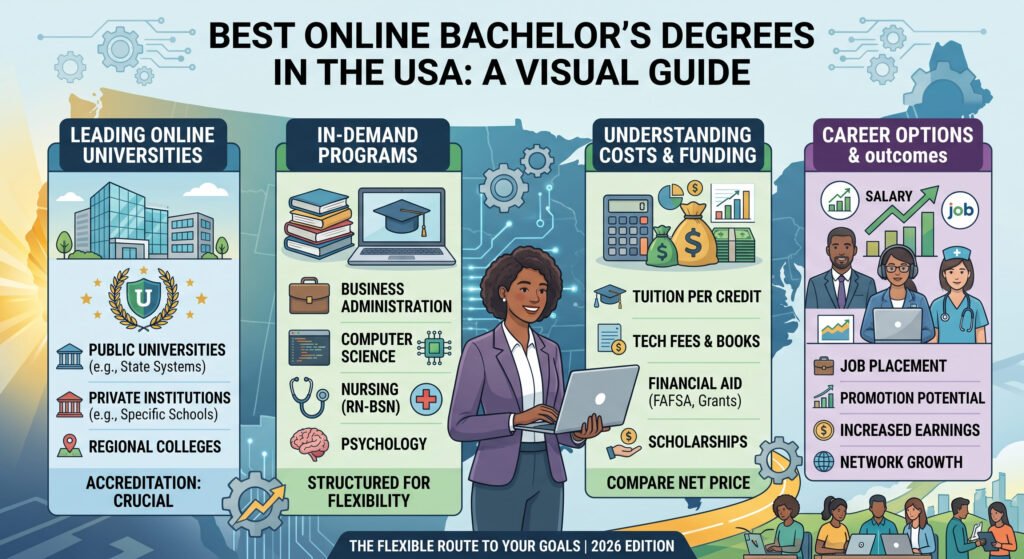
Bachelor’s Degree Costs
The cost of an online bachelor’s degree varies widely depending on the university, program, and your residency status. Understanding the full financial picture is essential before you enroll.
Average Cost Ranges
| University Type | Cost per Credit (Approx.) | Total Cost (120 Credits) |
|---|---|---|
| Public In-State | $250 – $400 | $30,000 – $48,000 |
| Public Out-of-State | $500 – $800 | $60,000 – $96,000 |
| Private Nonprofit | $450 – $700 | $54,000 – $84,000 |
| For-Profit | $300 – $600 | $36,000 – $72,000 |
Keep in mind that many online programs charge the same tuition regardless of residency. This is a significant advantage for out-of-state students who would otherwise pay higher rates.
Additional Costs to Consider
Tuition is only part of the equation. Factor in these additional expenses:
- Technology fees: Many online programs charge $50–$200 per semester for access to learning platforms.
- Textbooks and materials: Digital textbooks can cost $500–$1,000 per year.
- Proctoring fees: Remote exam proctoring services may charge $15–$30 per exam.
- Application fees: $50–$100 per application.
- Graduation fees: $100–$300 for diploma and commencement.
Some universities offer “all-inclusive” tuition that covers textbooks and fees. Compare total costs carefully.
Pro Tip: Always calculate the total cost of attendance, not just tuition per credit. Two programs with the same per-credit cost can have very different total expenses when fees and materials are added.
Financial Aid, Scholarships, and FAFSA
Financing your online bachelor’s degree is entirely possible with the right combination of aid, scholarships, and planning. Here is everything you need to know.
FAFSA: Your First Step
The Free Application for Federal Student Aid (FAFSA) is the gateway to federal financial aid. You must complete the FAFSA to qualify for:
- Pell Grants: Need-based grants that do not have to be repaid.
- Federal Direct Loans: Low-interest loans with flexible repayment options.
- Work-Study: Part-time employment opportunities.
- State and institutional aid: Many states and universities use FAFSA data to award their own scholarships and grants.
Complete the FAFSA as early as possible, ideally in October for the following academic year. Funds are distributed on a first-come, first-served basis.
Scholarships for Online Students
Many students assume scholarships are only for traditional students. That is a myth. There are thousands of scholarships specifically for online learners.
Here are some categories to explore:
- University-specific scholarships: Many online programs offer their own merit-based and need-based scholarships.
- Field of study scholarships: Professional organizations offer scholarships for students pursuing specific majors.
- Demographic scholarships: Scholarships for women, minorities, military veterans, first-generation students, and other groups.
- Employer tuition reimbursement: Many companies offer tuition assistance for employees pursuing job-related degrees.
Federal Student Loans
Federal loans are often the most affordable borrowing option. Key types include:
- Direct Subsidized Loans: For undergraduates with financial need. The government pays interest while you are in school.
- Direct Unsubsidized Loans: Available to all undergraduate students, regardless of need. You are responsible for all interest.
- PLUS Loans: For parents or graduate students with good credit.
Important Note: Always borrow only what you need. While student loans can help you afford college, too much debt can strain your finances after graduation. Look for grants and scholarships first.
Employer Tuition Assistance
Many employers offer tuition reimbursement as a benefit. Some companies pay up to $5,250 per year tax-free under IRS rules. Check with your HR department to see if your employer offers this benefit and what the requirements are.
Transfer Credits
If you have previously completed college coursework, you may be able to transfer those credits toward your online bachelor’s degree. This can save you significant time and money.
How Transfer Credits Work
When you apply to a new program, the university evaluates your previous coursework to determine which credits can be applied to your degree. Factors include:
- Course content: The course must be similar in scope to the university’s own offerings.
- Grade earned: Most schools require a “C” or better for transfer.
- Accreditation: Credits from accredited institutions are more likely to transfer.
- Time limit: Some schools have time limits on how old certain credits can be, especially in fields like technology and healthcare.
Maximizing Your Transfer Credits
- Request official transcripts from all previously attended institutions.
- Work with an academic advisor to map out how your credits apply to your new program.
- Consider credit for prior learning — some schools offer credit for military training, professional certifications, or even life experience.
- Use tools like Transferology to see how your credits might transfer before applying.
Pro Tip: If you are planning to transfer, apply to your target program early and request a preliminary transfer evaluation. This gives you time to address any gaps or appeal decisions before you enroll.
Common Transfer Policies
| Policy | Description |
|---|---|
| Maximum Transfer Credits | Most schools accept up to 90 credits toward a 120-credit degree. |
| Residency Requirement | You must complete a certain number of credits at the awarding institution (usually 30). |
| Core Curriculum | General education requirements may be more flexible than major-specific courses. |
Online Degree Admission Requirements
Admission to online bachelor’s programs is competitive but often more flexible than traditional on-campus programs. Here is what you can expect.
Standard Admission Requirements
- High school diploma or GED: You must have a secondary school credential.
- Official transcripts: From your high school and any colleges you have attended.
- Minimum GPA: Most programs require a 2.5–3.0 GPA in high school or previous college work.
- SAT/ACT scores: Some schools have gone test-optional, especially for online programs.
- Personal statement or essay: An opportunity to share your goals and motivation.
- Letters of recommendation: Usually 1–3 from teachers, employers, or mentors.
- Application fee: Typically $50–$100.
Additional Requirements for Some Programs
- Prerequisite coursework: For programs like nursing or engineering, you may need to complete specific courses before admission.
- Portfolio or audition: For fine arts or design programs.
- Professional experience: Some programs, especially at the bachelor’s completion level, prefer applicants with work experience.
- English proficiency: International students must demonstrate English proficiency through TOEFL or IELTS.
Test-Optional Policies
Many online programs have adopted test-optional admissions, meaning you can choose whether to submit SAT or ACT scores. If your test scores do not reflect your abilities, you may benefit from applying without them.
Expert Tip: If you have a strong GPA and relevant work experience, you may be a strong candidate even without stellar test scores. Focus on writing a compelling personal statement that highlights your unique strengths and motivation.
Top Degree Fields
Not all online bachelor’s degrees are created equal. Some fields are particularly well-suited to online learning and offer excellent career prospects. Here is a breakdown of the most popular and valuable online majors.
Business Degrees
Business degrees are among the most popular online offerings. They are versatile, practical, and in high demand across every industry.
Core topics include accounting, finance, marketing, operations management, and organizational behavior. Online business programs often incorporate case studies, group projects, and capstone experiences that simulate real-world business challenges.
Common specializations:
- General Business Administration
- Accounting
- Marketing
- Finance
- Management
- Entrepreneurship
Pro Tip: Look for online business programs with AACSB accreditation. This is the gold standard for business schools and signals to employers that you have received a rigorous education.
Computer Science
Computer science degrees are a natural fit for online learning. Coding, software development, and system design are skills that you can learn effectively through online instruction and hands-on practice.
You will study programming languages, algorithms, data structures, software engineering, and computer architecture. Many programs also offer tracks in cybersecurity, data science, and artificial intelligence.
Why it works online: Programming is inherently digital. You can complete assignments, collaborate with peers, and get feedback entirely online. Many online CS programs also partner with tech companies to offer internships and project-based learning.
Did You Know? Software developers earn a median salary of over $130,000 per year, making computer science one of the highest-return online bachelor’s degrees.
Nursing
Registered nurses (RNs) with an associate degree or diploma can pursue an online RN-to-BSN program to earn their bachelor’s degree. These programs build on existing clinical experience and focus on leadership, community health, and evidence-based practice.
While some clinical components require in-person attendance, the majority of coursework is online. Many programs offer flexible pacing for working nurses.
Key topics:
- Nursing leadership and management
- Community and public health nursing
- Research and evidence-based practice
- Healthcare policy and ethics
Important Note: If you are not already an RN, you will need to complete clinical training in person. Some hybrid programs combine online didactic coursework with in-person clinical placements.
Psychology
Psychology degrees are another popular online option. You will study human behavior, cognition, development, and research methods. This degree is excellent preparation for careers in counseling, human resources, social work, or further graduate study.
Online psychology programs typically include research projects, case analyses, and discussion-based learning. Many students go on to pursue master’s or doctoral degrees in clinical or counseling psychology.
Education
Online degrees in education are designed for aspiring teachers and educational professionals. You can earn a bachelor’s degree in elementary education, secondary education, special education, or educational studies.
Many programs include a student teaching component, which you complete in a local school district. This practical experience is typically arranged by the university.
Healthcare Administration
Healthcare administration degrees prepare you for leadership roles in hospitals, clinics, and healthcare organizations. You will study healthcare policy, finance, operations, and quality improvement.
This is a growing field with strong job prospects. The healthcare industry is one of the largest employers in the country, and experienced administrators are in high demand.
Information Technology
Information technology (IT) degrees focus on the practical application of technology in organizations. You will learn about networking, cybersecurity, database management, and IT project management.
IT degrees are more applied than computer science, with less emphasis on theory and more on practical skills. Many online IT programs offer industry certifications as part of the curriculum.
Engineering
While some engineering disciplines require extensive lab work, others are well-suited to online learning. Programs in electrical engineering, software engineering, and engineering management are increasingly available online.
Many online engineering degrees are designed for working professionals who already have some college credits. Look for ABET-accredited programs for the best recognition.
Accounting
Accounting is a stable and well-paying career path. Online accounting degrees cover financial accounting, managerial accounting, taxation, auditing, and accounting information systems.
Many programs are designed to help you meet the 150-credit requirement for CPA licensure. If you plan to become a CPA, verify that the program meets your state’s requirements.
Marketing
Marketing degrees focus on consumer behavior, branding, advertising, digital marketing, and market research. With the rise of e-commerce and social media, digital marketing skills are especially valuable.
Online marketing programs often include hands-on projects where you create real marketing campaigns for businesses.
Communications
A communications degree develops your skills in writing, public speaking, media studies, and interpersonal communication. Graduates work in media, public relations, corporate communications, and content creation.
This is a versatile degree that pairs well with almost any industry.
Criminal Justice
Criminal justice degrees explore the legal system, law enforcement, corrections, and criminology. Graduates pursue careers in police work, corrections, legal administration, and social services.
Many online programs offer specializations in forensic psychology, homeland security, or legal studies.
Best Universities for Online Bachelor’s Degrees
Several universities have established themselves as leaders in online education. These schools offer high-quality programs, strong student support, and recognized credentials.
ASU Online
Arizona State University is one of the largest and most respected providers of online education. ASU Online offers over 200 undergraduate degrees, covering nearly every field imaginable.
Key strengths:
- Same curriculum and faculty as on-campus programs.
- Full accreditation and strong reputation.
- Comprehensive student support, including tutoring, advising, and career services.
- Generous transfer credit policies.
- Innovative learning technologies and interactive course design.
ASU Online is a top choice for students seeking a public university experience with the flexibility of online learning.
Purdue Global
Purdue Global is the online branch of Purdue University, a prestigious public university known for its strength in engineering, business, and technology.
Key strengths:
- ExcelTrack accelerated programs that let you progress at your own pace.
- Strong focus on career-ready skills.
- Military-friendly with special support for veterans.
- Competitive tuition rates and financial aid options.
Penn State World Campus
Penn State World Campus is the online arm of Pennsylvania State University. It offers a wide range of bachelor’s degrees with the same quality as the on-campus experience.
Key strengths:
- Over 60 online bachelor’s programs.
- Highly ranked for student support and satisfaction.
- Strong alumni network and career connections.
- Accredited and recognized worldwide.
University of Florida Online
The University of Florida offers a growing selection of online bachelor’s degrees through UF Online. As a top public university, UF provides a rigorous education with excellent value.
Key strengths:
- Same degree as on-campus students.
- Affordable in-state tuition for all online students.
- Strong programs in business, psychology, and education.
- Partnership with local community colleges for seamless transfer.
Comparison of Top Universities
| University | Programs Offered | Tuition (per credit) | Accelerated Options | Transfer Credits |
|---|---|---|---|---|
| ASU Online | 200+ | $561–$673 | Yes | Up to 90 |
| Purdue Global | 175+ | $371–$420 | Yes (ExcelTrack) | Up to 75 |
| Penn State World Campus | 60+ | $576–$672 | Limited | Up to 90 |
| UF Online | 30+ | $129 (in-state) / $552 (out-of-state) | No | Up to 90 |
Career Opportunities and Salary
One of the most common questions prospective students ask is: “What can I do with an online bachelor’s degree?” The answer depends on your major, but the possibilities are extensive.
Average Salaries by Major
| Degree Field | Entry-Level Salary | Mid-Career Salary | Job Growth Outlook |
|---|---|---|---|
| Computer Science | $75,000 | $130,000+ | Strong (22% growth) |
| Business Administration | $55,000 | $95,000 | Steady (7% growth) |
| Nursing (RN to BSN) | $65,000 | $90,000+ | Strong (10% growth) |
| Accounting | $55,000 | $88,000 | Steady (6% growth) |
| Marketing | $50,000 | $85,000 | Steady (8% growth) |
| Psychology | $42,000 | $70,000 | Moderate (6% growth) |
| Education | $40,000 | $60,000 | Moderate (4% growth) |
| Criminal Justice | $45,000 | $75,000 | Moderate (5% growth) |
| Information Technology | $60,000 | $100,000+ | Strong (15% growth) |
| Healthcare Administration | $55,000 | $95,000 | Strong (15% growth) |
Employer Perceptions of Online Degrees
One of the most persistent myths about online degrees is that employers do not value them. This is no longer true. A survey by the Society for Human Resource Management (SHRM) found that 92% of employers view online degrees from accredited institutions as equal to or better than traditional degrees.
What employers care about most is:
- Accreditation — They want to know your degree comes from a legitimate institution.
- Skills — They want to see that you have developed relevant, practical abilities.
- Experience — Internships, projects, and work experience matter as much as the degree itself.
Expert Tip: To make your online degree stand out, highlight projects, case studies, and practical work you completed during your program. Employers value tangible evidence of your skills.
Industries That Hire Online Graduates
Online graduates are employed across nearly every sector, including:
- Technology — Software companies, IT departments, startups.
- Healthcare — Hospitals, clinics, insurance companies.
- Finance — Banks, accounting firms, investment firms.
- Education — K-12 schools, universities, educational technology.
- Government — Federal, state, and local agencies.
- Nonprofits — Charitable organizations, advocacy groups.
- Retail and E-commerce — Marketing, supply chain, management.
Online vs Traditional Bachelor’s Degree
Choosing between online and traditional education is one of the most significant decisions you will make. Here is an honest comparison to help you decide.
Pros of Online Degrees
- Flexibility: Study when and where you want. This is the biggest advantage for students with jobs or families.
- Cost savings: Many online programs are more affordable than on-campus options. You also save on housing, commuting, and meal plans.
- Accessibility: You can attend a top university regardless of your geographic location.
- Self-paced learning: Many programs allow you to move through material at your own speed.
- Digital skills: You will develop online collaboration and communication skills that are valuable in the modern workplace.
Cons of Online Degrees
- Less face-to-face interaction: You miss out on spontaneous conversations and networking opportunities.
- Requires self-discipline: Without the structure of a physical classroom, it is easier to fall behind.
- Fewer hands-on experiences: Lab work, studio time, and clinical rotations are harder to replicate online.
- Technology dependence: You need reliable internet and a capable device.
Pros of Traditional Degrees
- In-person networking: You build relationships with professors and peers that can last a lifetime.
- Campus resources: Libraries, labs, gyms, and student activities are readily available.
- Structured environment: Fixed schedules help many students stay on track.
- Hands-on learning: Some fields require physical presence for labs and workshops.
Cons of Traditional Degrees
- Higher costs: Tuition, room, board, and transportation add up quickly.
- Less flexibility: You must attend classes at specific times and locations.
- Geographic limitations: You can only attend schools you can commute to or relocate for.
Which Is Right for You?
Choose an online degree if:
- You need flexibility to balance work, family, or other commitments.
- You are a self-starter who can stay motivated without constant oversight.
- You want to save money on housing and commuting.
- You live far from a university that offers your desired major.
Choose a traditional degree if:
- You thrive on in-person interaction and structured schedules.
- Your field requires hands-on lab work or clinical experience.
- You want the full “college experience” with campus activities.
- You prefer face-to-face instruction and immediate feedback.
Key Takeaway: There is no universally “better” option. The right choice depends on your personal circumstances, learning style, and career goals. Many students today successfully combine online and traditional coursework.
Frequently Asked Questions
Is an online bachelor’s degree respected by employers?
Yes, absolutely. As long as the degree comes from an accredited institution, employers view online degrees as equally valuable as traditional degrees. Many employers have even embraced remote work and distance learning themselves, making them more open to candidates with online credentials.
How much does an online bachelor’s degree cost?
Costs vary widely. Public in-state tuition can be as low as $250 per credit, while private universities may charge $500 or more. The total cost for a 120-credit degree typically ranges from $30,000 to $96,000. Additional fees for technology and materials should also be factored in.
Can I get financial aid for an online bachelor’s degree?
Yes, you are eligible for the same federal financial aid as traditional students, including Pell Grants, federal loans, and work-study. You must be enrolled at an accredited institution and complete the FAFSA. Many scholarships are also available specifically for online students.
How long does it take to complete an online bachelor’s degree?
A standard full-time program takes four years. Accelerated programs can be completed in 2.5 to 3 years. If you have transfer credits or prior learning that applies, you may finish even sooner. Many programs also offer part-time options that take longer but offer more flexibility.
Are online degrees accredited?
Reputable online programs hold the same regional or national accreditation as their on-campus counterparts. Always verify accreditation through the U.S. Department of Education’s database or CHEA. Avoid unaccredited “diploma mills” that offer degrees for little work.
Can I transfer credits to an online degree program?
Yes, most online programs accept transfer credits from accredited institutions. Typically, you can transfer up to 90 credits toward a 120-credit degree. Each school has its own transfer policies, so check with your target program for specific details.
What are the admission requirements for online bachelor’s programs?
Most programs require a high school diploma or GED, official transcripts, a minimum GPA (often 2.5 or higher), and a personal statement. Some may require SAT/ACT scores, though many have gone test-optional. International students must demonstrate English proficiency.
What is the difference between synchronous and asynchronous online learning?
Synchronous learning involves live, scheduled classes that you attend in real-time. Asynchronous learning allows you to access recorded lectures and complete assignments on your own schedule. Many programs offer a mix of both formats.
Are accelerated online bachelor’s programs more difficult?
Accelerated programs are not necessarily more difficult in content, but they are more intensive. You take more courses per semester and have shorter breaks. The compressed timeline requires strong time management and focus.
Can I work while earning an online bachelor’s degree?
Yes, many online students work while studying. The flexibility of online learning makes it possible to balance employment and education. Part-time enrollment is also an option if you need to manage a demanding work schedule.
What technology do I need for an online degree?
You will need a reliable computer, a stable internet connection, and a webcam for proctored exams. Specific software requirements depend on your major — for example, programming courses may require specialized development tools. Most programs provide a list of technical requirements before you enroll.
Are there online bachelor’s degrees in nursing?
Yes, but with a caveat. RN-to-BSN programs are available online for registered nurses who already hold an associate degree or diploma. If you are not already an RN, you will need to complete clinical training in person, often through a hybrid program.
What is the job placement rate for online graduates?
Job placement rates vary by university and program. Most reputable online programs report placement rates comparable to their on-campus counterparts. Many schools offer dedicated career services to help you find jobs, internships, and networking opportunities.
Can I pursue a master’s degree after an online bachelor’s?
Absolutely. An accredited online bachelor’s degree meets the admission requirements for graduate programs. Many students go on to master’s degrees in business, education, nursing, law, and other fields. Your online credential is treated the same as a traditional degree for graduate admissions.
What are the best online bachelor’s degrees for career changers?
Business administration, computer science, accounting, and nursing are excellent for career changers. These fields offer strong job demand, competitive salaries, and clear career pathways. Healthcare administration and information technology are also growing fields that welcome professionals from other backgrounds.
Conclusion
Earning an online bachelor’s degree in the USA is a smart, practical, and increasingly common choice. Whether you are starting your education journey, finishing what you started, or pivoting to a new career, online programs offer the flexibility and quality you need to succeed.
To summarize, here are the most important takeaways:
- Accreditation matters: Always choose a regionally accredited institution to ensure your degree is recognized.
- Costs vary: Compare total costs, including fees and materials, not just per-credit tuition.
- Financial aid is available: Complete the FAFSA and explore scholarships to reduce your out-of-pocket expenses.
- Transfer credits save time: If you have prior coursework, make sure to maximize your transfer credits.
- Choose the right major: Align your degree with your career goals and interests. Business, CS, nursing, and healthcare are among the most lucrative and in-demand fields.
- Top universities deliver: Schools like ASU Online, Purdue Global, Penn State World Campus, and UF Online are leaders in online education.
- Career prospects are strong: Online graduates find meaningful employment with competitive salaries across all industries.
The decision to pursue an online bachelor’s degree is a significant investment in your future. With careful research, clear goals, and a commitment to your studies, you can graduate with a credential that opens doors and transforms your life.
Take the first step today. Research programs, talk to admissions advisors, and start your application. Your future is waiting.