Paying for college can feel overwhelming, but millions of students and families navigate this process every year with the help of federal financial aid. At the heart of this system is the Free Application for Federal Student Aid, commonly known as the FAFSA. This comprehensive guide will walk you through everything you need to know about applying for college financial aid in the USA, with a focus on the 2026 application cycle.
Whether you are a high school senior, a returning adult student, or a parent helping your child navigate the process, this guide is designed to answer your questions, simplify the steps, and help you maximize the financial aid you qualify for. Let’s demystify the FAFSA together.
What Is the FAFSA and Why Does It Matter?
The Free Application for Federal Student Aid, or FAFSA, is the official form that students and families use to apply for federal financial aid for college or graduate school in the United States. The U.S. Department of Education uses the information you provide on the FAFSA to determine your eligibility for federal grants, work-study programs, and student loans.
But the FAFSA is not just for federal aid. Most states and individual colleges also use the FAFSA to award their own financial aid packages. This means that completing the FAFSA is the single most important step you can take to unlock funding for your education.
Expert Tip: Even if you think your family makes too much money to qualify for need-based aid, you should still complete the FAFSA. Many colleges use it to award merit-based scholarships and other non-need-based aid. You might be surprised by what you qualify for.
For the 2026 academic year, the FAFSA has undergone some important changes designed to make the application process simpler and more accessible. Understanding these changes and preparing in advance can significantly impact the amount of aid you receive.
Who Should Apply for Financial Aid?
One of the most common questions students and parents ask is whether they should bother applying for financial aid. The short answer is yes. Every student who plans to attend college, university, or graduate school should complete the FAFSA, regardless of their family’s income level.
Here is a quick breakdown of who should apply:
- High school seniors planning to enroll in college the following fall
- Current college students who need to renew their financial aid each year
- Adult learners returning to school after a break
- Graduate students pursuing master’s or doctoral degrees
- International students who are U.S. citizens or eligible non-citizens
- Students attending community college, trade school, or vocational programs
The FAFSA is not just for traditional four-year universities. It applies to a wide range of postsecondary institutions, including community colleges, technical schools, and career training programs.
Pro Tip: Many state scholarship programs and college-specific grants require a completed FAFSA as a prerequisite, even if you are not applying for federal loans. Do not miss out on free money by skipping this step.
FAFSA Eligibility Requirements for 2026
To qualify for federal student aid through the FAFSA, you must meet several basic eligibility requirements. Understanding these criteria upfront can save you time and frustration.
Basic Eligibility Criteria
- U.S. citizenship or eligible non-citizen status (such as a permanent resident or refugee)
- A valid Social Security number (with some exceptions)
- High school diploma, GED certificate, or completion of a homeschool program approved by state law
- Enrollment or acceptance as a regular student in an eligible degree or certificate program
- Registered for Selective Service (if male and between the ages of 18 and 25)
- Satisfactory academic progress in college if you are already enrolled
- No outstanding federal student loan defaults or overpayments on federal grants
Financial Eligibility Considerations
While the FAFSA does not have strict income cutoffs, your financial eligibility for need-based aid is determined by a formula that considers your family’s income, assets, household size, and the number of family members attending college. The result is your Student Aid Index, which replaces the older Expected Family Contribution.
Many families with moderate incomes still qualify for significant aid, including grants and subsidized loans. The only way to know for sure is to complete the application.
Important Note: The FAFSA is free to complete. If you encounter a website that charges a fee, you are not on the official government site. Always use the official FAFSA website at studentaid.gov.
Key FAFSA Deadlines You Cannot Miss
Missing the FAFSA deadline is one of the most costly mistakes students make. The federal deadline for the 2026 academic year is June 30, 2027, but state and college deadlines can be much earlier.
Here is a breakdown of the three types of deadlines you need to track:
| Deadline Type | Typical Timeframe | What You Need to Know |
|---|---|---|
| Federal Deadline | June 30, 2027 | The absolute last date to submit your FAFSA for the 2026–2027 academic year. Corrections must be made by September 11, 2027. |
| State Deadlines | Varies (often February–April) | Each state sets its own deadline for state-based grants. Many states have early deadlines, so check your state’s specific date. |
| College Deadlines | Varies (often January–March) | Colleges often have priority deadlines for institutional aid. These can be as early as January or February for fall enrollment. |
The FAFSA for the 2026–2027 academic year opens on October 1, 2025. Submitting as early as possible increases your chances of receiving the maximum aid available, since some funds are awarded on a first-come, first-served basis.
Warning: Do not wait until the federal deadline. Many state and college aid programs run out of funding early. Submit your FAFSA as soon as possible after October 1 to maximize your aid opportunities.
Documents You Need Before You Start
Gathering your documents before you begin the FAFSA application will make the process much smoother. Having everything ready can save you time and reduce the likelihood of errors.
For Students
- Social Security number or Alien Registration Number (if applicable)
- Driver’s license or state ID (if you have one)
- Federal income tax returns for the prior-prior year (2024 tax returns for the 2026–2027 FAFSA)
- W-2 forms and other records of money earned
- Bank statements and records of investments
- Records of untaxed income (such as child support or interest income)
- FSA ID (username and password for the FAFSA website)
For Parents
- Social Security numbers (if the student is a dependent)
- Federal income tax returns for the prior-prior year
- W-2 forms and other earnings records
- Bank and investment account balances
- Records of untaxed income
- FSA ID for the parent (if applying as a dependent student)
Did You Know? The FAFSA now uses a direct data retrieval tool that can automatically pull your tax information from the IRS. This reduces errors and speeds up the application process. You will still need your tax records for reference.
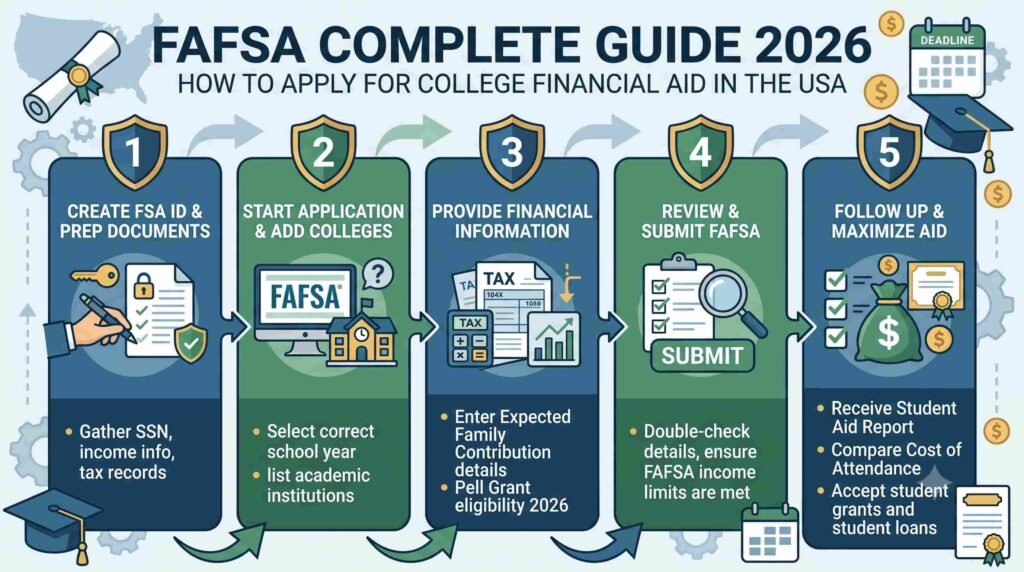
Step-by-Step FAFSA Application Guide for 2026
Now that you have gathered your documents, it is time to walk through the actual application process. This step-by-step guide will help you navigate the FAFSA with confidence.
Step 1: Create Your FSA ID
If you do not already have one, visit studentaid.gov to create your FSA ID. This is a username and password that serves as your electronic signature for the FAFSA. Parents of dependent students will also need to create their own FSA ID.
Important: Your FSA ID must match your legal name exactly as it appears on your Social Security card. Do not use nicknames or abbreviations.
Step 2: Start the FAFSA Application
Go to the official FAFSA website at studentaid.gov and select “Start New FAFSA.” Choose the correct academic year: 2026–2027 for enrollment starting in fall 2026.
Step 3: Complete the Student Information Section
Fill out your personal information, including your name, date of birth, Social Security number, and contact details. Double-check every entry to avoid errors that could delay your application.
Step 4: Determine Your Dependency Status
The FAFSA asks a series of questions to determine whether you are considered a dependent or independent student. This classification affects whose financial information must be reported.
You are considered an independent student if you meet any of these criteria:
- You are 24 years or older by January 1 of the academic year
- You are married or separated but not divorced
- You have children or dependents you support
- You are a veteran or on active duty in the U.S. armed forces
- You are an orphan, ward of the court, or foster youth
- You are an emancipated minor or in a legal guardianship
- You are experiencing homelessness or at risk of homelessness
Step 5: Provide Parent Information (If Dependent)
If you are a dependent student, your parent’s financial information is required. You will need to provide their Social Security numbers, tax return data, and asset information. The FAFSA will use the IRS Data Retrieval Tool to import tax data directly from the IRS.
Step 6: Enter Your Financial Information
This section collects your income and asset information. Use the prior-prior year’s tax returns (2024 taxes for the 2026–2027 FAFSA). Include wages, salaries, tips, taxable interest, and other income sources.
Step 7: List Your College Choices
You can list up to 20 colleges on the FAFSA. Each school will receive your FAFSA information electronically, and they will use it to determine your financial aid package. You can add more schools later if needed.
Step 8: Sign and Submit
Review all of your information carefully before submitting. Both you and your parent (if applicable) will need to sign the FAFSA using your FSA IDs. Once signed, submit the application. You will receive a confirmation email when your application has been processed.
Pro Tip: After submitting, the Department of Education will calculate your Student Aid Index. This number is not the amount you will pay for college — it is simply an index used to determine your financial need. Your actual cost will vary based on the college’s cost of attendance and the aid they offer.
Types of Financial Aid Available
One of the most valuable aspects of the FAFSA is that it unlocks access to multiple types of financial aid. Understanding the different forms of aid can help you make informed decisions about your college funding.
Here is an overview of the main types of financial aid you may qualify for:
Grants
Grants are gift aid that do not need to be repaid. They are typically awarded based on financial need. The most common federal grants include:
- Pell Grant: Need-based grant for undergraduate students with exceptional financial need
- FSEOG: Federal Supplemental Educational Opportunity Grant for students with the highest need
- TEACH Grant: For students who plan to teach in high-need fields and low-income areas
Work-Study Programs
Federal Work-Study provides part-time jobs for students with financial need, allowing them to earn money to pay for educational expenses. These jobs are often on-campus and can be related to your field of study.
Federal Student Loans
Loans are borrowed funds that must be repaid with interest. Federal loans generally have lower interest rates and more flexible repayment options than private loans.
- Direct Subsidized Loans: Need-based loans where the government pays the interest while you are in school
- Direct Unsubsidized Loans: Non-need-based loans where interest accrues while you are in school
- Direct PLUS Loans: Loans for parents and graduate students, not based on financial need
Scholarships
Many scholarships are awarded based on academic achievement, athletic ability, talent, or other criteria. While the FAFSA does not directly award scholarships, many colleges use the FAFSA to determine scholarship eligibility and to award institutional scholarships.
| Aid Type | Repayment Required? | Based On | Who It Is For |
|---|---|---|---|
| Pell Grant | No | Financial need | Undergraduates |
| FSEOG Grant | No | Exceptional financial need | Undergraduates |
| Subsidized Loans | Yes | Financial need | Undergraduates |
| Unsubsidized Loans | Yes | Not need-based | Undergraduates & graduates |
| Work-Study | No (earned through work) | Financial need | Undergraduates & graduates |
Understanding the Pell Grant
The Pell Grant is one of the most important sources of financial aid for students from low- and moderate-income families. As a grant, it does not need to be repaid, making it highly valuable for students who qualify.
What Is the Pell Grant?
The Pell Grant is a federally funded program that provides need-based grants to undergraduate students. The award amount depends on your Student Aid Index, the cost of attendance at your school, your enrollment status (full-time or part-time), and whether you attend for a full academic year.
Pell Grant Eligibility for 2026
To qualify for the Pell Grant, you must:
- Be an undergraduate student who has not earned a bachelor’s or professional degree
- Demonstrate exceptional financial need
- Be a U.S. citizen or eligible non-citizen
- Be enrolled in an eligible program
- Maintain satisfactory academic progress
Maximum Pell Grant Award for 2026
For the 2026–2027 academic year, the maximum Pell Grant award is expected to be around $7,395. The actual amount you receive may be lower depending on your financial circumstances and enrollment status.
Did You Know? The year-round Pell Grant allows students to receive up to 150% of their scheduled award, enabling them to take summer classes or accelerate their studies.
How the Pell Grant Is Calculated
Your Pell Grant eligibility is determined by a formula that considers your Student Aid Index, the cost of attendance at your school, and your enrollment intensity. Students with a Student Aid Index of zero are eligible for the maximum award, while those with higher indexes receive smaller amounts.
Pro Tip: The Pell Grant is not a loan, so you do not have to pay it back. If you qualify, it is essentially free money for your education. Always apply early to secure your eligibility.
Common FAFSA Mistakes to Avoid
Even small errors on your FAFSA can delay your application and reduce the amount of aid you receive. Being aware of the most common mistakes can help you avoid them and keep your application on track.
1. Missing Deadlines
As mentioned earlier, the FAFSA has multiple deadlines, and missing any of them can be costly. Submitting late could mean missing out on state grants and institutional aid that are awarded on a first-come, first-served basis.
2. Entering Incorrect Social Security Numbers
A single digit error in your Social Security number can prevent the Department of Education from processing your application. Always double-check this entry.
3. Using the Wrong Tax Year
The FAFSA for the 2026–2027 academic year requires 2024 tax information. Using the wrong year’s data will cause errors and may require corrections.
4. Reporting Assets Incorrectly
Some families mistakenly report retirement accounts or the value of their primary residence, which are not required on the FAFSA. Be sure to follow the instructions carefully to avoid over-reporting assets.
5. Not Using the IRS Data Retrieval Tool
The IRS Data Retrieval Tool imports your tax information directly from the IRS, reducing errors and making the process faster. If you are eligible to use it, take advantage of this feature.
6. Leaving Fields Blank
Leaving fields blank can cause processing delays. If a question does not apply, enter a zero or “not applicable” rather than leaving it blank.
7. Forgetting to Sign
An unsigned FAFSA is not processed. Both the student and a parent (if applicable) must sign the application using their FSA IDs.
8. Not Listing All Colleges
You can list up to 20 colleges on the FAFSA. Do not limit yourself to just one or two schools. Listing more schools gives you more options for financial aid packages.
Warning: Do not pay anyone to fill out the FAFSA for you. The FAFSA is free to complete, and there are legitimate resources to help you at no cost, including your school’s financial aid office and the Federal Student Aid website.
What Happens After You Submit the FAFSA?
After you submit your FAFSA, the Department of Education processes your application and sends your information to the colleges you listed. Here is what happens next.
Your Student Aid Report
Within a few days to a few weeks, you will receive your Student Aid Report, which summarizes the information you provided. Review it carefully for any errors or omissions. If corrections are needed, you can update your FAFSA online.
Your Student Aid Index
Your Student Aid Report will include your Student Aid Index, which is the number used by colleges to determine your financial need. This number replaces the old Expected Family Contribution.
Financial Aid Award Letters
Each college you listed will use your FAFSA information to create a financial aid package tailored to you. You will receive an award letter from each school outlining the grants, loans, work-study, and scholarships they are offering.
Award letters typically arrive between January and April for students starting in the fall. Compare your offers carefully and consider the total cost of attendance at each school before making your decision.
Accepting Your Aid
Once you have compared your offers and chosen a college, you will need to formally accept the financial aid package. This process varies by school but typically involves completing additional paperwork and signing promissory notes for loans.
Annual Renewal
You must complete the FAFSA every year you are in college. Even if your financial situation remains the same, you need to reapply to receive aid for each academic year.
Special Circumstances and Appeals
Every family’s situation is unique, and the FAFSA may not always reflect your current financial reality. If you have experienced significant changes in your income or family circumstances, you may be able to appeal your financial aid decision.
What Qualifies as a Special Circumstance?
Special circumstances are conditions that affect your family’s financial situation but are not captured on the FAFSA. These may include:
- Loss of a job or reduction in income
- Death of a parent or spouse
- High medical or dental expenses not covered by insurance
- Dependent care costs for a child or elderly family member
- One-time income events (such as selling a business)
- Separation or divorce
- Natural disasters or other emergencies
How to Appeal
If you believe you have a special circumstance, contact the financial aid office at the college you plan to attend. They will guide you through the appeal process, which may involve providing documentation of your situation and completing additional forms.
Expert Tip: Do not wait until after you have received your award letter to discuss special circumstances. Many colleges have specific deadlines for appeals, and acting early gives you the best chance of receiving additional aid.
Expert Tips to Maximize Your Financial Aid
Getting the most out of your FAFSA requires more than just filling out the form correctly. Use these expert tips to increase your chances of receiving the maximum aid available.
1. Apply Early, Every Year
The FAFSA opens on October 1 each year. Mark your calendar and submit as soon as possible. Many grants and scholarships have limited funds, and early applicants have the best chance of receiving them.
2. Maximize Your Reported Assets Wisely
The FAFSA assesses certain assets more heavily than others. Assets in your child’s name are assessed at a higher rate than those in your name. Consider using strategies like 529 college savings plans, which are assessed at a lower rate.
3. Be Honest and Accurate
Falsifying information on the FAFSA is a federal crime and can result in fines, penalties, and loss of eligibility. Always provide accurate information, and use the IRS Data Retrieval Tool when possible.
4. Research State and Institutional Deadlines
In addition to the federal deadline, each state and college has its own deadlines. These can be significantly earlier than the federal deadline. Make sure you know and meet all relevant deadlines.
5. Compare Financial Aid Offers Carefully
When you receive award letters, do not simply look at the total amount. Consider the types of aid being offered, the interest rates on loans, and the cost of attendance at each school. A lower-cost school with a generous aid package might be a better value than a more expensive school.
6. Consider Work-Study
Work-study is a valuable form of aid that allows you to earn money while gaining work experience. If you are offered work-study, accept it. It is a great way to reduce your reliance on loans.
7. Keep Your FSA ID Secure
Your FSA ID is the key to your financial aid information. Keep it secure and do not share it with anyone. You will need it each year to complete the FAFSA and to make changes to your application.
Frequently Asked Questions
1. What is the FAFSA deadline for the 2026 academic year?
The federal FAFSA deadline for the 2026–2027 academic year is June 30, 2027. However, states and colleges have their own deadlines, many of which are much earlier. You should submit your FAFSA as soon as possible after October 1, 2025, to maximize your aid.
2. Can I submit the FAFSA if my parents are not U.S. citizens?
Yes. Your parents do not need to be U.S. citizens for you to complete the FAFSA. However, you must be a U.S. citizen or eligible non-citizen to qualify for federal aid. Your parents will need to provide their Social Security numbers if they have them, but the application can still be processed without them.
3. Do I have to pay back the Pell Grant?
No, the Pell Grant is a grant, not a loan. It does not need to be repaid as long as you complete your enrollment period and meet your school’s satisfactory academic progress requirements.
4. What is the maximum Pell Grant for 2026?
The maximum Pell Grant for the 2026–2027 academic year is expected to be approximately $7,395. The exact amount depends on your Student Aid Index, enrollment status, and school cost of attendance.
5. How do I know if I am a dependent or independent student?
The FAFSA asks a series of questions to determine your dependency status. You are considered independent if you are 24 or older, married, have dependents, are a veteran, or meet other specific criteria. If none of these apply, you are considered a dependent student and must provide your parents’ financial information.
6. Can I submit the FAFSA without my parents’ tax information?
If you are a dependent student and your parents refuse to provide their information, you may be limited to unsubsidized loans only. You should contact your college’s financial aid office to discuss your options. There is also a process for dependency overrides in certain cases.
7. What is the difference between subsidized and unsubsidized loans?
Subsidized loans are need-based, and the government pays the interest while you are in school, during grace periods, and during deferment. Unsubsidized loans are not need-based, and interest accrues from the time the loan is disbursed. You are responsible for all interest on unsubsidized loans.
8. Can I apply for financial aid if I am attending community college?
Yes. Students at community colleges and other two-year institutions are eligible for the same federal aid programs as students at four-year colleges. You may qualify for grants, work-study, and federal loans.
9. How does the FAFSA handle divorced or separated parents?
The FAFSA requires information from the parent you lived with the most during the past 12 months. If you lived with both parents equally, the parent who provided more financial support should be listed. Your stepparent’s information may also be required if your parent has remarried.
10. What is the Student Aid Index?
The Student Aid Index is a number calculated from your FAFSA information that is used by colleges to determine your financial need. It replaces the previous Expected Family Contribution. A lower index indicates greater financial need.
11. Do I need to complete the FAFSA every year?
Yes, you must complete the FAFSA for each academic year you attend college. Your financial situation may change from year to year, so your eligibility for certain types of aid may change as well.
12. Can I make changes to my FAFSA after submitting it?
Yes. If you discover an error or need to add additional colleges, you can log in to studentaid.gov and make corrections to your submitted FAFSA. Changes must be made by the deadline for corrections.
13. Is there an income cutoff for FAFSA eligibility?
No. There is no specific income cutoff for completing the FAFSA or receiving federal aid. Even high-income families may qualify for unsubsidized loans or merit-based aid. It is always worth applying, as many scholarships and institutional grants require a FAFSA.
14. Can international students apply for FAFSA?
International students who are not U.S. citizens or eligible non-citizens generally cannot receive federal student aid. However, some states and colleges have financial aid programs for international students. Check with your school’s financial aid office for more details.
15. What happens if I do not use all of my financial aid?
If you receive more aid than your cost of attendance, your school may reduce your aid package to stay within federal limits. If you decline a portion of your aid, it may be reallocated to other students. You are not required to accept any loans you are offered.
Conclusion
Applying for college financial aid in the USA does not have to be an overwhelming process. The FAFSA is your gateway to federal grants, loans, work-study programs, and many state and institutional scholarships. By understanding the application process, gathering the right documents, and submitting early, you can maximize the financial aid you receive and reduce the burden of college costs.
Remember these key takeaways:
- Always apply — even if you think you will not qualify for need-based aid
- Submit early — funding is limited and often awarded on a first-come basis
- Avoid common mistakes — errors can delay your aid and reduce your offers
- Compare award letters — choose the school that offers the best overall value
- Renew every year — your financial aid is not automatic; you must reapply annually
Your education is one of the most important investments you will ever make. The FAFSA is a powerful tool that can help make that investment affordable and accessible. Take action today — visit studentaid.gov, gather your documents, and start your application. The sooner you apply, the sooner you will have a clearer picture of your financial future.
Good luck on your college journey, and do not hesitate to reach out to your school’s financial aid office for personalized guidance. They are there to help you succeed.