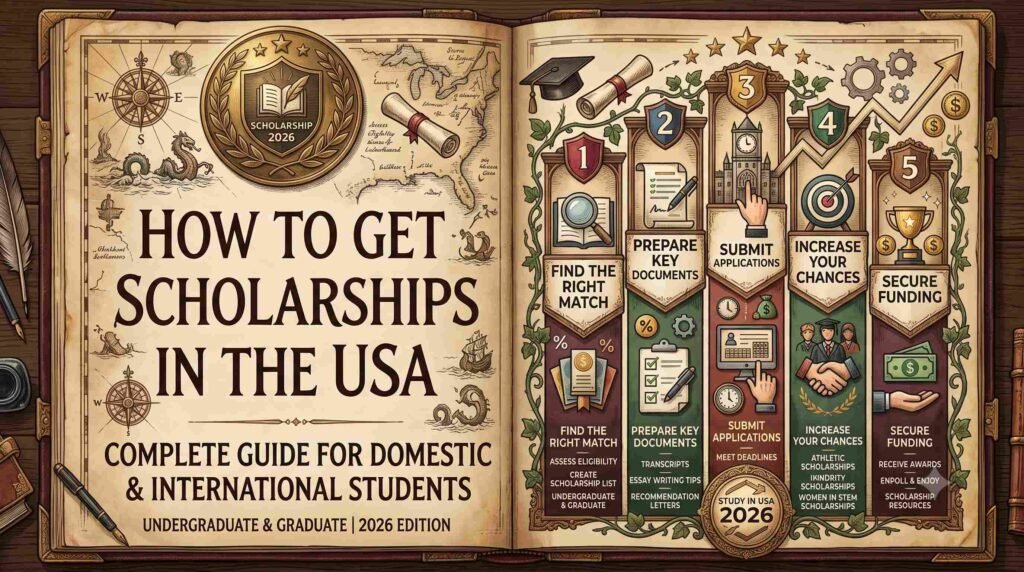
Every year, millions of students dream of studying in the United States but worry about the cost. The price tag of American higher education can feel overwhelming. Tuition, housing, books, and living expenses add up quickly.
Here is the good news: billions of dollars in scholarships go unclaimed every year. Many students simply do not know where to look or how to apply. Others give up before they even start.
This guide will change that. You will learn exactly how to get scholarships in the USA, whether you are a domestic student or an international applicant. We will cover every type of scholarship, where to find them, how to apply, and the mistakes that cost students thousands of dollars.
By the end of this article, you will have a clear roadmap to funding your education. Let us begin.
Table of Contents
- 1. Understanding the Scholarship Landscape in the USA
- 2. Types of Scholarships Available
- 2.1 Merit-Based Scholarships
- 2.2 Need-Based Scholarships
- 2.3 Athletic Scholarships
- 2.4 Departmental and Major-Specific Scholarships
- 2.5 Identity-Based Scholarships
- 2.6 Community Service and Leadership Scholarships
- 2.7 Creative and Talent-Based Scholarships
- 3. Scholarships for International Students
- 4. Where to Find Scholarships
- 5. The Scholarship Application Process
- 6. Scholarship Deadlines: What You Need to Know
- 7. How to Write a Winning Scholarship Essay
- 8. Securing Strong Recommendation Letters
- 9. Common Scholarship Mistakes to Avoid
- 10. Scholarship Interview Tips
- 11. Comparison of Top Scholarship Search Platforms
- 12. Frequently Asked Questions
- 13. Final Conclusion
1. Understanding the Scholarship Landscape in the USA
Before you start applying, you need to understand how scholarships work in the United States. The system is vast, diverse, and competitive. But it is also accessible if you know where to look.
American colleges and universities offer more than $50 billion in scholarships annually. This money comes from federal programs, state governments, private organizations, corporations, and individual donors.
Scholarships are different from student loans. You do not have to repay them. They are essentially free money for education. That is why the competition can be intense.
But here is the thing: many scholarships have specific criteria. Some are for students in certain majors. Others are for students from particular backgrounds. Some are for students with specific talents or interests.
The key is finding the scholarships that match your profile. The more specific the criteria, the fewer applicants you will compete against.
Expert Tip: Start your scholarship search at least 12 to 18 months before you plan to enroll. Many deadlines fall in the fall or winter of the year before you start college. Early preparation gives you a significant advantage over students who wait until the last minute.
Scholarships in the USA fall into two main categories: merit-based and need-based. But there are many subcategories within these. Let us explore them in detail.
2. Types of Scholarships Available
Understanding the different types of college scholarships is essential. Each type has its own application process, requirements, and deadlines. Some are easier to get than others. Some offer small amounts, while others cover full tuition.
Here is a breakdown of the most common scholarship types in the United States.
2.1 Merit-Based Scholarships
Merit scholarships are awarded based on academic achievement, test scores, or other accomplishments. These scholarships do not consider financial need. They reward excellence.
Universities often offer merit scholarships to attract top students. Private organizations also offer them. The amounts vary widely, from a few hundred dollars to full tuition coverage.
To qualify for merit scholarships, you typically need a strong GPA and high standardized test scores. Some also consider leadership, extracurricular activities, and community involvement.
Many top universities offer prestigious merit scholarships. For example, the University of Southern California offers the Trustee Scholarship, which covers full tuition. The University of North Carolina offers the Morehead-Cain Scholarship, which covers full costs.
Pro Tip: Even if you do not have a perfect GPA, you can still win merit scholarships. Many scholarships consider “holistic” applications. They look at your essays, activities, and personal story. Do not count yourself out just because your grades are not flawless.
2.2 Need-Based Scholarships
Need-based scholarships are awarded based on financial need. These scholarships help students who cannot afford to pay for college on their own.
The federal government offers need-based aid through the FAFSA (Free Application for Federal Student Aid). Many colleges also offer institutional need-based scholarships. Private organizations offer them as well.
To apply for need-based aid, you must submit the FAFSA. International students may need to submit the CSS Profile instead. These forms calculate your Expected Family Contribution (EFC).
Need-based scholarships can cover partial or full costs. Some are renewable every year. Others are one-time awards.
Many students assume they will not qualify for need-based aid. But the FAFSA considers many factors. Even middle-class families often qualify for some assistance.
Need-based scholarships are not just for low-income families. Many private colleges offer need-based aid to families earning up to $150,000 or more.
Important Note: Always submit the FAFSA, even if you think you will not qualify. Some scholarship programs require FAFSA submission for consideration. And many states have aid programs that require FAFSA but have higher income thresholds.
2.3 Athletic Scholarships
Athletic scholarships are awarded to student-athletes who excel in sports. These scholarships are offered by colleges and universities in the NCAA, NAIA, and NJCAA.
Athletic scholarships can cover partial or full tuition. Some cover room and board as well. The amount depends on the sport, the level of competition, and the university.
To get an athletic scholarship, you need to be recruited by a college coach. This typically involves attending camps, showcases, and sending game footage. You also need to maintain academic eligibility.
Division I and II schools offer athletic scholarships. Division III schools do not offer athletic scholarships but often provide financial aid through other means.
Not all sports offer full scholarships. Football and basketball often have full scholarships. Sports like track, soccer, and baseball may offer partial scholarships.
Expert Tip: If you are an international student, athletic scholarships can be a powerful pathway to studying in the USA. Many American universities actively recruit international athletes. Start contacting coaches at least two years before you plan to enroll.
2.4 Departmental and Major-Specific Scholarships
Many colleges offer scholarships for students in specific majors or departments. These are often funded by alumni or corporate donors.
STEM majors often have abundant scholarships. Engineering, computer science, and mathematics students can find many opportunities. But humanities, arts, and social sciences also have dedicated funding.
These scholarships may require a separate application. You might need to submit a portfolio, research proposal, or additional essays. Deadlines vary by department.
Departmental scholarships are often less competitive than general scholarships. Fewer students apply because they are not widely advertised. This creates an opportunity for students who research thoroughly.
Pro Tip: Contact the department directly. Ask about scholarship opportunities for incoming students. Many departments have funds they do not widely promote. A simple email can lead to an application you would never find online.
2.5 Identity-Based Scholarships
Identity-based scholarships support students from specific backgrounds. These include scholarships for women, minorities, first-generation students, veterans, and students with disabilities.
These scholarships aim to increase diversity in higher education. Many organizations and foundations offer them. They recognize that certain groups have been historically underrepresented.
For example, the United Negro College Fund offers scholarships for African American students. The Hispanic Scholarship Fund supports Latino students. The American Indian College Fund supports Native American students.
Women have many scholarship opportunities. The American Association of University Women offers funding. The Society of Women Engineers supports women in STEM fields.
First-generation students — those whose parents did not graduate from college — also have many options. Organizations like the First Generation Foundation provide resources and funding.
Did You Know? The American Indian College Fund has provided more than $300 million in scholarships and support to Native American students since its founding in 1989. Many identity-based organizations have similarly impressive track records.
2.6 Community Service and Leadership Scholarships
These scholarships reward students who have made a difference in their communities. They look for leadership, volunteer work, and social impact.
Organizations like the Rotary Club, Kiwanis, and Lions Club offer these scholarships. Universities also offer them. The amounts vary, but some are quite generous.
To apply, you need to demonstrate your community involvement. This could include volunteer hours, organizing events, starting a nonprofit, or leading a team. Letters of recommendation from community leaders are often required.
These scholarships are less about grades and more about character and impact. If you have been active in your community, you have a real chance.
2.7 Creative and Talent-Based Scholarships
These scholarships reward artistic and creative talent. They are for students who excel in music, art, writing, dance, theater, or other creative fields.
Portfolios are central to these applications. For visual arts, you need a strong portfolio. For music, you need audition recordings. For creative writing, you need writing samples.
Many colleges offer talent-based scholarships as part of their admissions process. These can be substantial, especially at arts-focused institutions.
Even if your major is not in the arts, you can still apply for some creative scholarships. Many organizations value creativity and innovation in any field.
3. Scholarships for International Students
International students face unique challenges when applying for scholarships in the USA. Many scholarships are restricted to U.S. citizens or permanent residents. But there are still many opportunities.
First, look at universities themselves. Many American colleges offer scholarships specifically for international students. These can be merit-based, need-based, or both.
Some universities offer full scholarships to international students. Harvard, Yale, and MIT are known for offering generous need-based aid to international applicants. Amherst College offers need-blind admissions for international students.
Second, look at private organizations. The Fulbright Program offers funding for international students. The Mastercard Foundation offers scholarships for African students. The Joint Japan/World Bank Scholarship supports students from developing countries.
Third, look at your home country. Many governments offer scholarships for students to study abroad. Check with your ministry of education or local embassies.
Expert Tip: International students should apply to universities that are “need-blind” for international students. These schools do not consider your ability to pay when making admissions decisions. They also commit to meeting your full financial need. This is rare but exists at a few top institutions.
Here is a table of top scholarships for international students in the USA:
| Scholarship Name | Eligibility | Coverage | Deadline |
|---|---|---|---|
| Fulbright Program | International students (country-specific) | Full tuition, living stipend | Varies by country |
| Mastercard Foundation Scholars Program | African students | Full tuition, living expenses | Varies by university |
| MIT International Student Financial Aid | All international students | Need-based full aid | January 1 |
| Harvard International Financial Aid | All international students | Need-based full aid | January 1 |
| Yale International Student Aid | All international students | Need-based full aid | January 1 |
| Princeton International Financial Aid | All international students | Need-based full aid | January 1 |
| Joint Japan/World Bank Scholarship | Developing country nationals | Full tuition, travel, living | Varies |
International students should also look for scholarships offered by organizations in their home countries. Many governments have agreements with U.S. universities. These can provide significant funding.
Warning: Be careful about scholarship scams. Legitimate scholarships never charge application fees. If a program asks for money to apply or to “process” your application, it is likely a scam. Stick to well-known organizations and university websites.
4. Where to Find Scholarships
Finding scholarships in the USA requires strategy. You cannot just search “scholarships” on Google and expect to find everything. You need to use multiple resources and be systematic.
Here are the best places to look for scholarships:
University Websites
Every college and university has a financial aid page. This is your first stop. Look for scholarships offered by the institution. Many have their own application forms and deadlines.
Some universities automatically consider all admitted students for scholarships. Others require a separate application. Read the instructions carefully.
Scholarship Search Engines
Dedicated search engines are powerful tools. They match you with scholarships based on your profile. Some of the best include:
- Scholarships.com — One of the largest databases. Over 3.7 million scholarships listed.
- Fastweb — Matches you with personalized scholarships. Very user-friendly.
- College Board Scholarship Search — Uses your PSAT/SAT data to match you with relevant scholarships.
- Niche — Offers scholarships and helps you find schools where you might qualify.
- Unigo — Focuses on scholarships and also provides college reviews.
Professional Organizations
Many professional associations offer scholarships. If you know your major, look up the relevant professional organization. For example:
- American Medical Association offers scholarships for medical students.
- Society of Petroleum Engineers offers scholarships for engineering students.
- American Institute of Architects offers scholarships for architecture students.
Corporations and Employers
Many companies offer scholarships. Some are for employees and their children. Others are open to the public.
Examples include the Coca-Cola Scholars Program, the McDonald’s Scholarship Program, and the Walmart Foundation. Tech companies like Google and Microsoft also offer scholarships for STEM students.
Community Organizations
Local organizations are often overlooked. Your local Rotary Club, Kiwanis, Lions Club, and chambers of commerce offer scholarships. Many are for students in their communities. The applicant pool is smaller, so your chances are higher.
Also check with your high school. Guidance counselors often have lists of local scholarships. Many are not advertised online.
Religious and Faith-Based Organizations
Many religious organizations offer scholarships. If you are active in a faith community, ask about opportunities. National organizations like the Catholic Education Foundation and Islamic Scholarship Fund offer funding.
Ethnic and Cultural Organizations
As mentioned earlier, many organizations support students from specific backgrounds. Search for scholarships based on your heritage, ethnicity, or cultural identity.
Pro Tip: Create a spreadsheet to track every scholarship you find. Include the name, deadline, amount, requirements, and status. This will keep you organized and prevent missed deadlines.
Here is a comparison of the top scholarship search platforms:
| Platform | Scholarship Database Size | Best For | Cost |
|---|---|---|---|
| Scholarships.com | 3.7+ million | General search, large database | Free |
| Fastweb | 1.5+ million | Personalized matches, user-friendly | Free |
| College Board | 2,000+ (high quality) | PSAT/SAT takers, vetted scholarships | Free |
| Niche | Thousands | Scholarships + college matching | Free |
| Unigo | Thousands | Easy-to-use interface, unique listings | Free |
5. The Scholarship Application Process
Applying for scholarships is a process. It is not something you do in one sitting. Plan to spend significant time on each application. Quality matters more than quantity.
Here is a step-by-step approach:
Step 1: Research and Identify Scholarships
Start by finding scholarships that match your profile. Use multiple search engines. Check university websites. Talk to your guidance counselor. Create a list of 20 to 30 scholarships you are eligible for.
Step 2: Organize Your Materials
Gather all the materials you will need. This includes your transcripts, test scores, letters of recommendation, and personal information. Having everything ready will save you time.
Create a master document with your academic achievements, extracurricular activities, work experience, volunteer hours, and honors. You will use this for multiple applications.
Step 3: Read Instructions Carefully
Every scholarship has specific requirements. Some require essays. Others require portfolios. Some ask for recommendation letters. Read the instructions thoroughly. Make sure you understand what is needed.
Many students make the mistake of skimming the instructions. This leads to incomplete applications. Take your time. Understand exactly what the selection committee wants.
Step 4: Write Your Essays
Essays are the most important part of many scholarship applications. This is where you differentiate yourself from other applicants. We will cover essay writing in detail in the next section.
Step 5: Secure Recommendation Letters
Request recommendation letters well in advance. Give your recommenders at least two weeks’ notice. Provide them with your resume and a brief summary of the scholarship. This helps them write a stronger letter.
Step 6: Submit Before the Deadline
Do not wait until the last minute. Submit early to avoid technical issues. Many applications close at midnight. If you wait too long, you might miss the deadline entirely.
Double-check your application before submitting. Check for typos, missing information, and correct formatting.
Step 7: Follow Up
After submitting, confirm that your application was received. Some systems send a confirmation email. If not, reach out to the scholarship provider. Also, check if they need any additional information.
Action Step: Set up a dedicated email folder for scholarship communications. This will help you stay organized and track all your applications.
6. Scholarship Deadlines: What You Need to Know
Scholarship deadlines vary widely. Some are in the fall of your senior year. Others are in the spring. Some deadlines are in January or February.
Here are the most important deadlines to know:
Summer and Fall Deadlines
Many scholarships have early deadlines in the summer and fall. These often include prestigious scholarships and those from large organizations.
For example, the Coca-Cola Scholars Program has a deadline in October. The Gates Scholarship has a deadline in September.
Winter Deadlines
Many college-specific scholarships have deadlines in December, January, or February. These are often tied to regular admissions deadlines.
For instance, many universities have scholarship consideration deadlines in December or January. If you want to be considered for institutional merit scholarships, you need to apply by these dates.
Spring Deadlines
There are also spring deadlines. These are for scholarships offered by local organizations, community groups, and smaller foundations. Deadlines can range from February to May.
While these are later, they are also less competitive. Many students have already stopped applying. This creates an opportunity for students who persist.
Rolling Deadlines
Some scholarships have rolling deadlines. They accept applications until funds run out. For these, applying early is especially important. The later you apply, the fewer funds remain.
Common Mistake: Many students miss scholarships because they focus only on early deadlines. They stop applying after January. But many scholarships are available throughout the spring. Keep applying until you have secured enough funding.
Here is a timeline checklist for scholarship applications:
| Timeframe | Action Items |
|---|---|
| 12–18 months before enrollment | Start researching scholarships. Build your list of potential scholarships. Identify essay prompts and requirements. |
| 10–12 months before enrollment | Begin writing essays. Request recommendation letters. Gather transcripts and test scores. |
| 8–10 months before enrollment | Submit early scholarships. Continue researching new opportunities. Refine your essays. |
| 6–8 months before enrollment | Submit major scholarship applications. Apply to college-specific scholarships. Submit FAFSA or CSS Profile. |
| 4–6 months before enrollment | Submit spring scholarships. Check deadlines for local and community scholarships. Follow up on applications. |
| 2–4 months before enrollment | Finalize funding. Compare financial aid offers. Accept scholarships and enroll. |
7. How to Write a Winning Scholarship Essay
Your scholarship essay is your chance to stand out. With hundreds or thousands of applicants, a strong essay can be the difference between winning and losing.
Here is how to write a scholarship essay that gets noticed:
Tell a Compelling Story
Do not just list your achievements. Tell a story. The best essays have a narrative arc. They start with a hook, build tension, and end with a resolution.
Think about a moment that changed you. What challenge did you overcome? What lesson did you learn? How did it shape who you are today?
Stories are memorable. Selection committees read thousands of essays. A good story will stand out.
Be Authentic
Do not try to be someone you are not. Write in your own voice. Be honest about your experiences. Authenticity resonates with readers.
You do not need to have a dramatic story. Everyday experiences can be powerful if you write them well. The key is to be genuine.
Address the Prompt
This sounds obvious, but many students fail to answer the question. Read the prompt carefully. Make sure your essay responds directly to it.
If the prompt asks about your leadership experience, focus on that. Do not write a general essay about your life. Stay on topic.
Show, Do Not Tell
Instead of saying “I am a leader,” show it. Describe a time you led a team. Explain the challenge, your actions, and the outcome. Let the reader conclude that you are a leader.
Use specific details. Instead of “I volunteered,” say “I spent 200 hours tutoring middle school students in math.” Specifics make your essay more believable and impactful.
Connect to Your Future Goals
Scholarship committees want to invest in students who will do great things. Connect your past experiences to your future goals. Explain how the scholarship will help you achieve your dreams.
Show ambition. Show that you have a plan. Show that you are ready to make a difference.
Revise and Edit
Your first draft is not your final draft. Revise your essay multiple times. Read it aloud. Check for clarity and flow. Remove unnecessary words.
Ask someone to read your essay. Get feedback from a teacher, parent, or friend. Fresh eyes can catch mistakes you missed.
Pro Tip: Customize each essay for the specific scholarship. Do not use the same essay for every application. Tailor it to the mission and values of each scholarship provider.
Common Essay Prompts
Here are some common scholarship essay prompts and how to approach them:
- “Tell us about yourself.” — This is an opportunity to introduce your personality, values, and passions. Do not just list facts. Share a story that reveals who you are.
- “Describe a challenge you have overcome.” — Focus on the challenge, your response, and what you learned. Show resilience and growth.
- “Why do you want to study this major?” — Explain your passion. Connect it to your experiences and future goals. Be specific.
- “How will you contribute to our community?” — Show that you are engaged. Explain how you will add value. Highlight your leadership and service.
- “What are your career goals?” — Be ambitious but realistic. Explain how your education will help you achieve your goals.
8. Securing Strong Recommendation Letters
Recommendation letters are a crucial part of many scholarship applications. They provide an outside perspective on your character and abilities.
Here is how to get strong letters of recommendation:
Choose the Right People
Select recommenders who know you well. A teacher who had you in class for a year can write a stronger letter than a principal who barely knows you.
Choose people who can speak to your skills and character. Teachers, mentors, employers, and community leaders are all good options.
Avoid family members. They are seen as biased. Also avoid friends or peers. The most credible letters come from people in positions of authority.
Ask Early
Give your recommenders plenty of time. At least two to three weeks is recommended. More time is better.
Asking early shows respect for their time. It also ensures they can write a thoughtful letter, not a rushed one.
Provide Materials
Help your recommenders write strong letters. Provide them with:
- A copy of your resume or list of activities
- A summary of the scholarship and its requirements
- Information about your goals and what you want them to highlight
- A deadline and submission instructions
This makes it easier for them to write a specific, detailed letter.
Write a Thank You Note
After they submit the letter, send a thank you note. This is common courtesy. It also maintains a positive relationship for future recommendations.
Expert Tip: If you are applying to multiple scholarships, ask your recommenders to write a general letter. They can then customize it for each application. This is more efficient for both of you.
9. Common Scholarship Mistakes to Avoid
Many students make mistakes that cost them scholarships. Here are the most common pitfalls and how to avoid them:
Missing Deadlines
This is the most common mistake. Deadlines are absolute. If you miss them, you cannot apply.
To avoid this, create a calendar with all deadlines. Set reminders. Submit early. Do not wait until the final day.
Not Reading Instructions
Many students submit incomplete applications because they did not read the instructions. Read every requirement carefully. Make sure you have all the necessary materials.
Applying to Too Many or Too Few Scholarships
Some students apply to every scholarship they find. Others apply to only a few. Both approaches are problematic.
Apply to a manageable number of scholarships. Focus on quality over quantity. A well-crafted application to 10 scholarships is better than poor applications to 50.
But also, do not limit yourself. Apply to as many scholarships as you can handle. Each award reduces your costs.
Submitting Generic Essays
Generic essays are easy to spot. They lack personality and specificity. Each scholarship is unique. Your essay should be too.
Take time to research each scholarship. Understand its mission. Tailor your essay accordingly. This extra effort will pay off.
Ignoring Small Scholarships
Many students ignore small scholarships. They think the amount is not worth the effort. But small scholarships add up. A $1,000 scholarship is still $1,000 less you need to borrow.
Small scholarships are also less competitive. Your chances of winning are higher. Do not overlook them.
Forgetting to Proofread
Typos and grammatical errors create a bad impression. They suggest carelessness. Always proofread your application. Read it aloud. Ask someone else to review it.
Not Applying for Need-Based Aid
Many students assume they will not qualify for need-based aid. But the FAFSA considers many factors. You might qualify for more than you think.
Always submit the FAFSA. It is free and opens the door to many opportunities.
Warning: Never pay for scholarship applications. Legitimate scholarships are free to apply. If a scholarship asks for a fee, it is likely a scam.
10. Scholarship Interview Tips
Some scholarships require an interview. This is the final step in the selection process. If you are invited to an interview, you are already a strong candidate. Now you need to seal the deal.
Prepare for Common Questions
Practice your responses to common interview questions. Here are some examples:
- Tell me about yourself.
- Why do you deserve this scholarship?
- What are your strengths and weaknesses?
- What are your career goals?
- Tell me about a time you overcame a challenge.
- How will you contribute to our community?
- Why do you want to study at this university?
Research the Scholarship
Understand the scholarship’s mission and values. Know the organization behind it. This will help you tailor your answers and show that you are invested.
Dress Professionally
First impressions matter. Dress in professional attire. Business casual is usually appropriate. Avoid overly casual clothes.
Be Confident but Humble
Confidence is attractive. But arrogance is not. Strike a balance. Be proud of your achievements but also show that you are ready to learn and grow.
Ask Questions
Interviews are a two-way conversation. Ask thoughtful questions about the scholarship and the organization. This shows engagement and genuine interest.
Follow Up with a Thank You
Send a thank you email or note after the interview. It is a simple gesture that leaves a positive impression.
Pro Tip: Practice your interview with a friend or family member. Mock interviews help you refine your responses and reduce anxiety.
11. Comparison of Top Scholarship Search Platforms
Choosing the right scholarship search tool can make a big difference. Here is a detailed comparison of the most popular platforms:
| Feature | Scholarships.com | Fastweb | College Board | Niche | Unigo |
|---|---|---|---|---|---|
| Database Size | 3.7+ million | 1.5+ million | 2,000+ curated | Thousands | Thousands |
| Personalized Matching | Yes | Yes | Yes (via SAT/PSAT) | Yes | Yes |
| Scholarship Amount Range | $100–$100,000+ | $100–$50,000+ | $100–$50,000+ | $100–$25,000+ | $100–$50,000+ |
| Additional Resources | Student loans, career advice | College search, financial aid | SAT/AP resources | College reviews, rankings | College reviews |
| Mobile App | Yes | Yes | Yes | Yes | Yes |
| Cost | Free | Free | Free | Free | Free |
Each platform has its strengths. Scholarships.com has the largest database. Fastweb is known for its user-friendly interface. College Board offers curated, high-quality scholarships. Niche combines scholarships with college matching. Unigo is easy to navigate and has unique listings.
Use multiple platforms for the best results. Each will match you with different scholarships.
12. Frequently Asked Questions
1. What is the best way to find scholarships in the USA?
The best strategy combines multiple approaches. Use scholarship search engines like Fastweb and Scholarships.com. Check university financial aid websites. Research professional organizations in your field. Ask your guidance counselor about local scholarships. And apply to as many as you qualify for. Do not rely on any single source.
2. When should I start applying for scholarships?
Start at least 12 to 18 months before you plan to enroll. Many deadlines fall in the fall and winter of your senior year. Early preparation gives you more time to write essays, gather materials, and find opportunities you might otherwise miss.
3. Can international students get scholarships in the USA?
Yes. Many U.S. universities offer scholarships for international students. Some are need-based, others are merit-based. Additionally, organizations like the Fulbright Program and Mastercard Foundation offer scholarships. International students should also check with their home governments for study abroad funding.
4. What are the most common types of college scholarships?
The most common types are merit-based scholarships, need-based scholarships, athletic scholarships, identity-based scholarships, departmental scholarships, and community service scholarships. Each has different eligibility criteria and application requirements.
5. How important are recommendation letters for scholarships?
Very important. A strong recommendation letter can differentiate you from other applicants. Choose recommenders who know you well. Give them enough time to write a thoughtful letter. Provide them with the information they need to write a strong recommendation.
6. How can I write a winning scholarship essay?
Tell a compelling story. Be authentic. Address the prompt directly. Show, do not tell. Connect your past experiences to your future goals. Revise and edit your essay multiple times. Customize each essay for the specific scholarship.
7. What are the biggest mistakes students make on scholarship applications?
Missing deadlines, not reading instructions, submitting generic essays, ignoring small scholarships, forgetting to proofread, and not applying for need-based aid are the most common mistakes. Avoid these by being organized, thorough, and careful.
8. Do I need to submit the FAFSA for scholarships?
Not all scholarships require the FAFSA. But many need-based scholarships do. Even if you are applying for merit scholarships, submitting the FAFSA is a good idea. It opens the door to federal aid and some scholarships that require it. It is free, so there is no downside.
9. Are there scholarships for graduate students?
Yes. Many scholarships are specifically for graduate students. These include fellowships, research grants, and teaching assistantships. Check with your graduate department and professional organizations. The Fulbright Program and the National Science Foundation also offer graduate funding.
10. How can I avoid scholarship scams?
Legitimate scholarships never charge application fees. They also do not ask for sensitive financial information like your bank account. Stick to well-known organizations, university websites, and reputable scholarship search engines. If something seems too good to be true, it probably is.
11. How many scholarships should I apply for?
Apply to as many scholarships as you can manage. Quality matters more than quantity. A well-crafted application to 10 scholarships is better than poor applications to 50. Start with a manageable number and increase as you become more efficient.
12. What should I do if I am waitlisted for a scholarship?
Be patient. Waitlisted applicants are often offered awards if selected recipients decline. Continue applying to other scholarships. There is no penalty for receiving multiple scholarships. Accept the best offers and decline others.
13. Can I combine multiple scholarships?
Usually, yes. Most scholarships allow you to combine awards. Check the terms of each scholarship. Some limit how much aid you can receive. But generally, you can stack scholarships to cover more of your costs.
14. What if I miss a scholarship deadline?
If you miss a deadline, you cannot apply for that scholarship. But do not get discouraged. There are always more opportunities. Look for scholarships with later deadlines. Apply to those instead. And set up a calendar system to prevent missing future deadlines.
15. How do scholarship committees choose winners?
Committees look at multiple factors. They consider your academic record, test scores, essays, recommendation letters, and extracurricular activities. Some prioritize specific criteria like leadership or community service. The best applications show a combination of excellence and alignment with the scholarship’s mission.
13. Final Conclusion
Getting scholarships in the USA is achievable. It requires effort, organization, and persistence. But the payoff is enormous. Scholarships can reduce or eliminate the cost of your education.
Remember these key points:
- Start early and stay organized.
- Use multiple search strategies and platforms.
- Apply to a wide range of scholarships, both large and small.
- Write compelling, authentic essays that tell your unique story.
- Secure strong recommendation letters from people who know you well.
- Avoid common mistakes like missing deadlines and submitting generic applications.
- Always submit the FAFSA to unlock need-based aid opportunities.
Every scholarship you win reduces the amount you need to borrow. It is a direct investment in your future. Do not let the process intimidate you. Take it one step at a time.
You have the ability to fund your education. The opportunities are out there. Now you know exactly how to find them and what to do once you do.
Start your search today. Your future self will thank you.