

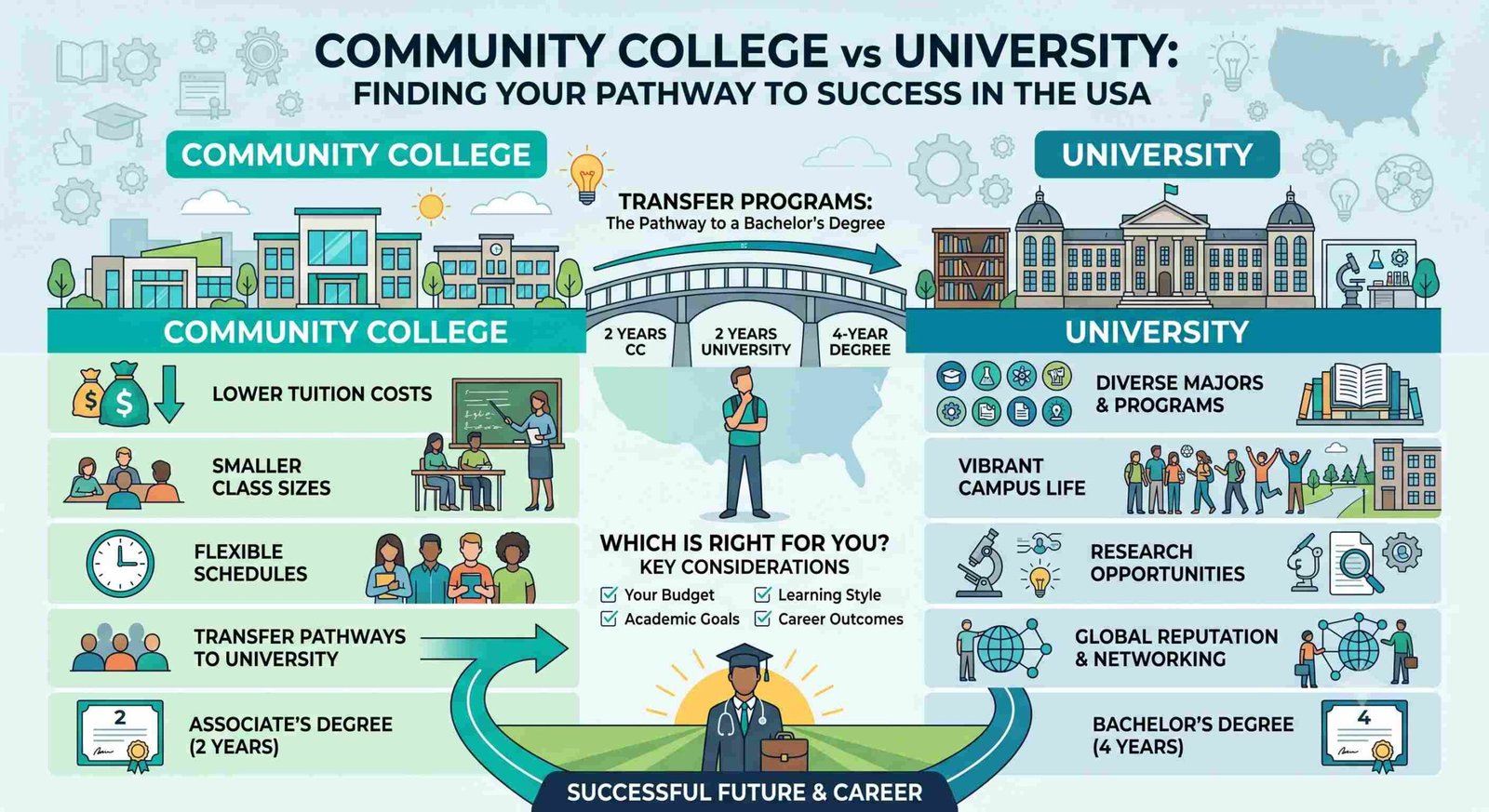
Choosing between a community college and a university is one of the most significant decisions you’ll make in your educational journey. With rising tuition costs, shifting job market demands, and evolving career pathways, the choice isn’t always as straightforward as it used to be.
Every year, millions of American students face this crossroads. Should you start at a community college and transfer later? Or does jumping straight into a four-year university offer a better return on investment? The answer depends on your personal goals, financial situation, and academic preferences.
This comprehensive guide explores every angle of the community college vs university debate. We’ll break down costs, academic quality, career outcomes, campus life, and transfer pathways—giving you the clarity you need to make the right choice for your future.
Cost Comparison: Tuition, Fees, and Hidden Expenses
Let’s start with the most tangible factor: money. The cost difference between community colleges and universities in the USA is substantial, and it’s often the primary driver behind many students’ decisions.
According to the College Board’s Trends in College Pricing 2024 report, the average published tuition and fees for in-state students at public four-year universities was approximately $11,260 per year, while community college tuition averaged just $3,990 per year. That’s a difference of more than $7,000 annually—and the gap widens significantly when you factor in room and board.
Tuition and Fees Breakdown
Community colleges charge significantly less because they rely more heavily on state and local funding and don’t typically offer residential facilities. Their mission is to serve the local community with accessible, affordable education.
Universities, on the other hand, invest heavily in research facilities, extensive libraries, specialized faculty, and campus infrastructure—all of which drive up costs. Private universities are in a league of their own, with average tuition exceeding $41,000 per year.
Room and Board
Most community colleges don’t offer on-campus housing, so students typically live at home or arrange their own off-campus housing. This can be a significant cost saver.
University students often live on campus or in university-affiliated housing, with room and board averaging $12,000–$15,000 per year at public institutions and even more at private schools. When you combine tuition, fees, and living expenses, the total cost of attending a four-year university can easily exceed $30,000 per year.
Hidden Costs to Consider
Beyond tuition and housing, both pathways come with additional expenses:
- Textbooks and supplies: Community college students often spend $1,200–$1,500 per year, while university students may spend $1,500–$2,000 or more.
- Transportation: Community college commuters spend on gas and parking, while university students may pay for campus transportation or maintain a vehicle.
- Student fees: Both institutions charge activity fees, technology fees, and health services fees, though these tend to be higher at universities.
- Opportunity cost: University students often take four full years to complete their degree, while community college students can sometimes accelerate their timeline.
| Cost Category | Community College (Avg.) | Public University (In-State, Avg.) | Private University (Avg.) |
|---|---|---|---|
| Tuition & Fees | $3,990 | $11,260 | $41,540 |
| Room & Board | $0–8,000 | $12,000 | $14,500 |
| Books & Supplies | $1,300 | $1,500 | $1,700 |
| Transportation | $1,200 | $1,500 | $1,200 |
| Estimated Total | $6,500–13,000 | $26,000 | $58,000+ |
Expert Tip: Many community college students qualify for federal Pell Grants and state financial aid that can cover the full cost of tuition. This means you could complete your first two years of college virtually debt-free while exploring your academic interests.
Warning: Avoid the trap of assuming that all universities are “too expensive” and all community colleges are “cheap.” Private universities often have substantial endowments and offer generous need-based aid that can bring the cost down significantly for lower-income families.
Academic Experience: Class Sizes, Faculty, and Curriculum
The academic environment differs significantly between community colleges and universities. Understanding these differences is crucial because they affect how you learn, how much individual attention you receive, and how prepared you’ll be for your career or further education.
Class Size and Student-to-Faculty Ratio
Community colleges typically offer smaller class sizes, especially in foundational courses. Average class sizes range from 15–25 students, and you’ll often have direct access to your instructors. Professors at community colleges are primarily focused on teaching rather than research.
Universities, particularly large public universities, often have massive introductory lecture classes with 200–500 students. Teaching assistants may lead discussion sections, and you might interact more with graduate students than with tenured faculty in your first year.
Faculty Qualifications
Community college instructors typically hold master’s degrees and have extensive teaching experience. Many are professionals with real-world experience in their fields, bringing practical knowledge to the classroom.
University professors usually hold doctoral degrees and are actively engaged in research. While they’re leaders in their fields, their primary focus may be on research and publishing rather than teaching—especially at research-intensive universities.
Curriculum and Academic Rigor
Both community colleges and universities offer rigorous academic programs. Community college courses cover the same foundational material as university courses and are transferable to four-year institutions.
However, the pace and depth can differ. University courses often move faster and require more independent study. Community colleges tend to provide more structured support for students, including tutoring centers, writing labs, and academic advising.
Program Offerings
Community colleges primarily offer associate degrees, certificates, and vocational training. They excel in career-focused programs like nursing, information technology, culinary arts, automotive technology, and paralegal studies.
Universities offer bachelor’s, master’s, and doctoral degrees across hundreds of disciplines. They provide more specialized and advanced coursework, research opportunities, and access to cutting-edge technology and laboratories.
| Academic Factor | Community College | University |
|---|---|---|
| Average Class Size | 15–25 students | 30–500+ students |
| Teaching Focus | Teaching-centered | Research-centered |
| Faculty Credentials | Master’s degrees | Doctoral degrees |
| Degree Offerings | Associate, certificates | Bachelor’s, master’s, doctoral |
| Research Opportunities | Limited | Extensive |
| Academic Support | Strong emphasis | Available but less personalized |
Pro Tip: If you’re unsure about your major or career direction, starting at a community college gives you two years to explore different fields at a lower cost. Use this time to take a variety of courses and discover what truly interests you.
Career Outcomes: Job Placement, Salaries, and Networking
One of the most important questions students ask is: “Will I get a good job after graduation?” The answer depends on many factors, including your field of study, geographic location, and the specific institution you attend.
Employment Rates
According to the U.S. Bureau of Labor Statistics, the unemployment rate for bachelor’s degree holders is consistently lower than for associate degree holders. However, this gap narrows significantly when comparing graduates in high-demand technical and healthcare fields.
Community college graduates in fields like nursing, radiologic technology, IT, and skilled trades often find employment immediately after graduation—sometimes before they even complete their programs.
Earning Potential
On average, bachelor’s degree holders earn significantly more over their lifetimes than associate degree holders. According to the Georgetown University Center on Education and the Workforce, bachelor’s degree holders earn an average of $2.8 million over their careers, while associate degree holders earn about $2.0 million.
But these are averages, and they don’t tell the whole story. Many associate degree holders in specialized fields earn more than bachelor’s degree holders in oversaturated fields. An associate-prepared registered nurse or IT specialist can out-earn a bachelor’s graduate in humanities or social sciences.
Networking Opportunities
Universities typically have stronger alumni networks, more employer connections, and more active career fairs. Large universities often have dedicated career services centers that host hundreds of recruiters each year.
Community colleges also have career services and employer connections, but the scale is usually smaller. Many community colleges work with local employers who specifically seek graduates from their programs.
Internship and Work-Study Options
Universities offer more formal internship programs, co-op opportunities, and research assistantships. These experiences can be invaluable for building your resume and professional network.
Community colleges often emphasize practical training and hands-on experience through clinical placements, apprenticeships, and externships. These experiences are directly aligned with career readiness.
Expert Insight: Many employers care more about your skills and experience than the specific institution you attended. Demonstrating competence through internships, certifications, and real-world projects can outweigh the prestige of a university name on your resume.
Campus Life: Social Scene, Extracurriculars, and Community
The social and extracurricular aspects of college life can be just as important as the academic experience. For many students, the friendships, clubs, and activities they engage in outside the classroom shape their college memories and personal development.
Student Organizations and Clubs
Universities typically have hundreds of student organizations covering every conceivable interest—academic clubs, cultural groups, performing arts, sports, volunteer organizations, and more. There’s almost always something happening on campus.
Community colleges have fewer student organizations, but many still offer a solid selection of clubs and activities. The focus tends to be more on academic and career-oriented groups rather than social or recreational ones.
Sports and Athletics
If you’re passionate about college sports, universities offer the full experience—NCAA Division I or II athletics, tailgating, school spirit, and massive stadiums. Even smaller universities have vibrant athletic programs.
Community colleges have athletic programs too, but they’re typically at the junior college level. Games are well-attended but lack the spectacle and fervor of university sports.
Housing and Residential Life
Living on campus is one of the defining experiences of university life. Residence halls, dormitory communities, and campus housing foster close friendships, late-night study sessions, and a sense of belonging.
Community colleges rarely offer on-campus housing. Students commute from home or nearby apartments, which can make it harder to build deep connections with fellow students. However, many community college students form study groups and friendships through shared classes.
Cultural and Social Events
Universities regularly host concerts, speaker series, film screenings, art exhibitions, and cultural festivals. These events are often free or discounted for students and contribute to a vibrant campus atmosphere.
Community colleges host events too, but on a smaller scale. They often partner with local community organizations to provide cultural programming and are deeply integrated into the surrounding community.
| Campus Life Aspect | Community College | University |
|---|---|---|
| Student Organizations | Limited, career-focused | Extensive, diverse |
| Sports Programs | Junior college level | NCAA Division I–III |
| On-Campus Housing | None or very limited | Extensive residential system |
| Campus Events | Moderate, community-focused | Extensive, student-centered |
| Greek Life | None or limited | Fraternities and sororities |
Quick Fact: According to the American Association of Community Colleges, nearly 30% of community college students are parents, and the average age is 27. These students often have family and work responsibilities that shape their campus experience differently.
Transfer Programs: Making the Leap from Community College to University
For many students, the ideal pathway is to start at a community college and transfer to a university to complete their bachelor’s degree. This hybrid approach combines the cost savings of community college with the prestige and resources of a university.
How Transfer Programs Work
Many community colleges have formal articulation agreements with nearby universities that guarantee admission to transfer students who meet certain GPA and course requirements. These agreements specify exactly which courses transfer and how they apply to specific majors.
Some states, such as California, Texas, and Florida, have statewide transfer agreements that make it easier for students to move between community colleges and public universities within the state system.
Benefits of Starting at a Community College
Starting at a community college before transferring offers several distinct advantages:
- Cost savings: You’ll save tens of thousands of dollars on your first two years of college.
- Smaller classes: You’ll receive more individual attention and support as you build your academic foundation.
- College readiness: Community colleges provide a supportive environment for students who need to develop study skills, time management, or remediation in certain subjects.
- Exploration: You can explore different fields of study without the pressure of a major declaration deadline.
- Higher GPA: Many students achieve higher GPAs at community college and then transfer with strong academic records.
Challenges of Transferring
While transfer pathways offer tremendous benefits, they also come with challenges:
- Credit transfer issues: Not all credits may transfer, especially from private or out-of-state institutions. Some courses may transfer as electives rather than fulfilling core requirements.
- Adjustment period: Moving from a community college to a university can be a culture shock—larger classes, different campus culture, and higher academic expectations.
- Timing: Transferring mid-year or in the spring semester can limit housing options and course availability.
- Financial aid: Your financial aid package may change when you transfer, and university financial aid offices often have different policies.
Steps to a Successful Transfer
If you’re considering the transfer pathway, follow these steps to maximize your chances of success:
- Research early: Start researching universities and their transfer requirements in your first year of community college.
- Meet with advisors: Both community college and university advisors can help you plan your course selection.
- Check articulation agreements: Look for formal transfer agreements that guarantee admission and course equivalency.
- Maintain a strong GPA: Transfer admissions are competitive, especially for popular majors.
- Complete prerequisites: Make sure you take courses that fulfill major requirements at your target university.
- Apply early: Transfer application deadlines are often earlier than you expect.
- Visit campuses: If possible, visit your target university to get a feel for the campus culture.
Action Step: Before enrolling in a community college, check whether your target university has a transfer agreement. Visit the university’s admissions page and look for “transfer admissions” or “transfer agreements” to find specific information.
Pros and Cons: Community College vs University Side-by-Side
Let’s lay out the advantages and disadvantages of each pathway clearly so you can see the trade-offs at a glance.
Community College: Pros
- Affordability: Significantly lower tuition and fees.
- Flexibility: Evening, weekend, and online classes accommodate work and family schedules.
- Smaller classes: More individual attention and support.
- Open access: Most community colleges have open enrollment, making them accessible to all students.
- Career-focused programs: Direct training for in-demand careers.
- Supportive environment: Additional resources for students who need academic support.
- Less debt: Graduate with much less student loan debt.
Community College: Cons
- Limited degree options: Fewer bachelor’s degree programs and advanced coursework.
- Less campus life: Fewer clubs, sports, and social activities.
- No residential experience: Miss out on the “traditional” college experience.
- Transfer challenges: Credits may not transfer as expected.
- Less name recognition: Some employers may be more familiar with university graduates.
- Fewer research opportunities: Limited access to labs, faculty research, and advanced facilities.
University: Pros
- Wide range of majors: Hundreds of degree options and interdisciplinary programs.
- Rich campus life: Extensive clubs, sports, arts, and social activities.
- Residential community: Living on campus builds lifelong friendships and connections.
- Research opportunities: Access to cutting-edge research, labs, and faculty mentors.
- Networking: Strong alumni networks and employer connections.
- Name recognition: Prestigious universities can open doors to certain careers.
- Advanced degrees: Direct pathways to graduate and professional programs.
University: Cons
- Higher cost: Tuition and fees are significantly more expensive.
- Larger classes: Less individual attention in large lecture courses.
- More debt: Students graduate with more student loan debt on average.
- Competitive admissions: Not all students are accepted to their preferred universities.
- Less flexibility: Course schedules may be less accommodating for working students.
- Pressure: More competitive environment with higher expectations.
| Factor | Community College | University |
|---|---|---|
| Cost | ✓ Lower | ✗ Higher |
| Class Size | ✓ Smaller | ✗ Larger |
| Degree Options | ✗ Limited | ✓ Extensive |
| Campus Life | ✗ Less vibrant | ✓ Rich and diverse |
| Transfer Flexibility | ✓ Yes, with agreements | N/A |
| Research Opportunities | ✗ Limited | ✓ Extensive |
| Networking | ✗ Local | ✓ National/Global |
| Career Training | ✓ Practical | ✓ Theory & Practical |
Who Should Choose Community College? Who Should Choose University?
Now that we’ve explored all the factors, let’s get practical. Here’s guidance on which path might be right for you based on your unique situation, goals, and priorities.
Community College Might Be Right for You If…
- You’re cost-conscious: You want to minimize student loan debt and are concerned about the financial burden of four years of university tuition.
- You’re not sure about your major: You want to explore different subjects and career paths without committing to a specific major or university.
- You need flexibility: You have work or family responsibilities that require a schedule that a traditional university may not accommodate.
- You need academic support: You may benefit from smaller classes, tutoring, and more individualized attention as you transition to college-level work.
- You’re pursuing a career-focused program: You know you want to enter a specific field like nursing, IT, paralegal studies, or the skilled trades where an associate degree is sufficient.
- You’re returning to school: You’re an adult learner or returning to education after a significant gap.
- You want a local option: You prefer to stay close to home, family, and your existing community.
University Might Be Right for You If…
- You know your major: You have a clear career direction and want to pursue specialized coursework from day one.
- You’re interested in research: You want to work in a lab, conduct research, or pursue graduate studies.
- You want the full college experience: Campus life, residential housing, clubs, sports, and social activities are important to you.
- You’re aiming for a competitive career: You’re targeting a field like law, medicine, finance, or academia where university prestige and advanced degrees matter.
- You have the financial means or aid: You have access to scholarships, grants, or family support that makes university affordable.
- You want to live away from home: You’re ready for independence and want to experience life in a new city or state.
- You value name recognition: The reputation and alumni network of a specific university are important to your career goals.
Common Mistake: Some students choose university solely because they feel it’s “expected” of them or because of social pressure. If you’re not academically prepared or financially secure, starting at a community college and transferring later is a smart and strategic move—not a step backward.
Real-World Examples: Success Stories and Cautionary Tales
Real stories from real students can help illuminate the community college vs university decision. Here are a few examples that illustrate different pathways and outcomes.
Success Story: The Transfer Path
Sarah’s Journey: Sarah graduated from high school with average grades and a dream of becoming a nurse. She couldn’t afford the private university she was accepted to, so she enrolled in her local community college’s associate degree in nursing program. She completed her associate degree, passed the NCLEX-RN, and began working as a registered nurse while completing her bachelor’s degree online through a partnership program. Within five years, she had her BSN, zero student debt, and was promoted to a supervisory role at a major hospital.
Key takeaway: The transfer pathway allowed Sarah to enter the workforce quickly while advancing her education at her own pace—all without taking on massive debt.
Success Story: The Direct University Path
James’s Journey: James knew from a young age that he wanted to be an aerospace engineer. He excelled in math and science, earned strong SAT scores, and was admitted to a top engineering school. He took advantage of internships, research opportunities, and the university’s strong industry connections. Upon graduation, he landed a position at SpaceX, where his university’s reputation and his internship experience played a significant role in his hiring.
Key takeaway: For students with clear career goals in competitive technical fields, a direct university path can provide invaluable access to research, internships, and industry networking.
Cautionary Tale: The Unplanned Transfer
Megan’s Experience: Megan enrolled in a community college with the intention of transferring to her state university after two years. However, she didn’t research transfer requirements early enough and took courses that didn’t align with her target major. She also missed the transfer application deadline. She ended up spending an extra year at community college and lost financial aid eligibility during the transition.
Key takeaway: Planning ahead is essential for a smooth transfer. Meet with advisors early, check transfer agreements, and stay on top of deadlines.
Cautionary Tale: The Wrong University
David’s Experience: David chose a private university that was a “reach” for his academic profile. He struggled in large classes, didn’t have support systems in place, and ended up on academic probation after his first year. He transferred to a community college, rebuilt his GPA, and eventually transferred to a public university where he flourished.
Key takeaway: Fit matters more than prestige. A university that’s the “right name” but the wrong environment can lead to academic struggles and unnecessary expense.
Frequently Asked Questions
1. Is a community college degree worth less than a university degree?
No. An associate degree from a community college is a legitimate, valuable credential recognized by employers and other institutions. In many fields, associate degree holders earn competitive salaries and are highly sought after by employers. The key difference is that a university offers bachelor’s and advanced degrees, which can open up additional career pathways and higher earning potential over time.
2. Can I transfer from a community college to any university?
Yes, community college students can transfer to universities, but the ease of transfer depends on the specific institution and your academic record. Many public universities have articulation agreements with local community colleges that guarantee admission and course equivalency. Private universities may be more selective and have individual transfer requirements. It’s essential to research your target university’s transfer policies early.
3. How much money can I save by starting at a community college?
The savings are substantial. Based on average tuition and fees, attending a community college for two years can save you more than $14,000 compared to a public in-state university and more than $75,000 compared to a private university. When you factor in room and board, the savings can be even greater—often exceeding $50,000 over the course of your entire college journey.
4. Do employers care if I went to a community college?
Most employers care more about your skills, experience, and how you present yourself than the specific institution you attended. In fields like healthcare, IT, and skilled trades, community college graduates are highly valued. For fields like law, finance, and academia, university prestige may carry more weight. Ultimately, your skills, internships, and professional network are what matter most.
5. Can I get financial aid at a community college?
Yes. Community college students are eligible for the same federal financial aid as university students, including Pell Grants, Stafford Loans, and work-study programs. Many community colleges also offer institutional scholarships and state-based aid. In many cases, financial aid can cover the full cost of community college tuition, making education virtually free.
6. Is campus life at a community college boring?
Not necessarily. While community colleges don’t have the same breadth of activities as universities, many have active student organizations, cultural events, and athletics. The social experience is different—less “college movie” and more “real life”—but there are still plenty of opportunities to connect with classmates and build community.
7. Can I get a bachelor’s degree at a community college?
A growing number of community colleges now offer bachelor’s degree programs in high-demand fields like nursing, IT, education, and applied technology. These programs are typically offered in partnership with universities or through statewide initiatives. Check with your local community college to see what degree options are available.
8. How long does it take to transfer from community college to university?
Most transfer agreements are structured so that students spend two years at community college and two years at university, graduating with a bachelor’s degree in four years total. However, the timeline can vary based on your major, credit transfer issues, and whether you attend full-time. Some students take longer, especially if they work part-time or have family responsibilities.
9. Do university classes transfer back to community colleges?
Yes, university credits can transfer back to community colleges, especially if you’re pursuing an associate degree after completing some university coursework. However, the transfer policies vary by institution, and you should always verify with the community college’s registrar before assuming credits will transfer.
10. What’s the average GPA for transfer students?
Transfer admission requirements vary by institution and major. Most public universities require a minimum GPA of 2.5–3.0 for transfer students, while competitive programs and private universities may require 3.5 or higher. The best strategy is to aim for the highest GPA possible and complete all prerequisite courses in your intended major.
11. Can I transfer from a community college to an Ivy League university?
Yes, but it’s highly competitive. Ivy League universities accept very few transfer students each year, and those who are admitted typically have outstanding academic records and compelling personal stories. If your goal is to transfer to an elite university, you’ll need to excel academically and build a strong extracurricular portfolio.
12. What should I do if I can’t afford university tuition?
If university tuition is beyond your financial reach, starting at a community college is an excellent alternative. You can complete your first two years at a fraction of the cost, then transfer to a university to finish your bachelor’s degree. This pathway not only saves money but also allows you to build a strong academic record that can help you qualify for scholarships and aid at the university level.
13. Can I work while attending community college or university?
Yes. Many community college students work part-time or even full-time while attending school, thanks to the flexible scheduling options. University students can work too, but the demanding pace and fixed class schedules may make it harder to maintain significant work hours. On-campus jobs, work-study, and internships are available at both types of institutions.
14. Which option is better for international students?
International students often find better opportunities at universities, which typically have established international student support services, cultural organizations, and visa guidance. However, community colleges are becoming more popular among international students due to lower costs and smaller class sizes. The right choice depends on your individual goals and financial situation.
15. Can I change my mind after starting?
Absolutely. Many students start at a university and transfer to a community college (or vice versa). Your educational pathway is flexible, and you can adjust your plans as your goals evolve. The key is to work closely with academic advisors to ensure your credits transfer and you stay on track toward your ultimate degree.
Conclusion: Making Your Final Decision
The choice between community college and university is deeply personal. There is no single “right” answer—only the right answer for you. Both pathways have led countless students to successful, fulfilling careers, and both have their unique advantages and challenges.
If you’re looking to save money, explore your options, and build a strong academic foundation, community college is an excellent choice. It’s not a “lesser” option—it’s a strategic one that millions of students use to get ahead without taking on crippling debt.
If you have a clear career vision, want the full residential campus experience, and have the financial means or aid to support it, university may be the perfect place for you to thrive.
And remember: you’re not locked into one decision forever. Many students start at community college and transfer to university, enjoying the best of both worlds. Others start at university and later decide to pursue a more flexible pathway. Your educational journey is yours to design.
Action Step: Take the information in this guide and apply it to your unique situation. Talk to your family, meet with academic advisors, and visit campuses if possible. Then make an informed decision that aligns with your goals, your budget, and your dreams.
Whichever path you choose, commit to it wholeheartedly. Make the most of your classes, build meaningful relationships, and never stop learning. Your future is bright—and it starts now.