

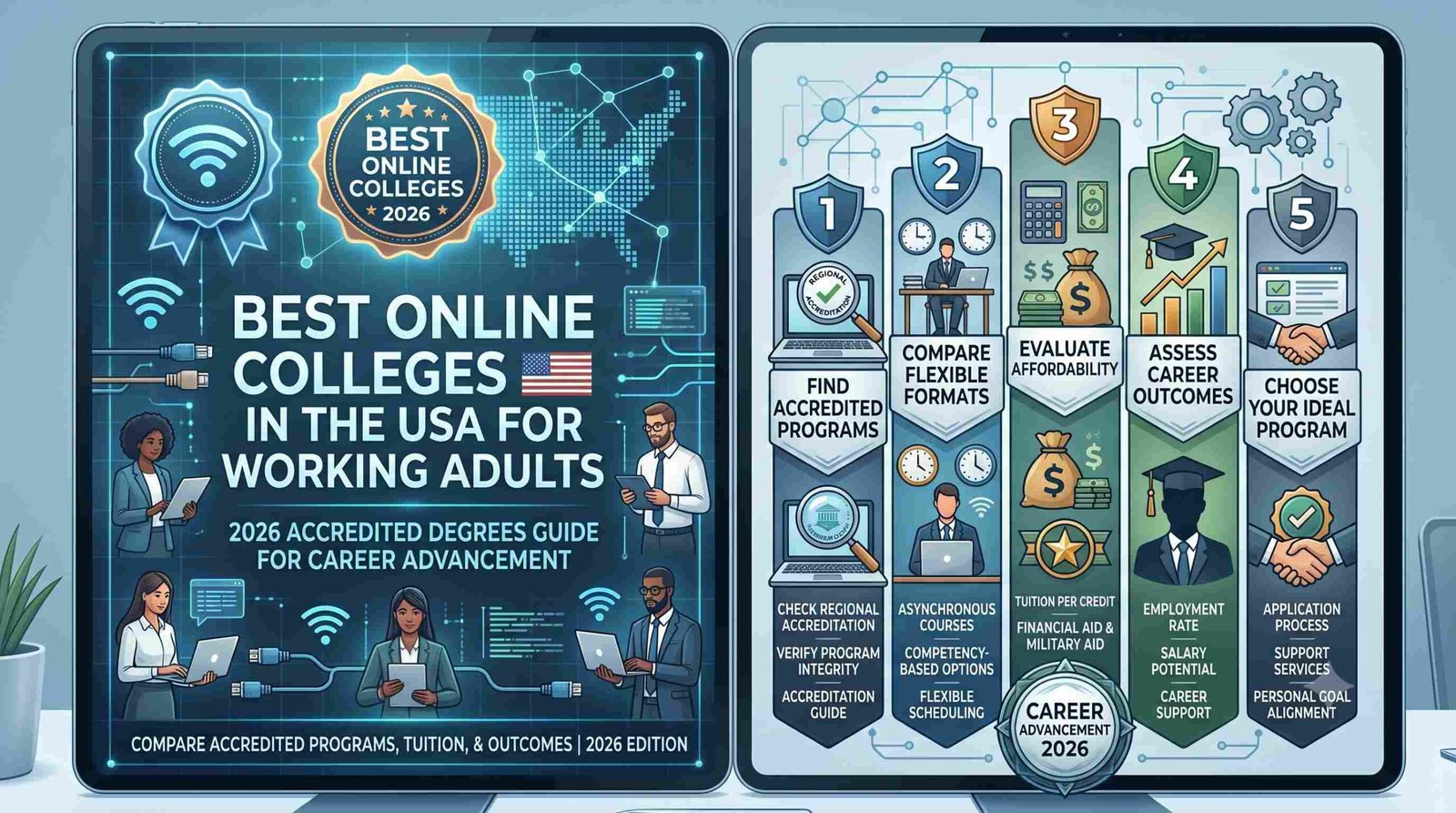
You work hard. You have a full plate—career, family, maybe a side hustle or two. And you know that earning a college degree could open doors to promotions, higher pay, and new career paths. But the thought of sitting in a traditional classroom while juggling everything else? That feels impossible.
Here is the good news: it is not.
Online education has matured dramatically. In 2026, top-tier universities offer fully accredited online bachelor’s degrees designed specifically for working adults like you. These programs understand that you cannot pause your life to earn a degree. They offer flexibility, affordability, and the same respected credentials as on-campus programs.
This guide walks you through everything you need to know—from the best online colleges for working adults to tuition costs, accreditation, career outcomes, and how to choose a program that actually fits your life.
Quick Fact: U.S. News & World Report assessed nearly 1,850 online bachelor’s and master’s degree programs for its 2026 rankings—the largest evaluation ever conducted.[reference:0] Online learning is no longer a niche option; it has become the norm.
Table of Contents
- Why Online Education Works for Working Adults
- Top-Ranked Online Colleges for 2026
- Understanding Accreditation: What Matters Most
- Tuition Costs and Financial Aid Options
- Types of Online Degrees for Working Adults
- Career Outcomes: What Employers Really Think
- How to Choose the Right Online Program
- Common Mistakes to Avoid
- Step-by-Step Application Guide
- Frequently Asked Questions
- Conclusion: Your Next Step Starts Now
Why Online Education Works for Working Adults
Online learning has evolved far beyond the early days of discussion boards and email assignments. Today, online programs offer rich, interactive experiences that rival—and sometimes surpass—traditional classroom learning.
Flexibility That Fits Your Schedule
Most online programs for working adults use asynchronous learning. This means you do not have to log in at a specific time for live lectures. You watch recorded videos, complete assignments, and participate in discussions on your own schedule—whether that is early morning, late at night, or during your lunch break[reference:1].
Expert Tip: Look for programs with multiple start dates throughout the year. Schools that offer rolling admissions or several term starts (January, March, August, October) give you the flexibility to begin when you are ready, not when the academic calendar says you must.[reference:2]
No Commute, No Relocation
One of the biggest advantages of online education is location independence. You can earn a degree from a top-ranked university without moving across the country or spending hours in traffic. This saves time, money, and stress—resources you can reinvest into your studies and your career.
Same Degree, Same Respect
Here is something many working adults worry about: Will employers respect my online degree? The answer is yes—when it comes from an accredited institution. Top online programs award the same diploma as on-campus programs, with no distinction made on the transcript or diploma that the program was completed online[reference:3].
Support Systems Built for Adults
Today’s online programs understand that adult learners have different needs than 18-year-old freshmen. They offer dedicated advisors, career services, tutoring, and tech support designed specifically for working professionals[reference:4].
Top-Ranked Online Colleges for 2026
U.S. News & World Report’s 2026 Best Online Programs rankings provide an excellent starting point for your search. The rankings evaluate factors including graduation rates, faculty credentials, and support services available remotely[reference:5].
Top 10 Online Bachelor’s Programs for 2026
| Rank | School | Tuition Per Credit (Out-of-State) | Application Deadline |
|---|---|---|---|
| #1 | University of Florida | $500[reference:6] | Rolling |
| #2 | University at Buffalo—SUNY | $353[reference:7] | Rolling |
| #3 | University of Illinois Chicago | $350[reference:8] | Rolling |
| #4 (tie) | The Ohio State University | $508[reference:9] | Rolling |
| #4 (tie) | University of North Carolina—Charlotte | $318[reference:10] | July 1 |
| #6 (tie) | Arizona State University | $580[reference:11] | Rolling |
| #6 (tie) | Oregon State University | $384[reference:12] | Rolling |
| #6 (tie) | University of Central Florida | $769[reference:13] | Rolling |
| #9 | CUNY School of Professional Studies | $350[reference:14] | Rolling |
| #10 | University of Tennessee—Knoxville | $460[reference:15] | Rolling |
The University of Florida holds the #1 spot for 2026, with UF Online offering a fully online degree pathway with access to the same faculty as UF’s residential campus[reference:16]. UF Online charges no out-of-state tuition for online students, making it an especially attractive option for working adults across the country.
Did You Know? The University of Florida’s online program has one of the lowest average net prices among online bachelor’s programs—just $4,702 per year after financial aid.[reference:17]
Other Top Contenders Worth Considering
Penn State World Campus offers over 150 online programs and is consistently recognized among the best online programs for veterans[reference:18]. Tuition runs approximately $644–$692 per credit for undergraduate students[reference:19].
University of Maryland Global Campus (UMGC) was recognized among Research.com’s 2026 Best Online College Programs in America. UMGC offers more than 135 degrees and certificates with flexible online and hybrid courses[reference:20].
Arizona State University Online moved up to #6 in the 2026 rankings and earned 25 top-10 rankings across various categories[reference:21]. ASU Online offers over 200 undergraduate and graduate programs with flat tuition regardless of residency status[reference:22].
CUNY School of Professional Studies continues its top-ten ranking streak at #9. The school was founded in 2003 specifically to help busy working adults complete their bachelor’s or earn an advanced degree[reference:23].
Washington State University Global Campus ranked 11th nationally for its undergraduate degrees in the Best Online Bachelor’s Programs category[reference:24].
Competency-Based Options: WGU and Beyond
Western Governors University (WGU) takes a different approach. Founded by 19 U.S. governors, WGU is a nonprofit focused on access for working adults[reference:25]. Instead of paying per credit, you pay a flat fee per six-month term and complete as many courses as you can—making it possible to finish faster and pay less[reference:26]. WGU’s business bachelor’s programs cost $3,945 per six-month term[reference:27].
Pro Tip: Competency-based programs like WGU are ideal if you have significant work experience in your field. You can test out of material you already know and focus your time on new concepts.
Understanding Accreditation: What Matters Most
Accreditation is the single most important factor when evaluating an online college. It ensures the institution meets quality standards and—crucially—that your credits will transfer and your degree will be recognized by employers and graduate schools.
Regional vs. National Accreditation
Regional accreditation is considered the gold standard in American higher education[reference:28]. It is granted by organizations like NECHE (New England), HLC (North Central), NWCCU (Northwest), and SACSCOC (South)[reference:29].
National accreditation typically covers career-focused, online, and vocational institutions[reference:30]. While national accreditation is legitimate, credits from nationally accredited schools may not transfer to regionally accredited institutions[reference:31].
In February 2026, the U.S. Department of Education proposed eliminating the “regional” accreditor label entirely, recognizing that geographic boundaries no longer make sense for online students[reference:32]. However, for now, regional accreditation remains the most widely recognized and respected credential.
Warning: Avoid schools that are not accredited by a recognized agency. Unaccredited degrees are essentially worthless—employers will not recognize them, and you will not be eligible for federal financial aid.
Programmatic Accreditation
Beyond institutional accreditation, certain fields require programmatic accreditation. For business degrees, look for AACSB, IACBE, or ACBSP accreditation[reference:33]. For nursing, look for CCNE or ACEN accreditation. For engineering, look for ABET accreditation.
Programmatic accreditation matters because employers in these fields specifically look for it. A business degree from an AACSB-accredited program carries more weight with top employers.
How to Verify Accreditation
Always verify a school’s accreditation status through the U.S. Department of Education’s database or the Council for Higher Education Accreditation (CHEA) website[reference:34]. Do not take the school’s word for it—check the source.
Tuition Costs and Financial Aid Options
Cost is a major consideration for working adults. The good news is that online degrees are often more affordable than traditional on-campus programs, and many schools offer flat tuition regardless of residency.
Average Costs
Tuition for an online bachelor’s degree typically ranges from $40,000 to $62,000 total, depending on the school, program, and learning environment[reference:35]. However, there is wide variation:
| School | Tuition Model | Cost |
|---|---|---|
| University of Florida | Per credit (out-of-state) | $500[reference:36] |
| University at Buffalo—SUNY | Per credit (out-of-state) | $353[reference:37] |
| University of Illinois Chicago | Per credit (out-of-state) | $350[reference:38] |
| WGU (Business) | Per 6-month term | $3,945[reference:39] |
| LSU Online | Per credit | $465[reference:40] |
| Bellevue University | Per credit | $459[reference:41] |
Financial Aid for Working Adults
Many working adults assume they do not qualify for financial aid. That is often wrong. Here is what you need to know:
- FAFSA: Complete the Free Application for Federal Student Aid. Even if you think you earn too much, you may qualify for federal loans or work-study programs.
- Employer Tuition Reimbursement: Many companies offer tuition assistance. Check with your HR department—you might be eligible for thousands of dollars per year.
- Military Benefits: Schools like UMGC offer military tuition rates as low as $250 per credit, matching the federal Tuition Assistance cap[reference:42].
- Scholarships: Many online programs offer scholarships specifically for adult learners and working professionals.
Quick Fact: 61% of Arizona Online students utilize financial aid.[reference:43] You are not alone in seeking help to fund your education.
Types of Online Degrees for Working Adults
Online colleges offer a wide range of programs. Here is what is available and what to consider for each.
Bachelor’s Degrees
Most online bachelor’s programs require 120 credits and take about four years to complete full-time. However, many working adults take longer—and that is perfectly fine. Look for programs with generous transfer credit policies. Some schools allow you to transfer up to 90 credits, significantly reducing your time and cost[reference:44].
Popular bachelor’s fields for working adults include:
- Business Administration
- Psychology
- Computer Science / Information Technology
- Criminal Justice
- Healthcare Administration
- Communications
- Interdisciplinary Studies
Accelerated Programs
Some schools offer accelerated bachelor’s programs designed for working adults. Bellevue University’s accelerated business program, for example, is built for adults who want a modern, flexible business credential[reference:45]. These programs often have shorter course terms and more frequent start dates.
Associate Degrees and Certificates
If a full bachelor’s degree feels overwhelming, consider starting with an associate degree or certificate program. These can often be completed in two years or less and provide immediate career benefits. Many community colleges offer fully online associate programs designed for working adults.
Master’s Degrees
For working adults who already have a bachelor’s degree, online master’s programs offer a path to career advancement. U.S. News ranks online MBA programs separately from other master’s degrees, with top programs including Carnegie Mellon University, University of Southern California, and Texas A&M University[reference:46].
Career Outcomes: What Employers Really Think
This is the question that keeps working adults up at night: Will an online degree actually help my career?
The data says yes—especially when you choose an accredited program from a respected institution.
Salary Expectations
Career outcomes vary by field, but here is what you can expect:
- Business: Marketing Associate roles can offer median annual salaries of $159,660[reference:47]. Risk Management Specialists earn around $106,090 median[reference:48].
- Computer Information Systems: Computer Systems Analysts earn a mean annual salary of $111,960[reference:49].
- AI Engineering: AI engineers earn average annual salaries from $89,000 to $134,000[reference:50].
- Accountancy: Salary ranges from $70,000 to $120,000, with pathways to CPA, CMA, and CIA certifications[reference:51].
Employer Perception
Employers care about three things: accreditation, the reputation of the institution, and your skills. When you earn a degree from a regionally accredited university—especially one with a strong brand like Penn State, University of Florida, or Arizona State—employers view it the same as an on-campus degree.
Almost 75% of Arizona Online students are looking to advance their careers or pursue a career in a new field post-graduation[reference:52]. They are not alone—and employers are increasingly recognizing online degrees as valid credentials.
Expert Tip: Network while you learn. Many online programs offer virtual career fairs, alumni networks, and professional development resources. Take advantage of these—they are often the difference between a degree and a career.
How to Choose the Right Online Program
With so many options, choosing the right online college can feel overwhelming. Use this framework to narrow your choices.
Step 1: Define Your Goals
What do you want to achieve? A promotion? A career change? A personal accomplishment? Your goals will shape your program choice.
Step 2: Verify Accreditation
This is non-negotiable. Only consider regionally accredited institutions with appropriate programmatic accreditation for your field.
Step 3: Evaluate Flexibility
Look for asynchronous programs with multiple start dates. Avoid programs with mandatory live sessions if your schedule is unpredictable[reference:53].
Step 4: Compare Costs
Look beyond the per-credit price. Consider total program cost, fees, textbook costs, and financial aid availability. Some schools with higher per-credit costs may actually be cheaper overall if they offer generous transfer credit policies or flat-rate tuition.
Step 5: Research Support Services
Does the school offer academic advising, career services, tutoring, and tech support for online students? These services are critical for working adults who need extra support.
Step 6: Read Reviews and Talk to Alumni
Do not rely solely on rankings. Read reviews from current students and alumni. Ask about their experience balancing work, life, and school. This real-world perspective is invaluable.
Common Mistakes to Avoid
Working adults face unique challenges when pursuing an online degree. Here are the most common pitfalls—and how to avoid them.
Mistake 1: Choosing the Cheapest Option Without Checking Quality
Low cost can be appealing, but if the program is not accredited or has poor student outcomes, you are wasting time and money. Always verify accreditation and check graduation rates before enrolling.
Mistake 2: Underestimating the Time Commitment
Online does not mean easier. Most bachelor’s programs require 15–20 hours of work per week per course. Be realistic about your capacity.
Warning: Many students drop out because they underestimated the workload. Before enrolling, map out your weekly schedule and identify exactly when you will study. If there is no time, wait until there is.
Mistake 3: Ignoring Transfer Credit Policies
If you have previous college credits or professional experience, find a school that will accept them. Some schools allow you to transfer up to 90 credits, saving you significant time and money[reference:54].
Mistake 4: Not Using Financial Aid
Many working adults assume they do not qualify for financial aid. Complete the FAFSA anyway. You might be surprised.
Mistake 5: Choosing a Program That Does Not Match Your Learning Style
Some people thrive in self-paced, competency-based programs. Others need more structure and regular interaction with instructors. Know yourself and choose accordingly.
Step-by-Step Application Guide
Ready to apply? Here is your roadmap.
1. Research Programs (3–6 Months Before Start)
Identify 3–5 programs that meet your criteria. Request information, attend virtual info sessions, and talk to admissions counselors.
2. Gather Documents (2–3 Months Before Start)
Collect transcripts from previous colleges, your resume, letters of recommendation, and any required test scores.
3. Complete the FAFSA (As Early as Possible)
Submit the Free Application for Federal Student Aid. Many schools use it to determine financial aid packages.
4. Submit Applications (1–2 Months Before Start)
Most online programs have rolling admissions, meaning you can apply at any time[reference:55]. However, some have specific deadlines—check each program.
5. Apply for Scholarships (Ongoing)
Search for scholarships specifically for working adults, career changers, and students in your field.
6. Enroll and Register (4–6 Weeks Before Start)
Once accepted, complete the enrollment process, register for classes, and order textbooks.
Pro Tip: Many online programs offer free application weeks or waived application fees. If cost is a concern, ask about fee waivers before you apply.
Frequently Asked Questions
Are online degrees respected by employers?
Yes—when they come from regionally accredited institutions. Employers care about accreditation, institutional reputation, and your skills. The diploma from a top online program is identical to the on-campus version[reference:56].
How long does it take to complete an online bachelor’s degree?
Typically four years of full-time study. However, many working adults take longer—and that is fine. Accelerated programs and generous transfer credit policies can shorten the timeline[reference:57].
Can I transfer credits from a community college?
Yes. Most online bachelor’s programs accept transfer credits from regionally accredited community colleges. Some allow up to 90 transfer credits[reference:58].
What is the difference between regional and national accreditation?
Regional accreditation is the gold standard and is most widely recognized by employers and graduate schools[reference:59]. National accreditation typically covers career-focused and vocational institutions and may have narrower credit acceptance[reference:60].
How much does an online bachelor’s degree cost?
Total costs range from $40,000 to $62,000 on average[reference:61]. However, costs vary widely by school and program. Some schools offer flat tuition regardless of residency[reference:62].
Do online students have access to financial aid?
Yes. Accredited online programs are eligible for federal financial aid. Complete the FAFSA to determine your eligibility[reference:63].
What is competency-based education?
Competency-based education allows you to progress based on your ability to demonstrate mastery of a subject, rather than time spent in a classroom[reference:64]. WGU is a well-known example[reference:65].
Can I work full-time while earning an online degree?
Yes—that is exactly what these programs are designed for. Look for asynchronous programs with flexible scheduling[reference:66].
What fields have the best career outcomes for online graduates?
Business, computer science, healthcare administration, and accounting all offer strong career outcomes. AI engineering is a rapidly growing field with salaries from $89,000 to $134,000[reference:67].
How do I know if an online college is legitimate?
Verify accreditation through the U.S. Department of Education’s database or CHEA. Check for regional accreditation and appropriate programmatic accreditation[reference:68].
Do online programs offer career services?
Most reputable online programs offer career counseling, job placement assistance, virtual career fairs, and alumni networking[reference:69].
What is the application deadline for online programs?
Many online programs have rolling admissions, meaning you can apply at any time[reference:70]. However, some have specific deadlines—check each program.
Can I earn an online degree from a school in another state?
Yes. One of the biggest advantages of online education is location independence. You can earn a degree from a top university in another state without relocating[reference:71].
What is the difference between an online BA and BS?
A BA (Bachelor of Arts) typically requires more humanities and liberal arts coursework. A BS (Bachelor of Science) typically requires more math and science coursework. Both are valid—choose based on your career goals.
How do I balance work, family, and online study?
Time management is essential. Set a regular study schedule, communicate your commitments to your family and employer, and use the support services your program offers. Many students find it helpful to treat their studies like a second job—block out specific hours and protect that time.
Conclusion: Your Next Step Starts Now
Earning a degree as a working adult is not easy—but it is absolutely possible. The best online colleges in the USA for 2026 have made it easier than ever with flexible scheduling, affordable tuition, and robust support systems designed for people exactly like you.
You do not have to choose between your career and your education. You do not have to put your life on hold. You can earn an accredited online degree that opens doors, increases your earning potential, and gives you the confidence to pursue the career you deserve.
The research is done. The programs exist. The only question left is: are you ready to take the first step?
Start by identifying 3–5 programs that match your goals. Request information. Talk to admissions counselors. And remember—every journey begins with a single step. Yours starts now.
Action Step: Bookmark this guide. Share it with a friend who is also considering going back to school. And most importantly—take action today. Your future self will thank you.