The boundary between mechanical hardware and intelligent behavior has reached an unprecedented turning point. Industrial robots, once confined to safety cages along automotive assembly lines executing rigid pre-programmed routines, have evolved into mobile, perceptive machines capable of navigating unstructured physical spaces alongside human beings.
From autonomous aerial vehicles surveying desert ecological reserves to wearable exoskeletons restoring mobility in clinical settings, physical autonomy is remaking global infrastructure. As logistics networks, aerospace systems, defense architectures, and biomedical devices demand continuous operational adaptability, the engineering talent required to design, program, and maintain these machines has become one of the most critical labor forces in the world.
Arizona State University (ASU) stands at the vanguard of this computational and mechanical transformation. Through comprehensive cross-disciplinary degree tracks, advanced prototyping centers, and direct industry integration, the university prepares undergraduate and graduate engineers to build the intelligent robotic systems that will define the modern economy.
The Evolution of Autonomous Machines: From Structured Cells to Unstructured Realities
The history of modern robotics is divided into two distinct technological eras: structured industrial automation and unstructured physical autonomy. In structured environments, every physical variable is strictly controlled, materials arrive in fixed orientations, human workers are kept behind safety barriers, and robots execute deterministic coordinate routines without sensing their broader surroundings.
Unstructured autonomy inverts every one of those assumptions. In an unstructured operating environment—such as a congested metropolitan roadway, a collapsed structural disaster site, an agricultural orchard, or the unmapped surface of an extraterrestrial moon—machines must perceive variable physical reality, infer environmental dynamics, make probabilistic decisions, and physically interact with unpredictable objects.
Transitioning from deterministic automation to dynamic physical autonomy requires the simultaneous convergence of multiple engineering disciplines. Mechanical design, solid-state electronics, computational perception, feedback control theory, and algorithmic path planning must function in seamless harmony.
Quick Fact: Unlike legacy factory arms that rely purely on kinematic forward calculations, an autonomous mobile robot must solve the Simultaneous Localization and Mapping (SLAM) problem in real time, computing its own location within an unknown environment while simultaneously generating a map of that space.
To navigate these complex operational realities, modern robotics engineers require fluency across both the physical and computational realms. An engineer who understands control mathematics but cannot diagnose electromagnetic noise on a CAN bus will struggle in physical hardware deployments, just as a mechanical fabricator who cannot parse distributed software pipelines will fall short in modern autonomy integration.
Arizona State University has constructed its research and instructional infrastructure precisely around this reality, training engineers to operate fluidly across the entire mechanical-software continuum.
| Operational Dimension | Traditional Industrial Automation | Modern Autonomous Robotic Systems |
| Environmental Domain | Structured, static, strictly controlled factory floors | Dynamic, unstructured, unpredictable outdoor and human-shared spaces |
| Human Safety Approach | Physical cage interlocks, optical light curtains, complete physical isolation | Collaborative force-limiting joints, predictive spatial avoidance, active human-robot teaming |
| Primary Sensor Modalities | Basic limit switches, optical photo-eyes, calibrated jig encoders | Multispectral LiDAR, stereoscopic depth cameras, IMUs, tactile sensor arrays |
| Path Planning Logic | Hard-coded geometric point-to-point waypoints | Probabilistic motion planners, real-time dynamic obstacle recalculation, SLAM |
| Hardware Topology | Rigid cast-iron linkages with high-torque gearheads | Hybrid modular architectures, compliant soft mechanisms, lightweight carbon composites |
The Research Core: Centers, Laboratories, and Interdisciplinary Collaborations
At Arizona State University, robotics research does not reside inside a single departmental silo. The university’s research enterprise is anchored by the Ira A. Fulton Schools of Engineering, distributing computational, electrical, mechanical, and aerospace initiatives across both the Tempe and Polytechnic campuses.
The institutional focal point for this work is the Center for Autonomous and Robotic Systems (CARS). This multidisciplinary hub unites faculty investigators, doctoral candidates, and undergraduate researchers across electrical engineering, computer science, aerospace dynamics, mechanical design, and human systems engineering.
Rather than developing isolated prototypes that never leave the laboratory bench, CARS investigators emphasize operational translation. Research teams deploy physical prototypes into diverse environments, evaluating performance under severe environmental and physical stress.
Important: ASU’s robotics ecosystem spans multiple physical locations: high-density algorithmic and micro-fabrication laboratories are clustered on the Tempe campus, while the Polytechnic campus in Mesa features massive high-bay fabrication hangars, flight proving grounds, and industrial manufacturing machinery.
Prominent specialized research laboratories driving advances across the university include:
- Autonomous Systems and Perception Laboratory: Focuses on computer vision, real-time spatial mapping, and robust state estimation for ground and aerial robots operating in GPS-denied or visually degraded conditions.
- Human-Oriented Robotics and Control (HORC) Lab: Investigates wearable robotics, upper- and lower-limb powered exoskeletons, and bio-mechatronic prosthetic devices designed to enhance or restore human physical capabilities.
- Bio-Inspired Mechatronics and Soft Robotics Lab: Explores compliant structures, pneumatic elastomer actuators, and biomimetic locomotion mechanisms modeled after biological organisms.
- Cooperative Autonomous Systems Lab: Researches distributed swarm intelligence, multi-agent coordination mathematics, and scalable communication protocols for collaborative drone fleets and robotic teams.
These laboratories operate in close coordination with regional defense contractors, aerospace manufacturers, municipal transportation authorities, and healthcare hospital systems, ensuring that student research directly targets pressing technological needs.
Multi-Domain Autonomy: Ground, Air, Water, and Deep Space
Robotic systems face fundamentally distinct physical challenges depending on the environmental medium through which they move. Arizona State University has structured its research programs to address autonomy across four primary physical domains.
Students and faculty develop tailored mechanical configurations, mathematical models, and sensory suites designed to withstand the physical forces of each operational envelope.
1. Unmanned Ground Vehicles (UGVs) and Legged Locomotion
Wheeled and tracked ground platforms provide the foundational backbone for autonomous logistics, mining, agriculture, and urban transportation. Research in this domain concentrates on navigating high-slip terrain, optimizing power efficiency across long distances, and coordinating multi-point turn dynamics in confined spaces.
Concurrently, ASU researchers are advancing legged systems—including quadrupedal and bipedal platforms—capable of traversing rough, rocky inclines and navigating human architecture such as stairwells and ladders where wheeled robots cannot go.
2. Unmanned Aerial Systems (UAS) and Autonomous Flight
Aerial autonomy demands exceptional computational efficiency; every gram of electronic payload subtracts directly from battery endurance and flight duration. ASU engineers focus on developing ultra-lightweight optical perception hardware and neuromorphic sensors that process flight path decisions onboard quadcopters and fixed-wing drones.
Research projects explore autonomous flight through dense desert canyons, GPS-jammed military corridors, and cluttered forest canopies, using optical flow and LiDAR mapping to evade obstacles in fractions of a second.
3. Aquatic and Subsea Autonomous Systems (AUVs)
Underwater environments present extreme engineering challenges: radio frequencies cannot penetrate water efficiently, eliminating conventional Wi-Fi, cellular, and GPS satellite links. Subsea platforms must rely on acoustic telemetry, inertial dead-reckoning, and sonar imaging to navigate dark, high-pressure environments.
Student teams design and deploy autonomous underwater vehicles (AUVs) that map reservoir silt buildup, inspect critical irrigation canal infrastructure throughout the desert Southwest, and monitor fragile marine ecosystems.
4. Planetary Exploration and Extreme Space Robotics
Leveraging ASU’s renowned leadership in planetary science—including deep involvement in NASA missions like the Mars Perseverance rover, Psyche, and Lunar Reconnaissance Orbiter—the university designs robotic systems built for extreme space environments.
These research programs develop sample-acquisition drilling end-effectors, autonomous rovers capable of surviving freezing lunar nights, and micro-rovers engineered to explore deep planetary caves and volcanic lava tubes.
| Autonomous Domain | Primary Environmental Constraints | Core Sensor and Navigation Suite | Typical Research Application at ASU |
| Terrestrial Ground (Wheeled/Legged) | Variable surface friction, rollover risks, obstacle clutters | Solid-state LiDAR, Wheel Odometry, Stereoscopic Cameras, RTK-GPS | Autonomous agricultural harvesters, quadrupedal search-and-rescue units |
| Aerial (Fixed-Wing/Multi-Rotor) | Severe weight limits, wind turbulence, aerodynamic drag | Lightweight IMUs, Optical Flow Sensors, ToF Cameras, Barometric Altimeters | Micro-drone swarm mapping, pipeline and transmission line inspections |
| Aquatic (Subsea/Surface) | Zero GPS penetration, high hydrostatic pressure, acoustic multipath | Doppler Velocity Logs (DVL), Forward-Looking Sonar, Hydrophones | Canal structural assessment, environmental water quality sampling |
| Extraterrestrial / Space | Extreme thermal swings, cosmic radiation, severe communication lag | Radiation-Hardened Cameras, Star Trackers, Sun Sensors, Laser Profilers | Autonomous lunar crater mapping, micro-gravity sampling mechanisms |
Human-Robot Interaction (HRI) and Wearable Mechatronics
As autonomous machines move out of isolated cages and into homes, hospitals, and construction sites, the study of Human-Robot Interaction (HRI) has become essential. Robots must not only detect humans to avoid physical collisions; they must interpret human intent, communicate operational status intuitively, and work safely alongside human partners.
At ASU, researchers in the Human-Oriented Robotics and Control laboratory design wearable robotic systems that blur the line between human biology and electromechanical engineering. This work focuses on powered exoskeletons, actuated orthotics, and neuro-prosthetics.
These systems utilize non-invasive electromyographic (EMG) sensors placed along human limbs to detect electrical signals traveling from the motor cortex to the muscles. By reading these neurological intent signals milliseconds before the physical muscle contracts, the exoskeleton delivers targeted mechanical torque precisely in sync with the user’s voluntary movements.
Pro Tip: In wearable robotics, minimizing added joint inertia is far more critical than raw motor power. A heavy motor mounted directly on a knee joint forces the wearer to exert excessive metabolic energy just swinging the device forward, defeating the purpose of assistance.
Student researchers evaluate both military and industrial applications of this technology. For industrial trade workers, ergonomic exoskeletons provide passive and active mechanical support to the shoulders and lower back, dramatically reducing fatigue and preventing career-ending musculoskeletal injuries during repetitive lifting tasks.
In medical rehabilitation, adaptive robotic gait trainers assist stroke survivors and patients with spinal cord injuries. The machine senses the patient’s recovery progress, providing only the minimum necessary assistance to encourage neuroplastic rewiring and natural muscle rebuilding.
Soft Robotics and Bio-Inspired Engineering
Traditional robots are constructed from rigid materials: aluminum alloys, structural steel, and high-strength plastics driven by stiff electromagnetic motors and precision gearboxes. While rigid structures excel at high-speed precision positioning in structured factories, they struggle to adapt to delicate, irregularly shaped objects.
Soft robotics challenges this paradigm by utilizing flexible, elastomeric materials, fluidic backbones, and biological design principles. Taking inspiration from the muscular hydrostats found in elephant trunks, octopus arms, and human tongues, soft robots achieve complex multi-axis deformation without discrete mechanical joints.
At Arizona State University, soft robotics research bridges materials science, polymer chemistry, and mechanical engineering. Students synthesize specialized silicones, thermoplastic polyurethanes, and shape-memory alloys to create actuators that expand, twist, and grip using pneumatic fluid pressure or thermal excitation.
Expert Tip: Controlling soft robots requires throwing out conventional rigid-body kinematics. Because soft limbs possess an infinite number of degrees of freedom, engineers must rely on continuum mechanics and probabilistic neural controllers rather than standard Jacobian matrices.
The applications for soft robotic systems developed in ASU labs are vast:
- Delicate Agricultural Harvesting: Soft pneumatic grippers can handle fragile produce—such as ripe strawberries, peaches, and tomatoes—without bruising delicate surfaces.
- Minimally Invasive Surgery: Flexible, steerable catheter end-effectors navigate intricate cardiovascular pathways without perforating arterial walls.
- Compliant Marine Exploration: Biomimetic robotic fish constructed from soft silicones swim silently through coral reefs, matching the fluidic wake of real marine life to monitor ocean ecology without causing stress to wildlife.
- Search-and-Rescue Vine Robots: Pneumatically expanding tubular robots that “grow” through tightly packed debris and rubble, reaching trapped earthquake victims through narrow openings.
By studying compliant mechatronics, students learn to design machines that rely on material intelligence rather than expensive sensors and software loops to safely interact with delicate environments.
The Computational Stack: Software Architecture, ROS2, and Real-Time Systems
A sophisticated mechanical assembly is useless without a reliable computational software architecture to orchestrate its movements. The contemporary robotics industry has coalesced around open-source, modular, and distributed middleware frameworks, primarily the Robot Operating System (ROS and ROS2).
Arizona State University integrates ROS2 and real-time computing standards directly into its academic curriculum. Students learn to architect complex computational nodes that publish and subscribe to sensor telemetry, coordinate transform frames (TF), and execute low-latency motor control commands across distributed system buses.
Autonomous systems demand absolute determinism. If an obstacle-avoidance calculation stalls due to an operating system scheduling delay while a drone moves at fifteen meters per second, a catastrophic collision is guaranteed.
Warning: Building a robotics project on standard desktop Linux without configuring a real-time kernel (PREEMPT_RT) introduces unpredictable task latency, which can destabilize low-level feedback loops and cause violent motor oscillations.
The standard computational stack taught in ASU robotics laboratories reflects modern enterprise development environments:
| Software Architecture Layer | Primary Tools and Frameworks | Operational Responsibility inside the Robot |
| Hardware Abstraction & Firmware | C, C++, FreeRTOS, Micro-ROS, CANopen | Direct motor encoder reading, PID current loops, PWM driver output |
| Middleware Communication | ROS2 (Humble/Iron), DDS (FastDDS/Cyclone) | Inter-process message passing, hardware state publishing, clock synchronization |
| Perception & State Estimation | OpenCV, Point Cloud Library (PCL), PyTorch | Camera-LiDAR calibration, point-cloud filtering, object bounding classification |
| Localization & Mapping | Cartographer, LIO-SAM, GTSAM, EKF | Sensor fusion, IMU pre-integration, SLAM graph optimization, pose estimation |
| Planning & High-Level Control | Nav2, MoveIt2, BehaviorTree.CPP, OMPL | Global A* pathfinding, local trajectory generation, kinematic collision checking |
Through hands-on projects, students master modern software engineering practices: containerized development using Docker, automated testing pipelines, version-controlled system architectures, and simulation testing environments such as Gazebo and NVIDIA Isaac Sim before deploying code to physical platforms.
World-Class Prototyping Infrastructure and Proving Grounds
Engineering theory must be forged through empirical testing. Arizona State University has made multi-million-dollar capital investments to provide students with state-of-the-art physical facilities capable of rapid fabrication, precise measurement, and safe outdoor testing.
On the Tempe campus, the Innovation Hub and Fulton Engineering maker spaces provide 24/7 access to high-precision equipment: selective laser sintering (SLS) 3D printers, waterjet cutters, four-axis CNC mills, circuit-board pick-and-place assemblers, and laser metrology scanners. Students rapidly iterate through physical prototypes, transforming CAD blueprints into working aluminum and composite assemblies within hours.
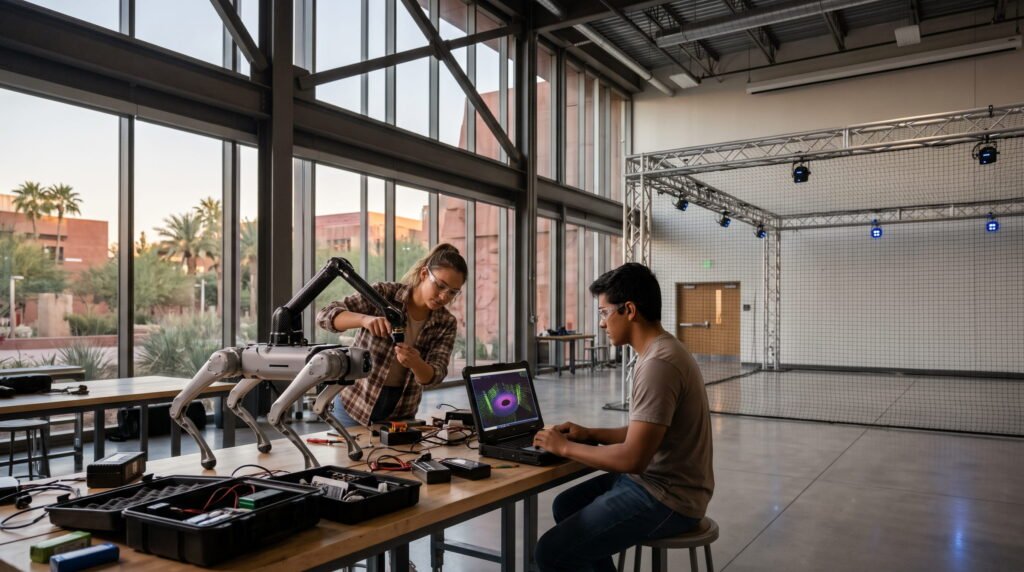
For flight testing, the university operates dedicated unmanned aerial flight cages. These massive, netted outdoor pavilions feature high-speed optical motion capture cameras mounted around the perimeter, providing millimeter-accurate ground-truth tracking for multi-agent swarm experiments.
Pro Tip: Always validate your robot’s localization accuracy by comparing onboard SLAM estimates against an external ground-truth motion capture system (such as Vicon or OptiTrack) before conducting untethered outdoor field runs.
At the Polytechnic campus, the Innovation Gallery and high-bay facilities provide expansive indoor arenas where full-scale agricultural robots, autonomous ground platforms, and earth-moving machinery can be tested on mixed soil beds and gravel pits.
Furthermore, ASU’s geographic location in the Sonoran Desert provides students with hundreds of square miles of extreme testing terrain: high-heat desert expanses, rocky volcanic bluffs, and complex irrigation canals that serve as rugged testing environments for physical machines.
Degree Programs, Specializations, and Academic Pathways
Arizona State University offers clear academic entry points for students at every stage of their educational journey, ranging from specialized undergraduate degrees to doctoral research programs.
The cornerstone program is the Master of Science in Robotics and Autonomous Systems (MS-RAS). Administered collaboratively across the Fulton Schools of Engineering, this graduate program allows students to select one of four specialized technical tracks:
- Electrical Engineering Concentration: Focuses on sensor systems, microelectronics, RF communication, signal processing, and low-level hardware control.
- Mechanical and Aerospace Engineering Concentration: Emphasizes structural kinematics, multi-body dynamics, propulsion, fluid mechanics, and advanced actuator design.
- Systems Engineering Concentration: Delivers deep training in human-machine integration, operations research, system reliability, and complex infrastructure optimization.
- Artificial Intelligence and Computing Concentration: Prioritizes computer vision, deep reinforcement learning, algorithmic motion planning, and software architecture.
Important: Undergraduates enrolled in Fulton engineering degrees can take advantage of the accelerated “4+1” program, completing both their Bachelor of Science and Master of Science in Robotics and Autonomous Systems in just five academic years.
For undergraduates, students major in foundational disciplines such as Mechanical Engineering, Electrical Engineering, Computer Systems Engineering, or Software Engineering, while tailoring their studies with dedicated robotics concentrations and research electives.
Students participate in faculty-mentored research through the Fulton Undergraduate Research Initiative (FURI), receiving paid stipends and laboratory budgets to complete original investigative projects that culminate in public scientific symposia.
Career Trajectories: Where ASU Robotics Graduates Work
The global demand for robotics engineers continues to expand dramatically as automated systems move into commercial production. Graduates from Arizona State University’s robotics programs enter an exceptionally favorable hiring landscape across diverse industrial sectors.
The Phoenix metropolitan area—frequently dubbed the “Silicon Desert”—has become a major national hub for autonomous vehicle testing, semiconductor microelectronics manufacturing, and aerospace defense logistics. Global technology leaders recruit directly from ASU laboratories.
Graduates step into high-impact engineering roles across five primary career tracks:
| Professional Job Title | Primary Industry Sectors | Core Daily Responsibilities | Average Early-to-Mid Career Compensation |
| Robotics Perception Engineer | Autonomous Driving, Warehouse Logistics | Calibrating multi-camera and LiDAR sensor suites, designing point-cloud segmentation algorithms | $115,000 – $160,000 |
| Motion Planning & Controls Engineer | Aerospace, Industrial Robotics, Defense | Writing real-time trajectory optimization algorithms, implementing PID/MPC feedback loops | $110,000 – $155,000 |
| Robotics Mechatronics Designer | Medical Devices, Consumer Electronics | Designing custom robotic arm linkages, selecting brushless actuators, CAD modeling, thermal management | $95,000 – $140,000 |
| Field Autonomy Test Engineer | Defense, Mining, Agricultural Equipment | Deploying machines to remote test sites, diagnosing sensor telemetry anomalies, executing validation tests | $90,000 – $130,000 |
| Unmanned Systems Flight Software Engineer | Aerospace, Defense, Drone Delivery | Writing real-time embedded flight code, implementing fail-safe logic, tuning autopilot parameters | $105,000 – $150,000 |
Major corporate employers actively recruiting ASU robotics graduates include Waymo, Intel, Boeing, Honeywell Aerospace, General Dynamics, Northrop Grumman, Amazon Robotics, Lucid Motors, and the Department of Defense. Many graduates also transition into high-growth deep-tech startups or launch venture-backed enterprises through the university’s Edson Entrepreneurship + Innovation Institute.
Student Competitions, Clubs, and Experiential Leadership
Academic coursework provides the theoretical foundation, but true engineering resilience is developed through high-stakes competitive engineering projects. At ASU, self-directed student organizations provide an essential environment where engineers learn to troubleshoot complex systems under real-world competition constraints.
A premier example is the ASU RoboSub team, an interdisciplinary group that designs, fabricates, and programs fully autonomous underwater vehicles to navigate complex obstacle courses, identify submerged acoustic pings, and manipulate underwater objects without human intervention.
Other active student robotics groups driving innovation on campus include:
- Sun Devil Motorsports (Formula SAE): Designing and building high-performance electric race cars, complete with active aerodynamics, custom battery management systems, and emerging autonomous driving tracks.
- ASU Drone Club: Competing in national autonomous flight challenges, focusing on long-range package delivery, search-and-rescue target identification, and indoor obstacle racing.
- VEX U and Combat Robotics: Building agile, high-torque teleoperated and autonomous combat machines that test material durability and electrical drive limits.
- Women in Science and Engineering (WISE) and IEEE Robotics and Automation Society: Hosting technical hardware workshops, professional mentorship panels, and regional youth robotics competitions.
Expert Tip: Corporate engineering hiring managers consistently state that hands-on leadership experience in a student competitive team (such as Formula SAE, RoboSub, or NASA challenges) differentiates top candidates far more effectively than an unblemished grade point average without project work.
These student groups cultivate leadership, budget management, systems engineering, and team collaboration—skills that prepare graduates to lead complex technical teams in industry.
Step-by-Step Guide: How to Build a Career in Robotics at ASU
Navigating an engineering education in robotics requires strategic, proactive planning. Because robotics requires cross-disciplinary mastery, waiting until your senior year to begin hands-on integration can leave you underprepared for the technical hiring pipeline.
Follow this systematic four-year roadmap to maximize your education and establish a distinguished portfolio:
- Year One: Master the Fundamental Languages of Mathematics and SoftwareFocus deeply on your foundational courses: Multivariable Calculus, Linear Algebra, Differential Equations, and Classical Physics. Simultaneously, establish fluency in C++ and Python on a native Linux environment. Join a competitive engineering team like RoboSub or Sun Devil Motorsports as an underclass apprentice to observe systems engineering in action.
- Year Two: Learn Electronics, Microcontrollers, and Version ControlTake coursework in basic circuit analysis, digital design, and signals. Begin building personal mechatronics projects using STM32 ARM microcontrollers or ESP32 boards. Learn to design custom printed circuit boards (PCBs) in KiCAD and manage all project repositories using professional Git workflows. Complete your workshop training to gain access to campus laser cutters, 3D printers, and machine shops.
- Year Three: Integrate ROS2, State Estimation, and Apply for FURIEnroll in intermediate control systems and introductory robotics courses. Transition your software projects to the ROS2 framework, learning how to configure simulation models in Gazebo and interface real sensors (LiDAR, depth cameras, IMUs). Apply for the Fulton Undergraduate Research Initiative (FURI) to secure paid laboratory research under a faculty mentor, and attend fall engineering career fairs to land a summer engineering internship.
- Year Four: Deliver an Industry-Sponsored Capstone and Transition to Industry or Graduate SchoolLead a multidisciplinary senior design capstone project that tackles an authentic industry challenge sponsored by an aerospace or robotics company. Document your project thoroughly with public GitHub repositories, technical demonstration videos, and clear system architecture diagrams. Leverage your research portfolio and internship experience to secure full-time engineering offers or transition into the accelerated 4+1 MS-RAS program.
Common Mistake: Relying on simple Arduino hobbyist projects without demonstrating low-level C++ efficiency, Linux proficiency, or ROS2 integration. Professional employers want to see that you can write clean, modular code suitable for production-grade autonomous hardware.
Frequently Asked Questions
Do I need to declare a specific “Robotics” major as an undergraduate at ASU?
ASU does not require an exclusive standalone undergraduate “Robotics” degree title. Instead, undergraduates major in Mechanical Engineering, Electrical Engineering, Computer Systems Engineering, or Software Engineering, choosing an explicit Robotics and Autonomous Systems concentration or technical elective track. Graduate students can enroll directly in the Master of Science in Robotics and Autonomous Systems (MS-RAS) program.
What is the most important programming language for a student entering robotics research?
Modern robotics requires two complementary languages: C++ and Python. C++ is universally required for high-speed, performance-critical tasks like embedded motor control, computer vision, and real-time state estimation. Python is the industry standard for rapid prototyping, data visualization, machine learning integration, and high-level behavioral scripting.
Can students without previous engineering experience join ASU robotics teams?
Yes. Student organizations such as Sun Devil Motorsports, the ASU Drone Club, and RoboSub welcome students of all skill levels. They host dedicated onboarding workshops at the beginning of each semester to teach welding, composite laying, PCB design, soldering, and basic software development to motivated underclassmen.
What is the difference between industrial automation and autonomous robotics?
Industrial automation typically refers to static machines operating in highly structured, predictable factory environments executing repetitive, pre-programmed tasks behind safety fences. Autonomous robotics involves mobile machines navigating unstructured, changing real-world environments using onboard sensors, adaptive path planners, and real-time decision-making without constant human oversight.
How does Arizona State University support student robotics entrepreneurs?
Through the J. Orin Edson Entrepreneurship + Innovation Institute and Venture Devils, student robotics founders receive dedicated startup mentorship, legal support for patent filings, and access to non-dilutive grant funding competitions. Skysong Innovations works directly with student and faculty inventors to license technologies and spin out commercial hardware ventures.
What facilities does ASU provide for testing autonomous drones safely?
ASU operates multiple outdoor and indoor flight testing facilities, including large, netted aerial drone enclosures equipped with high-speed optical motion capture tracking systems. These enclosures allow students to test aggressive flight maneuvers, autonomous obstacle avoidance, and drone swarms in realistic outdoor wind conditions without risk of flyaways.
How does the accelerated 4+1 program work for robotics engineering students?
The 4+1 accelerated program allows high-performing undergraduate engineering students to begin taking graduate-level courses during their senior year. Up to nine credit hours can be shared between the Bachelor of Science and the Master of Science in Robotics and Autonomous Systems, allowing students to complete both degrees in just five total academic years.
Are robotics students involved in medical and healthcare applications at ASU?
Yes. The Human-Oriented Robotics and Control (HORC) laboratory and the School of Biological and Health Systems Engineering conduct extensive research on wearable exoskeletons, powered pediatric orthotics, and neuro-prosthetic hands that assist individuals recovering from strokes, spinal cord trauma, or neurodegenerative conditions.
What math topics are most critical for success in robotics and autonomous systems?
Linear algebra is the foundational mathematical language of robotics; transformation matrices, coordinate rotations, eigenvectors, and vector spaces are essential for kinematics and sensor fusion. Additionally, students must master multivariable calculus, differential equations, and probability and statistics for state estimation.
Can international students work in robotics internships in the United States?
Yes. International students holding F-1 visas can participate in paid internships through Curricular Practical Training (CPT) and work for up to three years post-graduation using the STEM-designated Optional Practical Training (OPT) extension. However, certain defense-related robotics positions may require United States citizenship or permanent residency due to ITAR regulations.
What is ROS2, and why is it taught in ASU robotics coursework?
ROS2 (Robot Operating System 2) is the industry-standard open-source middleware framework that provides hardware abstraction, device drivers, communication protocols, and package management for robotics. ASU teaches ROS2 because it is the universal platform used by commercial robotics companies worldwide, ensuring students can immediately contribute to professional engineering teams.
How do students obtain funding for undergraduate robotics research?
Undergraduate researchers can apply for the Fulton Undergraduate Research Initiative (FURI), which provides paid semester stipends and material budgets for faculty-mentored research. Additional funding pathways include the Grand Challenge Scholars Program, departmental student worker positions, and federally sponsored National Science Foundation (NSF) Research Experiences for Undergraduates (REU) grants.
The Road Ahead: Building the Autonomous Future
The transition toward an autonomous society represents one of the most significant engineering endeavors in human history. The challenges ahead—designing machines that perceive with superhuman clarity, move through complex environments with grace, and interact safely and empathetically with human beings—cannot be solved by fragmented engineering approaches.
Arizona State University has proven that an institution grounded in accessibility, deep interdisciplinary research, and active industry partnerships can produce the visionary talent needed to lead this revolution. By uniting advanced mechanics, robust software architecture, and real-world field experimentation, ASU provides students with an unparalleled platform to transform their technical passions into transformative careers.
Whether your goal is to design planetary rovers for deep-space exploration, engineer wearable exoskeletons that restore human movement, or program the autonomous flight controllers that will safeguard our skies, the opportunity begins on the laboratory benches of Arizona State University. The future of autonomous technology is being built today—and the next generation of robotics pioneers is already at work.